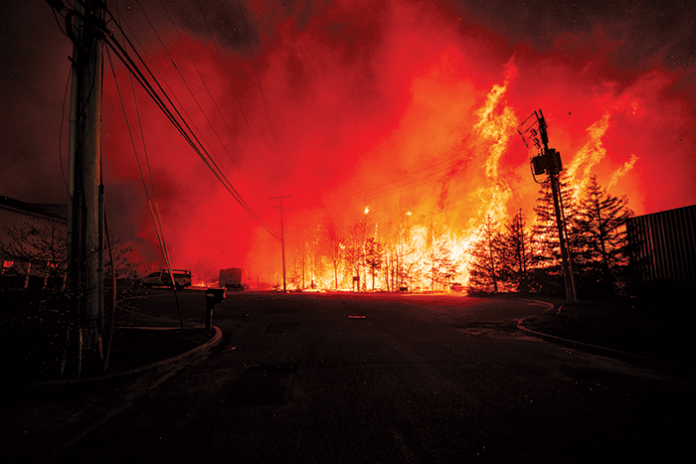
NEW JERSEY – The ground may feel damp some mornings, but by afternoon it is already drying out across the state, including parts of Ocean and Monmouth counties. That was the message from New Jersey environmental officials, who warned that lingering drought conditions continue to fuel wildfire risk despite a snowy winter and recent rain.
During the New Jersey Forest Fire Service’s annual spring briefing, now in its third year, officials said conditions beneath the surface remain a concern as the state enters peak wildfire season.
“We were dry going into the winter, reservoirs were low, groundwater supplies were not exactly where we’d like to see them,” said John Cecil, assistant commissioner for State Parks, Forests and Historic Sites. “Some of that snowfall evaporated and didn’t contribute to groundwater the way we would like.”
Cecil said recent rainfall is being quickly absorbed by plants and trees that are now in a period of rapid growth, leaving surface conditions vulnerable to drying out as temperatures rise and winds pick up.
That dynamic is especially concerning in Ocean and Monmouth counties, in what officials describe as the wildland urban interface, where development meets forested land.
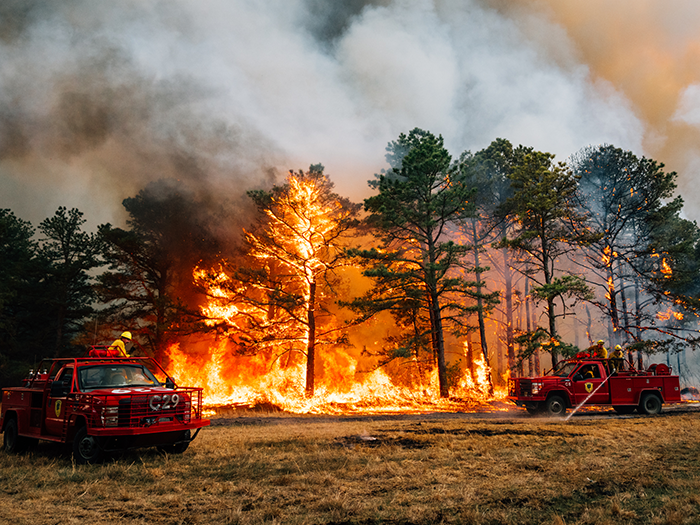
State Fire Warden Bill Donnelly said the spring wildfire season, which runs from mid-March through mid-May, is already underway.
“People typically think it’s summertime when it’s dry and hot, but here in New Jersey, our spring fire season is what we’re entering now,” Donnelly said. “Spring also brings longer days, lower humidity, gusty winds, the perfect conditions for rapid fires.”
Donnelly added that crews have already responded to just over 200 wildfires burning roughly 150 acres statewide in 2026. While that is lower than the same period last year, officials cautioned that conditions can change quickly.
“It doesn’t take long for a fire this time of year to get up and start running,” Donnelly said, noting that fires can ignite just hours after rainfall.
Firewise Grants Target High-Risk Communities
State officials also pointed to targeted prevention efforts at the local level, including $90,000 in grants awarded to communities participating in the Firewise USA program to reduce wildfire risk in vulnerable areas.
In Monmouth County, the Horizons at Woods Landing Homeowners Association in Hamilton received $4,200 to support mitigation efforts.
Ocean County saw widespread participation in the state’s Firewise grant program, reflecting the region’s elevated wildfire risk.
In Barnegat, Brighton at Barnegat Firewise Association received $3,500, while several neighboring communities, including Four Seasons at Mirage, Heritage Bay, Heritage Point, Horizons at Barnegat and Pheasant Run, were each awarded $4,200. Pinewood Estates Firewise received $2,000.
The funding extended across the county, with Four Seasons at Harbor Bay and Four Seasons at Sea Oaks in Little Egg Harbor each receiving $4,200. In Manchester, Crestwood Village Five and Crestwood Village Six were awarded slightly higher amounts of $4,300 each. Additional grants of $4,200 went to Atlantic Hills and Paramount Escapes Ocean Breeze in Manahawkin, Greenbriar Woodlands in Toms River, Cranberry Creek in Tuckerton and Greenbriar Oceanaire in Waretown.
Officials said the funding supports projects such as clearing brush, thinning vegetation, and creating defensible space around homes, all aimed at reducing the likelihood that a wildfire will spread into residential neighborhoods.
Prevention Efforts Fall Short Of Targets
Despite those localized efforts, broader statewide prevention work fell short this winter. Greg McLaughlin, administrator of Forests and Natural Lands, said the state completed about 8,600 acres of prescribed burns, far below the typical 20,000 to 25,000 acres.
“That’s the lowest treated acreage in about 25 years,” McLaughlin said.
Prescribed burns eliminate dry vegetation that can fuel wildfires. The work is typically done between February and early April, but prolonged snow cover limited how much could be completed before the state transitioned into peak wildfire season.
Crews also continued maintaining fuel breaks in areas like Bass River State Forest and Wharton State Forest, where vegetation is thinned to prevent flames from climbing into treetops and intensifying fires.
New Tools And Public Alerts
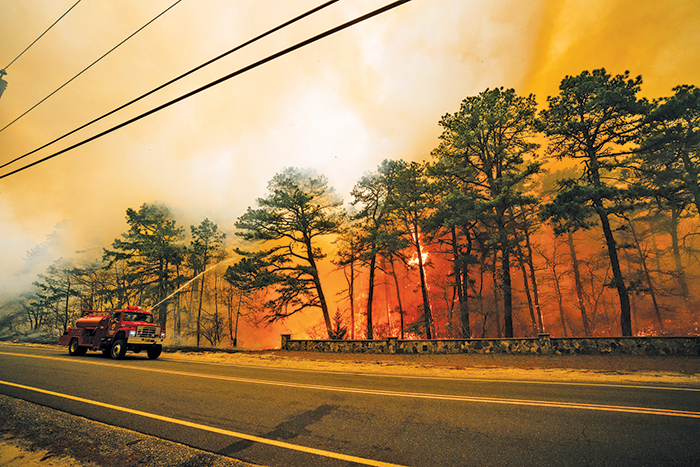
Officials said communication with the public is expanding this year. In addition to social media, wildfire updates will now be distributed through email and text alerts, allowing residents to receive real-time information about fires, evacuations, and road closures.
Notifications are typically issued when a wildfire exceeds 100 acres, threatens structures, or impacts major roadways. Residents can sign up for alerts at wildfire.nj.gov and can also view the state’s prescribed fire notification map to track controlled burns. Officials said anyone unsure about the source of smoke should call 911 or 877-WARN-DEP.
Another growing concern is the use of drones near wildfires. “If a drone is detected flying over or near a wildfire, all air support will be grounded,” said Jimmy Douglas, communications liaison for the Forest Fire Service. “That hampers suppression and observation efforts.”
New Fire Tower
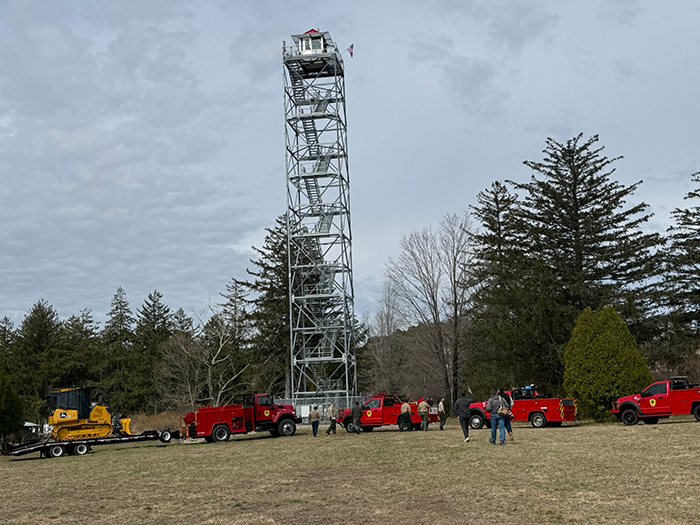
Officials also highlighted the completion of a new 133-foot fire tower in Jackson, the first built in New Jersey in 78 years.
The tower is part of a statewide network used to detect fires early and coordinate response efforts. It is expected to serve more than 500,000 residents and 200,000 homes in Ocean and Monmouth counties.
Jones Road Wildfire Still Looms Large
Nearly a year after it began, the Jones Road wildfire remains a defining example of how quickly conditions can spiral.
The fire ignited on April 22, 2025, and ultimately burned more than 15,000 acres across Ocean and Lacey townships, making it one of the largest wildfires in New Jersey in decades. It took about 20 days to contain and forced the evacuation of thousands of residents while shutting down major roadways including the Garden State Parkway and Route 9.
Officials said the fire began on what was initially considered a marginal fire day before conditions rapidly intensified. “That’s a reminder that conditions can change quickly,” Donnelly said.
Investigators later determined the fire was intentionally set. Ocean Township resident Joseph Kling of the Waretown section and a 17-year-old boy were charged in connection with the blaze. Kling faces charges including aggravated arson and arson. The juvenile has been charged with arson, aggravated arson, and hindering apprehension.
The wildfire destroyed a commercial building along with multiple outbuildings and vehicles and at its peak threatened more than a thousand structures.
A Season That Could Shift Fast
Officials said the combination of dry ground conditions, limited prescribed burning, and a forecast for minimal rainfall in the coming weeks could create a volatile spring. “Despite the snow we had over the winter, the forest remains dry, and the risk is real,” Donnelly said.
For residents in Ocean and Monmouth counties, the message was clear. Conditions can shift quickly, and preparation now could make the difference when the next fire starts.