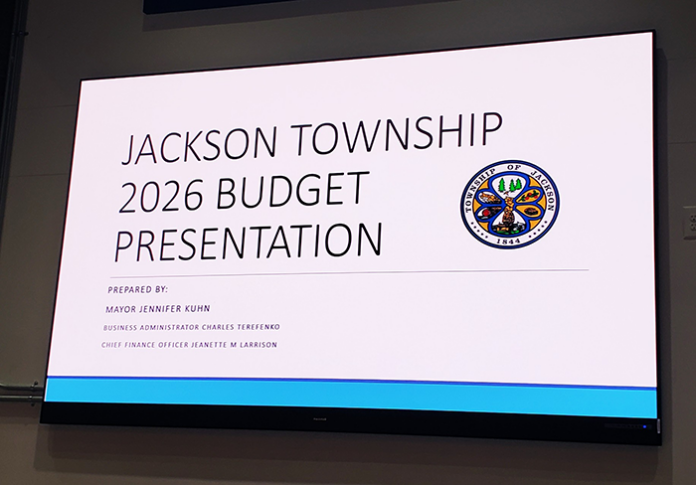
JACKSON – At times it seemed like a long arduous road for this year’s municipal spending plan to reach a vote.
The $62.9 million municipal budget has an increase of 5.15%. Even though the tax rate remains the same as last year, residents will see an increase of just $1.53 annually for an average home assessed at $654,000.
Even with a flat rate, the spending plan had been a contentious subject during the last several Township Council meetings where residents pointed out that Mayor Jennifer Kuhn had promised the budget had been prepared and questioned why it had not been released earlier.
The mayor was not present for its initial introduction and absent during the latest council meeting when the vote was taken to pass it. She did provide a letter to Business Administrator Charles Terefenko to read on her behalf that noted that it was “the council’s budget now” and that if the council wanted to make any adjustments or recommendations “now was the time to do it.”
During its introduction, residents and some officials questioned why few details were provided to explain how increased services would be covered within it. There was also concern that too much was being taken from the township’s surplus fund to support this year’s budget and that this might lead to a budget shortfall in years to come.
Before the budget could be adopted, an amendment had to be passed that allowed the municipal cap to be exceeded allowing for a $700,000 gap to be filled. Chief Financial Officer Jeannette Larrison and Township Attorney Gregory McGuckin noted that if the amendment wasn’t approved, the budget could not be adopted.
Resident Sheldon Hofstein, who frequently speaks about financial matters at meetings, noted “you are increasing the cap to 3.5% and you are raising three quarters of a million dollars. Where is this money coming from? What will it be used for? Is this beyond the budget amount and will there be an increase in taxes this year, next year or the year after?”
Larrison, who works at Manchester Township but was assisting Jackson through an agreement between the towns, explained, “that ordinance isn’t raising any kind of taxation or anything.” She said two standard cap laws were being followed – one being levy which the amount being raised through taxation on your tax bill the other is for appropriations.
Appropriations is the side of the ledger sheet where the town allots money for each line item.
“It allows them to increase the appropriations within the budget because the budget law limits the amount. The State will put a cap on it based on the cost-of-living adjustment and they allow us to go up to three and a half percent,” Larrison added.
Resident James Silecchia urged the council not to pass the budget, saying that there were gaps of information that needed to be addressed. “This document should not be adopted tonight. The budget that was introduced was incomplete.” He said the user-friendly budget put online needed to include details that were not present.
“That did not happen here. We received it 34 days after the introduction last Friday. I hate to say it – what was posted Friday is still incomplete. Because the user-friendly was missing the introduction, it was procedurally defective and the budget before you tonight was built on an introduction that did not comply with the state requirements,” he added.
Councilman Nino Borrelli said initially he opposed the budget’s introduction “due to insufficient detail and concerns about its reliance on our vital town surplus, which does get replenished every year and is essential for emergencies and critical projects. However, subsequent due diligence with finance officials and the Township Business Administrator revealed the budget’s extreme tightness, even after significant departmental cuts. We face dramatic increases in fuel, utilities, insurance, and health costs, alongside union contractual obligations.”
“Ultimately, the choice was between utilizing more of the surplus or implementing a substantial municipal tax increase. Given current economic pressures on residents, I reluctantly supported the former and voted yes on this year’s municipal budget,” he added.
Borrelli said, “our financial outlook remains challenging, with potential future deficits requiring immediate, proactive solutions. I strongly advocate for strict hiring and spending freezes, limiting discretionary expenditures to absolute necessities, controlling overtime, curbing political appointments, obtaining better and less costly contract agreements, and deferring non-critical projects. Pursuing grants and fostering vendor competition are also crucial long-term strategies.”
“I have some concerns about the budget too,” Councilman Ken Bressi said. “There really isn’t much to cut. I am involved with land use a lot and after certain projects that are now moving after, six, seven and 10 years come into fruition as they break land their rate of taxes will go up. All that will be increased revenues coming in.”
“Look around. I know you hate development but this is what is going to be paying your taxes right now so with that I feel we are in the right vein to draw back some of that surplus,” he added.
“You don’t need my vote to pass the budget. You got the votes. I’m going to abstain on this. I don’t want to put my name on this budget. I am not happy with the leadership, management of the town,” Councilman Chris Pollak said. “Cost increased, spending increased, more appointments, more hires and more services and we’re keeping the taxes flat.”
He added, “I think we are putting ourselves in line for tax increases in the future. I don’t think we are thinking about the future. I think we are only thinking about the election year.”
Council Vice President Giuseppe Palmeri said “a government shutdown would be irresponsible. Our government must operate. Our departments must be funded.” He noted from what Larrison had said about the overage of spending primarily caused by snow collection this year and that if there was less snowfall next year the situation would be different.
“I do agree with my colleagues here that we do need to take a hard look at these services and anything unnecessary we can eliminate as those contracts expire,” he said.
“Every year it is our responsibility to look at our contracts,” Council President Mordechai Burnstein said. “A couple of big union contracts are coming up now. We are looking forward to tough negotiations in the future obviously to give our employees what they need and making sure it is balancing the needs of our municipality.” He, Palmeri, Borrelli and Bressi voted to adopt the budget.