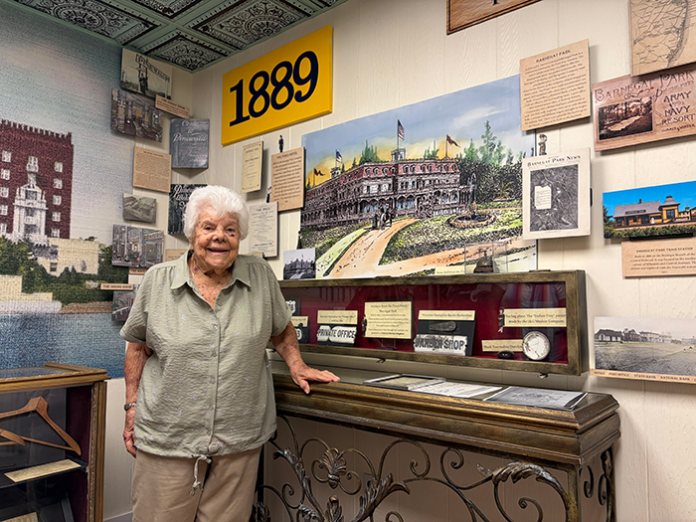
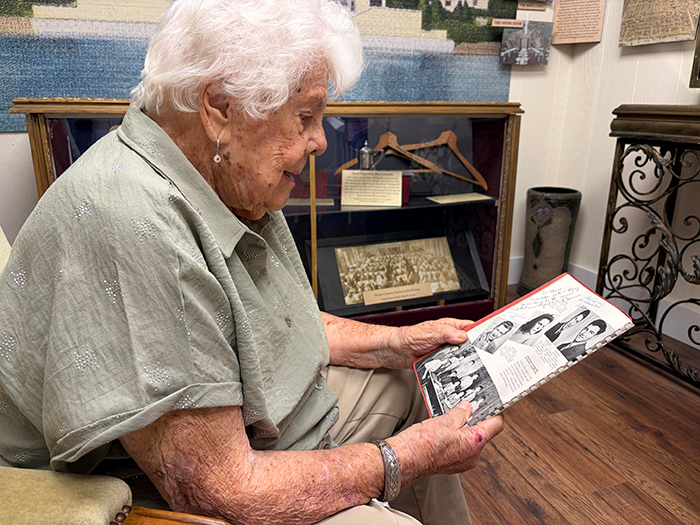
BERKELEY – As Norma Farrow Rush looks at her elementary school photo and high school yearbook, she tells stories about most of the people in the photographs. That’s hard for most of us, but Norma will be turning 100 this month, and oh, what a hundred years it’s been!
The fact that her school photos are exhibits at the Berkeley Township Historical Society says a lot about how long ago this was. Items like this are physical reminders of memories, of which Norma has plenty.
Maybe it’s because there are so few photos from that time.
“People didn’t use to get pictures of everything like they do today,” she said.
She knew that her dress in the black and white photo was red and white, and that it cost $1.99.
Although the Cedar Chest yearbook was property of the Historical Society, Norma keeps her memories close. She has hers in a locker at the foot of her bed.
She’s still quite sharp, and quick-witted – ready to fire off a one-liner as easily as a highly detailed story from her childhood.
Her family has some deep roots in Berkeley. Her great grandfather, John Allen, was the first keeper of the Barnegat Lighthouse. Her grandfather Lt. Edward S. Farrow built a community for Civil War veterans. Her father was the taxidermist that brought the dinosaur to Route 9.
And she has become their storyteller.
Civil War Soldiers In Berkeley
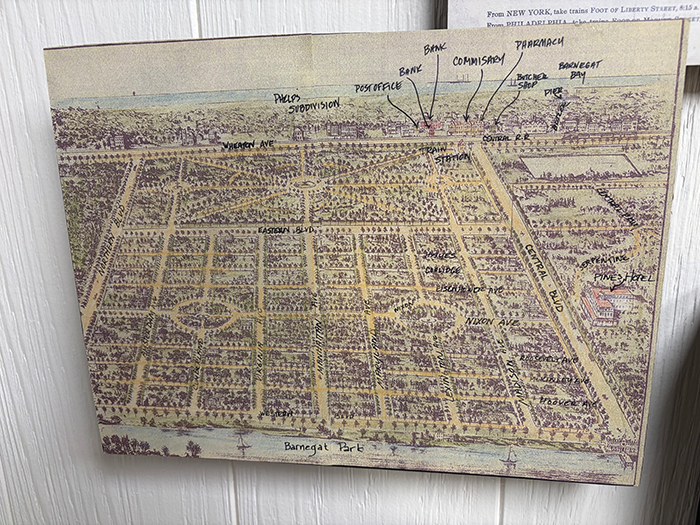
Barnegat Park was a community that has since been lost to time, replaced by modern homes.
The Historical Society has a display of artifacts from this era. On a map of Barnegat Park, Wheaton Avenue marks one boundary, and shows where a commissary and other important buildings were located. The lake in front of today’s Crystal Lake Nursing and Rehabilitation Center forms the other boundary. The rest of the frame is Northern and Central boulevards.
All of the people living there were soldiers or related to soldiers, Norma explained.
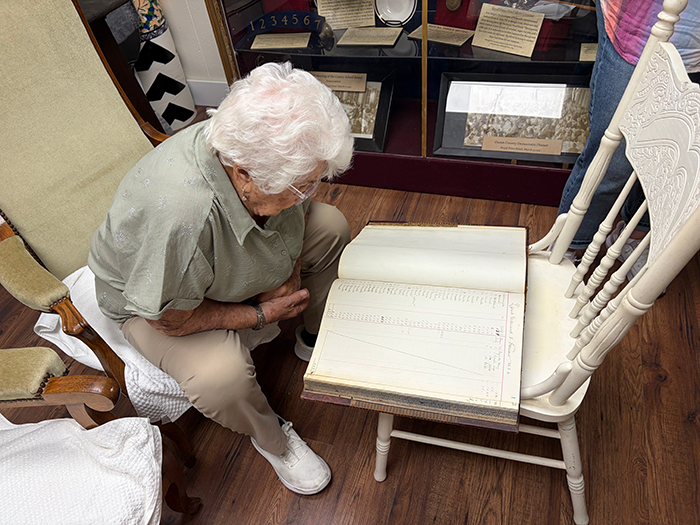
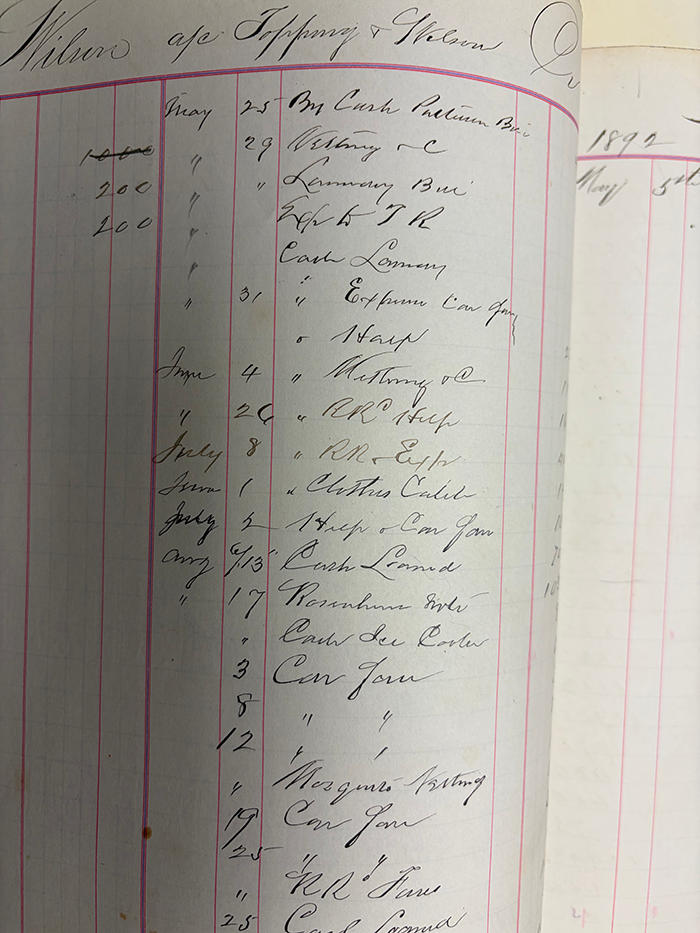
The Pines hotel was on Central, also owned by her grandfather. Norma peered through a hefty ledger, where the names of guests were noted in impeccable penmanship.
“Grandpa liked things nice,” she said. She pointed out that one person’s stay cost $2, so this hotel was for people of means.
The Taxidermist And The Dinosaur
Bud the dino, who is looking out over Route 9 even to this day, was brought to her father’s taxidermy shop as roadside advertising. It certainly got your attention back then and it still does.
Norma told a story about her father receiving a call from a roadside zoo in Camden. Their lion was sick and had to be destroyed. The zookeeper said her father could bring the lion back and stuff it and sell it, but he had to kill it.
Her mother, using Norma’s nickname, suggested “why don’t you take Skeeter with you?”
Norma asked if she could bring a friend. They said yes. “So my momma called Jackie’s mother” and asked if she could go with them to Camden, to kill the lion, and bring it back.
Certainly a unique childhood, but “I thought my life was the same as everybody else’s,” she said.
There was another instance where they had to retrieve a big bear. They needed to recruit a couple of men to carry it to the car.
“I sat in the back with my feet on the bear,” she recalled, adding that she asked “Daddy, are you sure it’s dead? I can feel it’s heart beating.”
Someone who owned a pool in Seaside called them because fisherman had caught a huge sea turtle. There were even pictures of it in the newspaper.
Naturally, a lot of people ask her about the dinosaur. Surprisingly, she never liked it. It wasn’t real, not like the animals in the taxidermy shop. People would say to her “I bet you used to climb all over that dinosaur when you were little.”
She would answer “The only thing that ever played on that was my dad’s pet monkey.”
See, when Buck, the roadside zookeeper in Camden, would go to Africa for a new animal, he’d always bring back some monkeys. They were popular as pets.
“We always had a monkey around the place,” she said. “I used to walk it on a harness.”
Her father was also a justice of the peace and had a courtroom in the taxidermy shop.
“My father could pick up any instrument but couldn’t read music,” she said. He ran a local orchestra that played at proms and special events.
He said he dreamed every night and remembered them, telling his family what happened.
To this, her mother had said “I’m not sure he doesn’t make it up.”
Her father was more to her than a collection of stories, though. Through him, she learned about people, and about how to be a good person.
“I grew up open to the world. I miss him to this day,” she said.
Learning And Growing Up
Bayville Elementary School broke ground in 1926, and its first class was the year 1927-28. Norma joined soon after.
“I got the best education at Bayville Elementary,” she said. “I hope my kids had as good a time in school as I did.”
She noted that in fifth grade, they started cooking and sewing classes. One thing they taught, which is a lost art, is presentation of a meal. There’s a right way to set a table and plate food.
Frank Sutton was the president of a local bank. He thought children should learn to save money. On Tuesdays, starting in first grade, students would go to the bank and learn how to make an allowance and save money for what they wanted.
“Finally, a banker did something sensible,” she said. She even remembers her bank number from then.
She also recalled the presidential election of 1936, Roosevelt vs. Landon. Her grandmother, who was secretary of the board of education, paid Norma and her friend to stand on the corner of her Route 9 property and yell at cars “Vote for Landon! He’s got sense!”
Route 9 was even busy then, relatively speaking. Her mother had always required safety when crossing the street. And in return, Norma would repeat her mother’s instructions, and make other people do the same.
“I must have saved someone’s life,” she said, explaining that her mother’s words, through her, had carried on down from neighborhood kid to neighborhood kid through the years.
She told the story of a friend named Jerry who had an old beautiful house that had a hidden doorway behind the fireplace that led to a secret room. At the time, she just thought it was fun. As an adult, she looks back at it and wonders if it was part of the Underground Railroad.
She attended Toms River High School, long before Central Regional was built. There was no preparation to go to the high school, which was much larger and had kids from all over. She even remembers that her bus driver was Mark Butler.
“When I graduated Toms River High School, I cried,” she said. “I didn’t want it to end.”
When she attends alumni events for the high school, they ask everyone to rise. Then they ask people to sit down if they were there 20 years ago, 30 years, 40 and so on. “All of the last five standing were from Bayville.”
Naturally, when it was time to settle down, she didn’t go far. She and her husband Charles were living in an apartment at the time. He went for a drive and found a large wooded lot on Bowline Street and Ship Avenue in Beachwood. He inquired to the town how much it cost. The parcel wasn’t even on their maps, so they charged him $10. He paid for it from his GI bill. He also bought an adjacent lot for $5. They built a ball field, tennis court and pool on that combined property for their four sons. That property has since been subdivided into five homes.
Looking back on her life, and her childhood, she recalled how she seemed to know everyone in town.
“I grew up quickly, there. My mom and dad talked to me as if I was older. Time went by fast, though. They were good years,” Norma said.
A pot luck dinner will be held in her honor at the Berkeley Rec Center at 6 p.m. on July 28. RSVP to Joan Potter (joaniegirl@comcast.net), with the number of guests and what you will be bringing.