JACKSON – The town’s budget will result in no tax increase but concerns have been expressed that cuts are still needed to gain back some of the depleted surplus that was used toward supporting the budget.
While the meeting started with the presentation of proclamations honoring the outgoing superintendent and two youth programs, most of the meeting centered on the financial stability of the township.
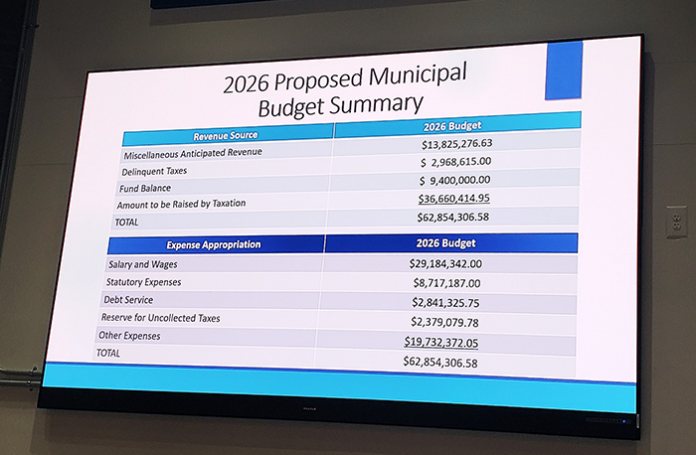
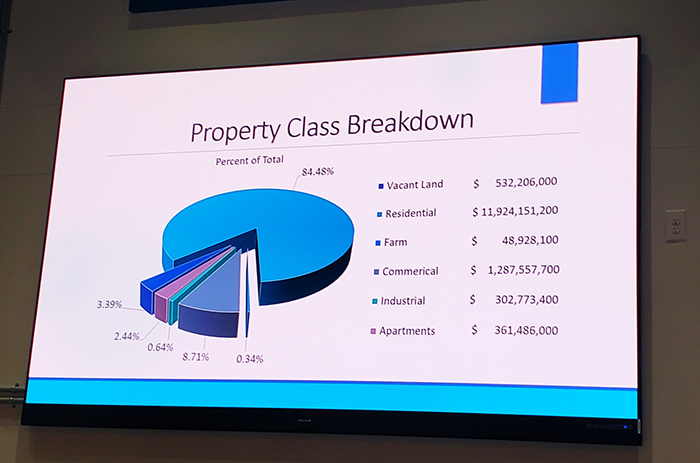
A presentation was made fleshing out more details of the town’s budget by members of the financial staff. Chief Finance Officer Jeanette Larrison gave an overview with a PowerPoint presentation concerning the $62,854,306.58 budget.
Larrison noted that the amount to be raised by taxation is $36,660,414.95. Delinquent taxes were listed as $2,968,615.00 while miscellaneous anticipated revenue totaled $13,825,276.63. The fund balance was noted as $9,400,000.
The budget’s salary and wages came to $29,184,342 and statutory expenses are $8,717,187 with the debt service figure at $2,841,325.75 and the reserve for uncollected taxes at $2,379,079.78.
A major disagreement during the evening was Ordinance 2026-17 which would have allowed the township to exceed the municipal budget appropriation limits and to establish a cap bank.
According to the ordinance, this increase would amount to $755,114.94 in excess of the increase in final appropriations otherwise permitted by the Local Government Cap Law.
State law caps certain budget increases in an attempt to control taxes, but allows towns to extend this cap a little bit if it is absolutely needed.
There are five council members to make the decision. Councilman Ken Bressi was absent and the vote on this came to 2-2.
Councilmen Nino Borrelli and Chris Pollak both voted against the ordinance. During a previous meeting, they also voted against the introduction of the budget, citing that few details were available to them prior to its release and concerns that the township’s surplus fund was being drained.
Even after hearing the finance staff’s presentation and delving further into it on his own, Borelli said “I still have great concerns about the budget, depleting almost all of our once healthy surplus to balance the budget leaving only a little over $7,000 in our town savings. I am voting ‘no’ to more spending with this ordinance.”
“I’m going to be voting ‘no’ on this ordinance,” Pollak said.
Pollak further explained the ordinance, “there is a limit on how much the town can increase spending each year. This ordinance allows them to go beyond that limit and spend more than what is normally allowed. We’ve increased spending. We’ve increased services and I don’t think you fix that by raising the ceiling. You fix it by controlling the spending. Things have to be done responsibly with the future in mind.”
Council Vice President Giuseppe Palmeri voted ‘yes.’ “Things have gotten more expensive. We need to pay our bills. We don’t want to default especially with the bond rating and how good it is now so I’m going to vote yes,” he said.
Before he voted, Council President Mordechai Burnstein asked Township Attorney Gregory McGuckin “what happens if we – at this point in the budget process – we don’t raise our amount of 3.5%?”
The budget had been sent to the State for review following its introduction at the previous council meeting. Without the ordinance, there would be a hole in the budget.
McGuckin responded that “if it is factored into the budget then the budget cannot be adopted at the next public hearing (June 9) and the ordinance would have to be reintroduced if the township intends to utilize the cap bank.”
“How do we continue paying our operations?” the council president asked.
The attorney reminded him that “we are currently operating under a temporary operating budget. There will come a point in time by the scheduled public hearing, that the township would not be in a position to pay bills.”
Burnstein replied, “so, I’m going to vote ‘yes’ to be fiscally responsible.”
Palmeri asked McGuckin, “what happens now, it’s a 2 to 2 tie?”
“The ordinance does not pass,” the attorney clarified.
In related news, it was later determined that there also weren’t enough votes to pay medical coverage payments for employees. Councilman Pollak agreed to withdraw his abstention and vote to pay those bills.