JERSEY SHORE – A high school student has an idea: whether biotechnology can help reduce harmful greenhouse gases right in our own back yard.
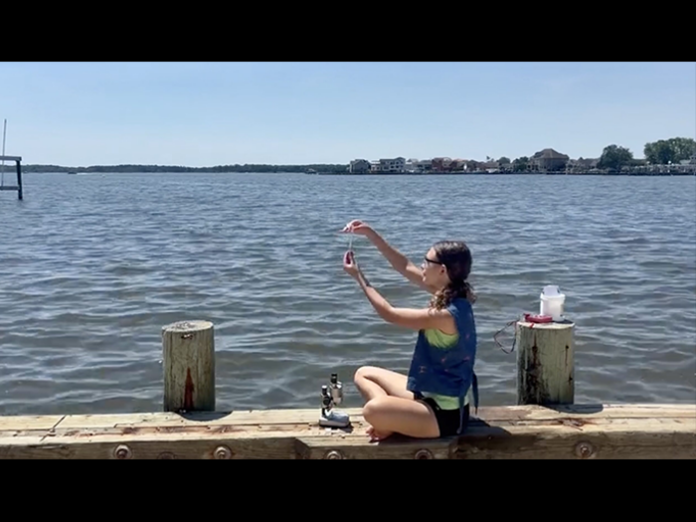
A rising junior, Alexandra Kanterezhi-Gatto’s laboratory is Cattus Island County Park.
The park spans acres and acres of a lush ecosystem on the Barnegat Bay. The wetlands filter water, store carbon and help protect the coastline, while providing habitat for fish, birds, reptiles, insects and more.
She is investigating whether a specially designed peptide could influence the natural microbial activity occurring in marsh sediments and potentially reduce methane production.
Organic material is broken down by different microbes. These microbes are all competing for the same resources. Whichever ones are successful impacts what compounds are produced by the material breaking down.
Alexandra’s research asks whether she can influence part of that process without disrupting the ecosystem itself.
“Methane receives far less public attention than carbon dioxide, yet it traps more than 80 times as much heat over the short term,” she said. “Healthy salt marshes naturally store carbon, filter water, and protect our coastline, but rising sea levels and warming temperatures are changing the microbial communities beneath the surface. I want to investigate whether biotechnology can work alongside these natural biological processes to help keep these ecosystems healthy.”
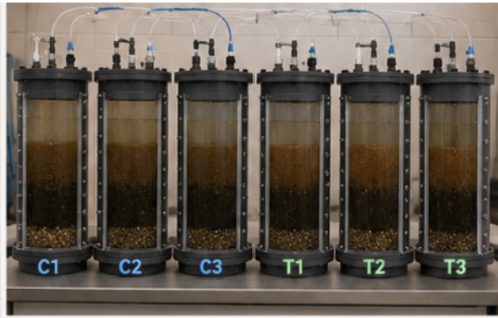
Alexandra will collect sediment from the Cattus Island salt marsh in six custom-built containers that will allow her to recreate conditions under controlled settings. She will then introduce a synthetic peptide to see if it can strengthen electron-transfer pathways in the marsh. The idea is to see if it could encourage iron-reducing bacteria to compete better against methane-producing microbes. This would potentially reduce methane emissions in a relatively natural way.
Further Impact
Although Alexandra’s experiment focuses mostly on methane, it could lead to greater understanding of the marsh habitat.
A healthier and more productive marsh can support the larger environmental system around it, from the microorganisms in its sediment to the animals that depend on that habitat.
“All of these things are connected,” she said. “The marsh isn’t just one thing. It’s an entire world of life.”
A Family Connection
Alexandra is searching for a way to protect the future of the environment after being taught to respect it in her past.
Her grandmother, Pamela, was one of her closest mentors. She introduced Alexandra to gardening, encouraged her curiosity about the natural world and taught her about the environmental problems facing the planet.
Before she passed away, Alexandra says her grandmother left her with a simple mission: find ways to protect the planet. That mission has stayed with her.
“Every flower I smell, every garden trip I take, and every smile I see, I think of her,” she said. “I want to accomplish what her last words for me were – to reach my dreams no matter what it took.”
How To Help
Alexandra has developed the project independently with guidance from scientific mentors and extensive review of primary scientific literature. Because the research requires specialized biotechnology equipment, peptide synthesis, environmental monitoring instruments, and laboratory materials beyond what is typically available to an individual high school researcher, she launched a crowdfunding campaign through Experiment.com to help make the project possible.
As of press time, the campaign has raised just over $2,000 toward its $3,800 goal. With the campaign entering its final days, Alexandra is still working to close the remaining gap.
For her, community support means more than simply paying for laboratory supplies. It means allowing a local student to ask a question about a local ecosystem – and actually giving her the chance to find out whether her idea works.
She hopes that the project can eventually contribute to a larger conversation about how communities protect wetlands, preserve biodiversity and respond to climate change.
Those interested in supporting the research or following its progress can visit experiment.com/restoringmarshes. Supporters receive regular updates as the project progresses from field collection through laboratory experimentation and data analysis.
“My goal is to show that meaningful scientific research can begin right here in our own community,” Alexandra said. “With the support of Ocean County residents, I hope this project can contribute to a better understanding of how we can protect the wetlands that make Barnegat Bay and the Jersey Shore such extraordinary places to live.”