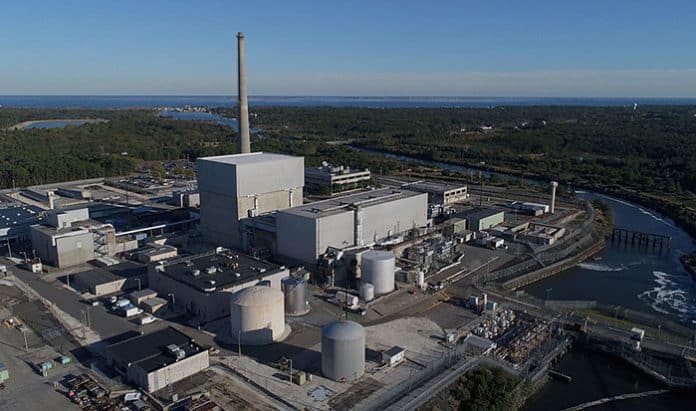
LACEY – The Oyster Creek Nuclear Generating Station could once again produce nuclear power under a concept being explored by Holtec International that would place four small modular reactors at the Lacey Township site after decommissioning is complete.
The concept was discussed during a recent nuclear energy conference hosted by Rowan University’s Steve Sweeney Center for Public Policy, where state officials, lawmakers and industry representatives examined how nuclear energy could help meet New Jersey’s growing demand for electricity. The discussion comes as New Jersey officials examine ways to meet growing electricity demand while maintaining carbon-free generation.
During the conference, Holtec Director of Government Affairs and Communications Patrick O’Brien identified Oyster Creek as a logical location for future nuclear development.
“The easiest place to site new nuclear is where you already have nuclear,” O’Brien said. “You have a knowledge base, you have a workforce, you have an understanding of the risks and benefits of what nuclear is. Oyster Creek presents that opportunity.”
Holtec later confirmed additional details in response to questions. According to O’Brien, Oyster Creek is being considered as a follow-on project after the company’s first small modular reactors are deployed at the Palisades site in Michigan.
“Still early, as the Oyster Creek plans are for a potential project on our site to follow the first two Holtec SMR 300s being built at the Palisades restart project site in Covert Michigan,” O’Brien said.
Those reactors are expected to come online in the early 2030s.
Under the concept currently being evaluated, Oyster Creek would host four of Holtec’s Generation 3+ pressurized water reactors. “OC would be four 340mw reactors of our PWR Generation 3+ design,” O’Brien said.
Combined, the four reactors would generate approximately 1,360 megawatts of electricity, more than double the output of the single reactor that operated at Oyster Creek before it went offline in 2018.
The original Oyster Creek reactor generated approximately 625 megawatts before the plant closed in 2018.
While no formal application has been submitted, local officials say they support redevelopment of the site, noting that discussions remain preliminary. “The township supports the redevelopment of the Oyster Creek site including the potential SMRs,” Mayor Steven Kennis said. “We will support the efforts of Holtec as best we can while also looking out for the best interest of Lacey taxpayers and residents.”

Decommissioning Continues
The discussion of new reactors may come as a surprise to some residents who believed Oyster Creek’s nuclear history was ending with the current decommissioning project. Oyster Creek ceased operations in September 2018 after nearly 50 years of service.
Holtec acquired Oyster Creek following its closure and is currently dismantling the former plant. “Decommissioning remains on track,” O’Brien said.
During the Rowan conference, O’Brien said former nuclear sites offer significant advantages when considering locations for future reactors. Part of the appeal is the existing infrastructure and workforce already associated with the site.
“We’ll have that facility decommissioned by 2031. We’re on track there, and that lays us out as a follow-on project for the Palisades site,” O’Brien said. “That will be potentially four units at that site, which would exactly double what used to sit on the Oyster Creek site.”
Assemblyman Greg Myhre (R-9th), whose district includes Lacey Township, voiced strong support for the concept during the conference.
“I would 100 percent love to have all the focus on Oyster Creek,” Myhre said while discussing legislation intended to encourage small modular reactor development.
Myhre said many residents still view the plant’s closure as an economic loss. “They have not gotten over the closure of Oyster Creek,” he said. “When I say they, the majority, a big majority of the population wants to have a nuclear power plant operating there.”
Jobs And Economic Impact
Holtec officials said a future Oyster Creek project could bring hundreds of permanent jobs to the area. O’Brien said Holtec’s two-reactor Palisades project is expected to support roughly 540 permanent jobs, suggesting similar economic benefits could accompany future reactor development elsewhere.
Beyond employment, supporters argue that small modular reactors could help address increasing electricity demand driven by electrification, artificial intelligence and data centers.
At the conference, O’Brien said the nation faces a broader challenge of replacing aging power generation while meeting future demand.
“We have to get it right now,” he said. “You’re going to have to build new nuclear right now to meet demand, whether it’s AI, electrification. We’re also going to have to show that we can build new nuclear to replace the current fleet.”
Safety And Fuel Storage
Holtec’s SMR-300 design remains under review by the Nuclear Regulatory Commission and has not yet received final approval for construction.
The company says the reactors rely on passive safety systems intended to function without external power or operator intervention during certain emergency scenarios. “The reactors have passive safety systems allowing a potential Emergency Planning Zone to be the site boundary,” O’Brien said.
Traditional nuclear plants generally maintain emergency planning zones extending beyond plant property lines. Any reduction in emergency planning requirements would ultimately require approval from federal regulators.
Questions also remain about the spent nuclear fuel currently stored at Oyster Creek. O’Brien said the fuel from the original reactor will remain at the site until the federal government fulfills its obligation to remove commercial nuclear waste.
The fuel is currently stored in dry cask storage systems on the Oyster Creek property.
During the Rowan conference, O’Brien argued that long-term fuel storage is no longer a technical challenge. “At the end of the day, when you talk about spent fuel, it is not a scientific issue,” he said. “We know how to safely store fuel. It is 100% a political issue.”
Critics of nuclear power continue to raise concerns regarding long-term disposal of spent fuel.
Plans Are Conceptual
For now, Holtec’s Oyster Creek plans remain conceptual and would require extensive federal review, licensing and financing before construction could begin. The company has not announced a timeline for any Oyster Creek application and says discussions about potential customers for the power remain preliminary.
When asked if there was a chance that a data center might be co-located on the site, O’Brien said there had been no discussions concerning the possibility.
Holtec officials believe Oyster Creek could play a significant role in the next generation of American nuclear energy. “As a New Jersey company, we would love to build in New Jersey and get those deployed here,” O’Brien said.
Environmental groups have historically opposed expansion of nuclear power, citing concerns about radioactive waste, costs and long-term storage issues. Supporters counter that nuclear energy provides reliable carbon-free electricity and can operate regardless of weather conditions.
Any future Oyster Creek reactor project would require federal licensing, financing and environmental review before construction could begin. While Holtec’s plans remain conceptual, the company has now publicly identified the former nuclear plant as a preferred location for future small modular reactor development.