BARNEGAT – More than two centuries after the Revolutionary War reached its official end, the struggle surged back to life on December 7 during the annual Affair at Cedar Bridge reenactment at Cedar Bridge Tavern. Hundreds gathered at the remote historic site to witness a dramatic recreation of what is widely regarded as the last documented land engagement of the American Revolution.
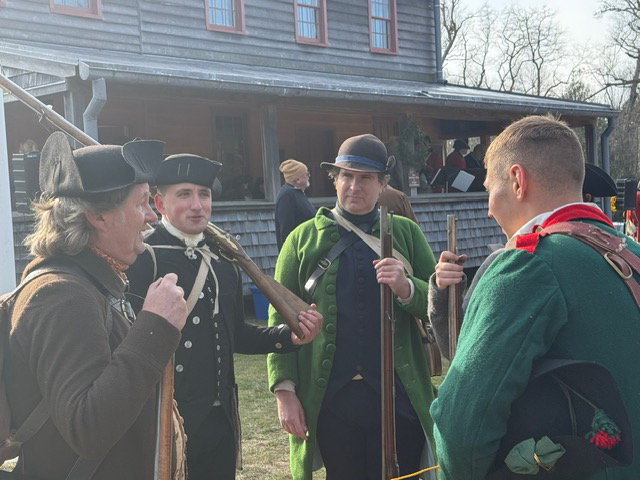
Reenactors traveled from across New Jersey, Pennsylvania, Delaware, and surrounding states to take part in the annual living history program. By midmorning, the quiet forest road that leads to the tavern had transformed into a full 18th century encampment. Drummers practiced cadence beneath bare winter branches. Officers reviewed strategy. Muskets were cleaned and loaded as families arrived and filled the rope lines that bordered the battlefield.
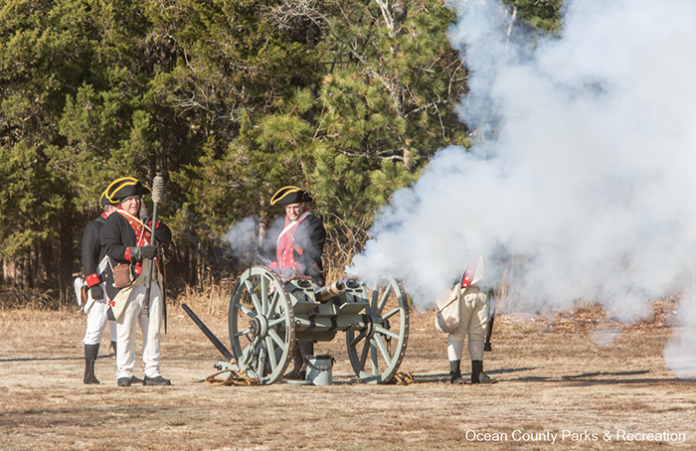
“We are the West Jersey Artillery,” one reenactor said as a cannon crew made final preparations. “We are one of two artillery regiments raised in March of 1776 by resolution of the Provincial Congress of New Jersey. That cannon over there is Thundering Barbara. She is named in honor of Saint Barbara, the patron saint of artillery.”
Thundering Barbara soon lived up to her reputation.
A Battlefield In The Pines
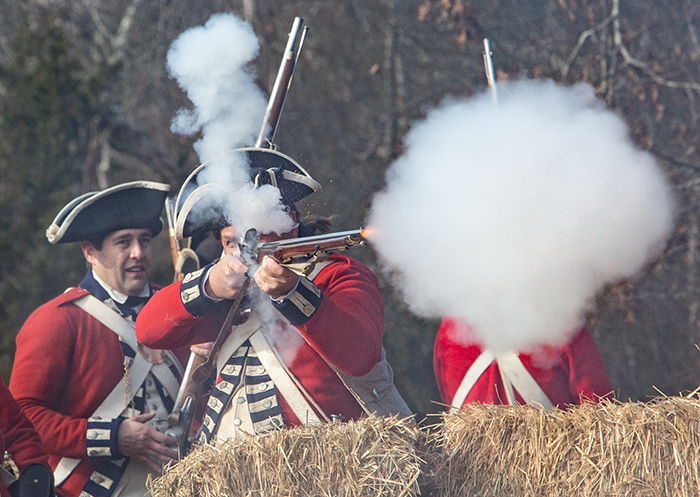
Loyalist forces in scarlet coats advanced across the sandy clearing. Patriot militia moved to intercept. Muskets were lifted. Powder ignited in a blinding flash. The skirmish had some clapping their hands over their ears. Others stared wide-eyed as soldiers fell into the straw, portraying the dead and wounded of a late-war clash that unfolded just weeks before peace officially arrived.
The reenactment traces the pursuit of Loyalist raider Capt. John Bacon and the militia sent to capture him after the violent Long Beach Island massacre in October of 1782. Though the war’s major battles had long since ended, southern New Jersey remained a dangerous patchwork of skirmishes, raids, and retaliation during its final months.
“This was not a grand battlefield like you see up north,” one reenactor explained between skirmishes. “This was a fast-moving pursuit. It was desperate. It was personal. And it happened right here.”
Reenactors also explained why winter fighting carried such a brutal edge during the Revolution.
“Typically, armies went into winter quarters because it was so hard to feed and supply an army in the cold months,” one participant said. “But Washington knew something dramatic had to happen because enlistments were running out and morale was collapsing. He realized the entire cause could end without action.”
The conflict recreated at Cedar Bridge unfolded on December 27, 1782. Patriot forces under Capt. Richard Shreve of the Burlington County Light Horse and Capt. Edward Thomas of the Mansfield militia stopped at a tavern to rest after days of searching for Bacon. Unbeknownst to them, Bacon and his men were close behind.
One Patriot was killed. Several were wounded. Loyalist losses included the death of Bacon’s right-hand man, Ichabod Johnson. Bacon himself was wounded but survived and returned to New York City, where newspapers later printed his version of the encounter.
A Full Immersion In Colonial Life
The battlefield was only part of the experience that unfolded throughout the day. Across the tavern grounds, visitors stepped into the rhythms of 18th century daily life.
“The only thing really scheduled are the cannon firings and skirmishes,” said Mary Jane Bavais, Director of Ocean County Parks and Recreation. “But in the back, you have reenactors doing carpentry, blacksmithing, and tavern keeping. People can walk through everything and see how life really worked back then.”
Period musicians added to the atmosphere with the steady notes of fifes and traditional maritime songs that once carried across rivers, ship decks, and colonial streets. The music flowed continuously between the demonstrations and the battlefield, weaving sound into the visual experience.
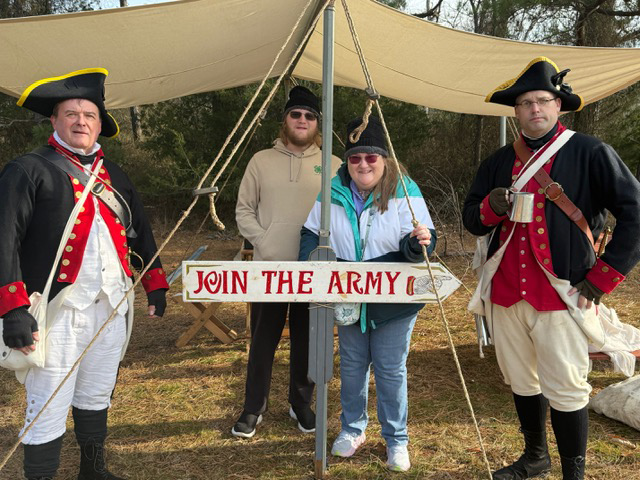
“My son has been coming to county programs since he was three or four years old,” said Lisa Burger of Lacey. “This was our first time at this particular event. It has grown so much since then. We really look forward to it now.”
While the reenactment brings 1782 back to life, the Cedar Bridge Tavern structure itself dates to about 1816. Its deeper story reaches back several generations earlier.
The site once sat along a vital colonial crossroads. The east-west Old Springfield Road linked Springfield in Burlington County with Manahawkin in what was then Monmouth County. A southern route led toward what would become Little Egg Harbor and Tuckerton. By the 1740s, a sawmill, a tavern, and a small settlement had formed around the bridge that spanned a branch of the Wading River.
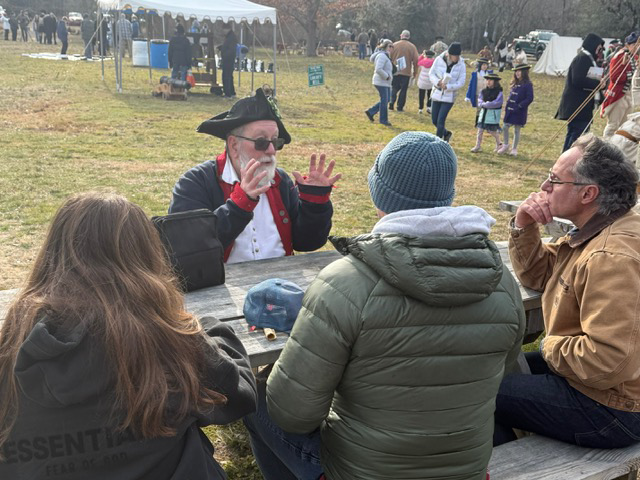
The Ocean County Board of Commissioners purchased Cedar Bridge Tavern in 2007. After years of architectural and archaeological research led by Historic Buildings Architects of Trenton, the building was restored and reopened in 2018. The site was placed on the National Register of Historic Places in 2013.
Inside, visitors still walk through the original barroom, dining room, fireplaces, and upper sleeping quarters. Much of the original floor plan, trim, doors, and windows remain intact. The restoration preserved one of the most complete surviving early tavern interiors in New Jersey.
It continues to draw visitors who are often surprised to learn that the final echoes of the Revolution were still unfolding in the forests of southern New Jersey long after Yorktown.
A Battle Claimed By Two Towns
The Cedar Bridge reenactment is held annually on the first Sunday in December at the tavern site. However, a group of Lacey Township residents say the event actually occurred elsewhere. Carol Mittelsdorf of Lanoka Harbor says historical records show that the late-war skirmish traditionally associated with Cedar Bridge took place several miles north in what is now Lacey Township.
“In older books and historic documents published before 2000, this event is listed as the ‘Battle of Cedar Creek Bridge,’ and it is clearly identified as occurring in the village of Cedar Creek, which is present-day Lanoka Harbor,” Mittelsdorf said. “It is only in more recent references that the location was shifted to ‘Cedar Bridge Tavern’ in Barnegat.”
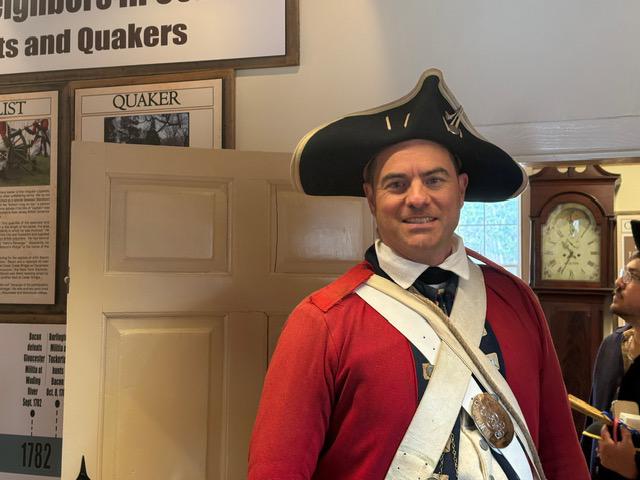
Mittelsdorf said she and other local researchers spent months reviewing original documents at the New Jersey State Archives in Trenton, where they found records she believes reinforce Cedar Creek as the true location.
Tim Hart, director of the Ocean County Cultural and Heritage Commission and county historian, said he is aware of Mittelsdorf’s assertions. However, he maintains that the battle occurred in Barnegat. Bavais added that archaeological findings support that conclusion.