TUCKERTON – Some might have thought it too cold and windy to venture out with a nor’easter approaching the coast. But on October 10, about thirty adventurous adults climbed aboard a pontoon boat at the Tuckerton Seaport for a narrated three-hour journey through time, bound for the ruins of the infamous Crab Island Fish Factory, better known to locals as the Stinkhouse.
“Welcome to the third sellout crowd to Stink Island,” called out Paul Hart, Seaport founder and trustee. “I’m 79 and the last generation that actually smelled it.”
The tour was more than a boat ride – it became a living history lesson. Alongside Hart was local historian Jim Allen, Jr., whose father’s vintage photographs helped tell the story. Ocean County’s recently retired naturalist German Georgieff added context on how the region’s natural beauty has endured through centuries of use and change.

Down Tucker’s “Crik”
As the boat slipped from the dock, Hart explained they were heading down Tuckerton Creek, or “Tucker Crik,” as locals call it. “It isn’t a river,” he said, “just a narrow tidal creek winding through the marsh.”
The group passed boats moored along the banks and watched herons and cormorants feeding among the reeds. Hart pointed out the “Dracula bird,” a black cormorant spreading its wings to dry after a dive. The passengers learned that these marshes once sustained the Lenape, who came to fish, hunt, and smoke their catch for the winter.
Hart gestured toward the reddish water below. “People say it’s cedar water,” he said, “but Rutgers (the Maine Field Station on the bay) hasn’t confirmed it.”
“The problem with that is that upstream, the water’s still red brown,” said Hart. “But there isn’t any red cedar. There are oak trees and the tannic acid leaves may color it brown.” Some suggest that the real reason the water is brown is because of the iron ore that’s in the Jersey sand. “Sand and iron and water go together, and make corrosion,” he added.
Cormorants, ospreys, and even bald eagles made appearances as the boat traveled toward Great Bay. “This is nature’s cafeteria,” Hart said. “Every baby bird, fish, crab, and eel starts life right here.” He warned that modern weed killers and runoff still threaten this fragile ecosystem.

As the creek widened toward the Great Bay, passengers learned how storm surges and rising seas have reshaped these wetlands. The ghost forests of white cedar, killed by saltwater intrusion during Superstorm Sandy, remain as skeletal reminders of climate’s reach.
Hart also recalled the days before the Barnegat Bay was protected, when development nearly erased parts of this landscape. “This was supposed to become lagoon homes,” he said. “But thank God, someone had the sense to save it.”
He pointed across the open water toward the distant silhouette of crumbling buildings rising from the marsh. “There she is,” he said. “The Stinkhouse.”
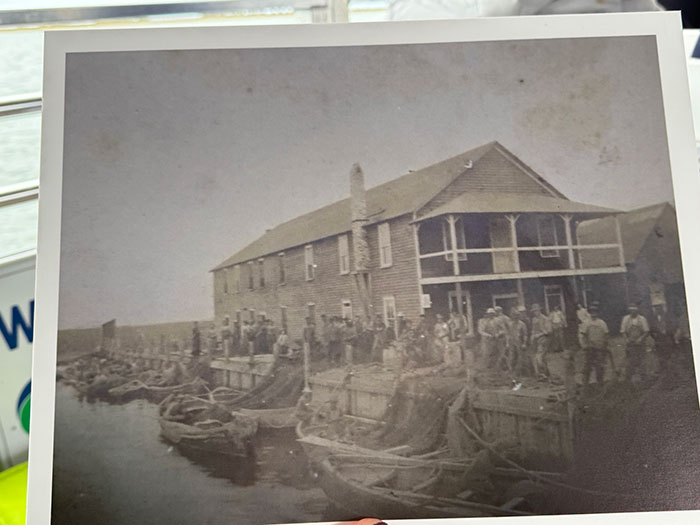
When The Air Smelled Like Fortune
To first-time visitors, Crab Island’s crumbling remains look like the bones of a wrecked ship. To locals, they tell the story of a working-class industry that once defined the bay.
Signs of the Crab Island Fish Factory first began around 1902, after the Newport Fertilizer Company purchased the island for $6,500. Official documents suggest the fish factory actually operated from 1930 until 1969. It passed through several owners, but to everyone in Tuckerton, it remained simply “the Stinkhouse.”
Allen’s father photographed the original fish factory, with further documentation maintained by the Tuckerton Historical Society as presented by Lori Edmunds on their behalf.

The plant processed menhaden, or “bunker,” small oily fish caught by the millions. Too bony to eat, they were cooked into oil, fertilizer, and animal feed, and when the wind blew south, the stench drifted for miles. “That smell,” Allen chuckled, “Was the smell of somebody getting paid.”
For decades, the factory operated like a city unto itself. Company boats, with names like Barnegat, Beach Haven, and Manasquan, hauled their catch to the island. Workers, many of them seasonal laborers from the South, lived in bunkhouses and worked twelve-hour shifts. A small number of locals handled maintenance and supervision year-round.
Inside the plant, conveyor belts rattled, steam hissed, and six giant cookers churned through endless piles of bunker. “The smell got into everything, including your clothes, your hair, even your skin,” said Allen. “But it was steady work, and people were proud of that.”
The island had a store, a water tower, and even a small airstrip used by hunters during duck season. The factory’s tugboats hauled away bagged fish meal, where it was shipped by rail.

By the late 1960s, automation had reduced the need for labor, and dwindling schools of bunker made operations less profitable. Only a handful of workers remained by the early 1970s. Soon after, the state purchased the property for a token sum and folded it into the Great Bay Wildlife Management Area, allowing the land, and its wildlife, to recover.
An arson fire in 1982 left the remaining walls and pilings in ruins. Today, the rusting structures rise from the marsh, reminding locals of a time when the bay smelled of industry instead of salt air.
As the pontoon turned for home, Hart’s voice softened. “The factory ruled the bay for a while,” he said. “But the birds, the marsh, and the water have taken it back.”