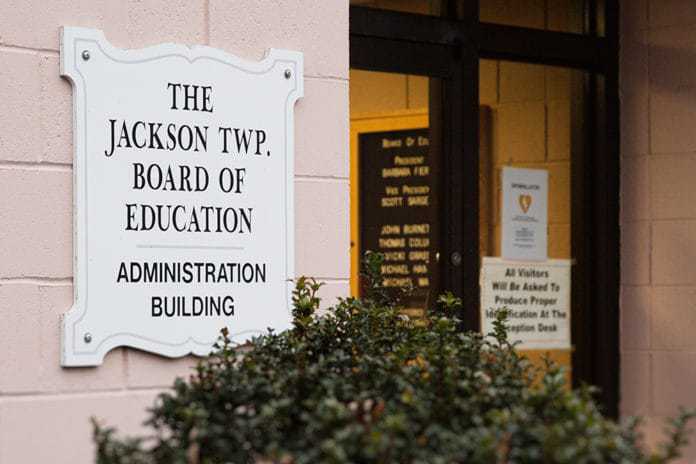
JACKSON – During a recent Board of Education meeting, administrators discussed behavioral problems of township high school students and why this necessitated a pause of the school’s Common Lunch period.
The Jackson Times posed several questions to the school district following that meeting, asking about the incidents of fighting and the protocols in place when such incidents occur. A response came after the deadline of last week’s edition.
Allison Erwin, who serves as the Coordinator of Communications and Technology for the district responded, “for security reasons, we do not provide specific details regarding the number or assignments of our security personnel or School Resource Officers. We can, however, assure you that our coverage and supervision are appropriate for the size and needs of our student body.”
“As was stated during the board meeting by the Superintendent, (Nicole Pormilli) this is not a supervision issue. It is an issue of a climate that was emerging that had the potential to be unsafe and we needed to pause it in order to address the concerns and create a better experience for all students,” Erwin added.
Erwin explained the decision to pause the common lunch period “was not made solely in response to student incidents. The broader concern centered on the overall culture and climate that had begun to emerge during that time.”
Pormilli said during the meeting that she was a “huge proponent of common lunch. In fact, I was one of the original initiators of the concept here in Jackson, and I know firsthand how valuable it can be when it’s working the way it’s intended.”
“It provides students with tremendous opportunities – time to get extra help from teachers, to meet with clubs, to connect socially, and to take a much-needed break in the middle of a demanding day. It’s something many high schools don’t have, and it’s something we want for our students,” she added.
“We saw an unhealthy culture emerging, recognized that the entire student body was not utilizing the period in positive ways, and realized we needed to make a change before something truly unsafe occurred,” Erwin added.
Some residents wanted to know whether parents are notified prior to their children being interviewed about incidents of violence.
Erwin said “we do not discuss matters involving individual students but in terms of our procedures, if a student is involved in a Code of Conduct violation, we do not need to notify the parents prior to speaking to the student about the incident during the course of our actions to safeguard the staff and students in our care. We absolutely respect a parent’s right to information about their child and work quickly to keep them informed.”
A presentation concerning the draft plan of a Flexible Learning Academy was also made during the meeting and the idea drew some criticism from the public. Erwin explained the program draft developed by “our administrative team and school administrators had been discussed for years as an alternative way to address chronic absenteeism, drug use and behaviors.”
“While the genesis of it came before any issues we had with Common Lunch, we definitely felt the program would help provide an alternate pathway to deal with students who were not thriving in the traditional classroom and school environment, including the common lunch period,” Erwin added.
She explained, “while it was not developed in response to the school culture that was emerging during the common lunch period, we did believe it would offer a positive result for both the students struggling with their behavior during that time and the student body as a whole.”
Erwin stressed, “our job is to work to both address and prevent serious issues from happening by addressing the needs of all of our students.” She noted the district “had been seeing some issues with students’ behavior, attendance and ability to manage the daily responsibilities of a high school schedule and we wanted to provide an alternate, flexible plan that would help those students remediate the issue so that the behaviors are not repeated.”
“The reality is that some of our students cannot manage the autonomy of a high school experience and have contributed to an environment that is unacceptable to the overall building climate and culture,” she said.
“Students who have used/abused substances are typically placed out of school for extended periods, missing needed counseling and education. Students with chronic tardiness and/or absenteeism under the traditional model of consequences end up missing more instructional time if they are merely suspended,” Erwin added.
School Board President Tina Kas echoed those sentiments. She told The Jackson Times the philosophy behind pursuing grant money to pilot the academy was “to help those kids who were struggling with discipline, substance abuse, chronic absenteeism or difficulty navigating the traditional high school schedule effectively.”
“The goal was to provide an alternative that would allow us to address and correct their behaviors and challenges, help them stay on track academically and bring them back into school to continue their education among their peers once their challenges were corrected,” Kas added.
Kas said, “we anticipate being able to provide an update at the next Board of Education meeting. In the meantime, the district remains focused on supporting a safe and positive learning environment for all students. We take any incidents that occur seriously and continue to work closely with administrators, staff, and our School Resource Officers to reinforce expectations and provide supports that promote student well-being and responsible behavior.”