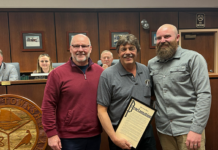
JACKSON – Resident Bruce Mohn has been sculpting since he was 2 years old and his passion has taken him to present a prehistoric showcase for a number of educational venues.
Mohn is someone who could design his own Jurassic Park and, in many ways, has done just that for museums and universities.
“My mom discovered that if she sat me down with a lump of clay, I would be engrossed for hours, which was a wonderful thing for a mom with four children,” he said. “I’ve always been interested in animals of all kinds and a number of my early sculptures were of dinosaurs.”
When his mother once brought home a pound of “Sculpey” shortly after it was introduced in the early 1970s, Mohn’s interest only intensified. “Sculpey is a plastic clay-like material that is easily sculpted and can be baked hard in a regular oven, which means your creations last forever, unlike typical plasticine clay, which can be reshaped over and over again, but isn’t so great for playing with in the dirt.”
Mohn developed a great interest in science fiction and puppetry in his teens and 20s and thought that “knowing something about anatomy might improve my skills at making believable aliens.”
“I enrolled as an art major at what was then Stockton College (now university) and began taking higher level biology courses to learn about anatomy and along the way, Roger Wood, one of the biology professors told me I could obviously handle the work and encouraged me to switch majors,” he said.
“Stockton’s art program was infamous for their graduates working as cab drivers, but the biology program was a whole different thing, with a number of graduates going on to prestigious university and museum employment,” Mohn added.
Mohn got an internship at the Smithsonian’s Vertebrate Paleontology Preparation Laboratory in 1992 and learned how to remove fossil bones from their rocky matrix and prepare them for study, how to make molds and casts and how to mount skeletons for exhibit.
Later that year he designed an independent study course in dinosaur reconstruction and Dr. Wood introduced him to the then-director of the Academy of Natural Sciences in Philadelphia, Keith Thompson.
Thompson “invited me to show my work at a fossil weekend event. While there I met Bob Walters and Paul Sorton who became respectively my agent and my instructor into the finer points of sculpture. Through Bob, I got my first paying gig as a dinosaur artist in residence at the Academy and worked alongside Paul making sculptures for the Academy’s Lost World show.”
“That was in 1993 and I’ve been doing it ever since. It’s been mostly a side job, but sometimes a very lucrative side job. I’ve had some years when I made more as a dinosaur artist than I did at my day job,” Mohn said.
He added, “these days I mostly do work for museums, universities and private collectors. My work is in 22 museums around the world. It’s been featured in books, magazines and television, but not yet in any movie.”

How To Make A Dinosaur
Mohn shared the techniques he uses in his museum work.
“I’m best known for making three dimensional reconstructions of the skeletons of small dinosaurs, early birds and pterosaurs. Because of their small size and delicate bones, it makes more sense to sculpt models of the bones than to prepare them out of the rock which would also destroy delicate impressions of feathers and skin,” he said.
“When possible, I obtain high quality casts of the actual fossils and use those as references and to pull measurements from. I supplement that with full sized enlargements of drawn reconstructions of the skeletons and refer to other more complete specimens to fill in missing parts,” he added.
Mohn said each bone is made as accurate as possible and each joint made as a working joint so that the skeleton can be mounted in any position the living animal could assume.
“I taught myself how to use a variety of tools, including brazing rigs for making metal armatures, grinding and engraving tools for doing sculpture too fine to be done by hand and amassed a collection of sculpting tools, dental tools, (and I) made tools to do the work,” Mohn said.
He noted that “sculpted life reconstructions start in a similar fashion. I make an enlarged drawing to the size of the piece to be done, then prepare a metal armature. I make a fairly accurate model of the skull and then add taxidermy eyes, musculature and skin, much like forensic reconstruction, but in this case, the dead have been dead for millions of years and I have to rely on comparisons with the anatomy of living animals to suggest the musculature.”
“When I started, very little was known about the skins of dinosaurs, beyond a few impressions of scales from some larger species. Today we know that many of the carnivorous dinosaurs had feathers and possibly some of the herbivorous dinosaurs as well,” he said.
“I bulk out my metal armature with crumpled aluminum foil and then cover that with a layer of Sculpey, making a rough model of the animal’s body, pulling measurements from the drawing and transferring them to the sculpture with plotters. This ensures that the animal is accurately proportioned,” he added.
Mohn sometimes make a rough sculpture of the skeleton before adding the muscles, baking the sculpture between layers so that he is always working on a hard surface. A final thin layer of Super Sculpey is then spread over the muscle layer and embossed with latex skin molds. He either makes up his own mold or makes them from the skins of modern reptiles that have similar scale patterns as the known dinosaur skins.
“I’ve pulled scale stamps from a variety of sources including lizards, turtles and snakes and on one occasion, from a nineteenth century Bible,” he added.
As to his typical week Mohn said, “I have a 9 to 5 job that I can rely on to pay the bills between artwork. Occasionally I have had artwork that paid well enough that I could just do that for a year. Generally, when I’m on assignment for a museum, I’m also on deadline, so I will work long hours to get the work out. Each job is different, so I can’t really say there is a typical pattern.”
Every Dino Tells A Story
Working in such a unique and artistic field, Mohn has had a few humorous incidents over the years. “Part of my job is restoration work. I was restoring and mounting the cast foot bones of a T-Rex one time and was painting that in my front yard. A car drove by and then backed up very slowly and stopped while the occupants gawked.”
He also recalled when he was restoring a 120-year-old Japanese giant spider crab from the Rutgers Geology Museum shortly after moving into his new home. “This is an actual specimen and had become quite fragile over the years it had been on display to the point that it was falling apart.
“I got the job of hardening it and strengthening it so that it could last another 100 years or so on display. It is a huge specimen with an arm span of 11 feet and a carapace as big as my chest. I was working on one of the claws (six feet long) in my backyard when my new neighbor looked over the fence and gasped. “Is that a crab?” I wasn’t sure how that was going to proceed, but he and his wife came over and took pictures,” Mohn said.
Mohn said he’s enjoyed his times working in public view. “One day I was finishing up the restoration of the legs of the mastodon skeleton at the Rutgers Geology Museum and was trimming excess paint from between the toes. A little boy wanted to know what I was doing and I told him I was giving it a pedicure.”
How Real Is “Jurassic Park?”
As to watching films like the “Jurassic Park” franchise or any version of King Kong, “I’ve never seen an accurate depiction of a dinosaur on film, not even the shows that were made for television, such as “Walking with Dinosaurs.” It is always amazing to me that while the studios will hire excellent paleo artists as consultants, they never use them to do the actual work,” Mohn said.
He added, “the dinosaurs made for Jurassic Park were designed by Mark “Crash” McCreery, who as far as I know never had any training in paleontology and never checked his work against real material. His T-Rex is one of the finest depictions of that species I’’ve seen cinematically, but it still has inaccuracies.
“His velociraptor and his triceratops, though, bear very little resemblance to the actual animals. It’s difficult for me to watch one of these movies and suspend disbelief, even when the writers include an out, by noting that the animals aren’t direct clones and so might not look like real dinosaurs at all (a quote from Jurassic World),” Mohn said.
“Technically, we see dinosaurs every day, because birds are a type of dinosaur. And even the extinct ones, we’ve seen their skeletons and in some cases the impressions of their skins, scales and feathers. There are several lovely dinosaur mummies on exhibit at the American Museum of Natural History,” Mohn said.
“Their bodies were buried in fine grained mud and then the flesh was replaced by stone over time, the scales and wrinkles of the hide preserved by the natural mold that had formed around their bodies. In some spectacular cases, even the shapes of their bodies and muscles are preserved. There are even two dinosaurs that include impressions of their internal organs,” he said.
As to a dinosaur’s true color, “we didn’t know anything about dinosaur color until relatively recently. It seemed like something that we just couldn’’t possibly ever know. We are slowly peeling back even that layer,” Mohn said.
He noted that “one of the small carnivorous dinosaurs was covered with hair-like feathers, that they were reddish in color and the tail was striped. Another is known to have had very dark, possibly black feathers. A recent armored dinosaur fossil is known to have had a reddish top side, but more of a cream-colored underside. Chemistry and various wavelengths of light have been employed to reveal those secrets.
“It’s reasonable to assume that the extinct dinosaurs had patterned skins. Some of them may have been brightly colored, if only during the breeding season. I tend to follow the model of large animals today when coloring the larger dinosaurs, subtle camouflage and more grays and browns. Some artists add gaudy colors, but I’m guessing that dinosaurs with horns or spikes relied more on their shape for display than for color. In the end, who really knows?” Mohn asked.
Mohn’s most difficult job “was probably restoring the Japanese giant spider crab. It had deteriorated to the point that much of its limbs were about the consistency and thickness of cardboard tubes. I had to harden them with washes of cyanoacrylate glue and resin and fiberglass, build an internal support armature and then paint it. That ended up taking about a year.”
One of Mohn’s most rewarding jobs was building a huge diorama for the Delaware Museum of Natural History. “That included four 1/10th scale dinosaurs, a crocodile, a turtle and thousands of plants and trees, including three giant redwoods. The entire job took about a year to complete and required the skills of a cabinet maker, a muralist and me to produce. It was on exhibit for twenty years, but sadly has been dismantled.”
Mohn got assignments through agents for a number of years. “They had been in the business for decades and mostly worked as illustrators. They would occasionally get sculpture requests and passed those on to me and Paul Sorton. In recent years I have become sufficiently well known that I’m contacted directly.”
He is a member of the Society of Vertebrate Paleontologists and as such, his work is seen by museum professionals and they contact him when they want a job done. “I’ve also been contacted by people who see my work online. Often they have no idea what it might cost. Sometimes they can afford it, but a lot of times I have people expecting that they can get an original piece of artwork for maybe $50. I have to gently explain the economics to them and that’s why most of my clients are museums and universities.”
As to his own favorite dinosaur, the seven-year resident of Jackson said, “that’s changed over the years. Triceratops and stegosaurus were big favorites for years. Brachiosaurus is another favorite but probably my absolute favorites are the elegant dromaeosaur species, the most famous of those being velociraptor.
“I should note that the animal depicted in the movies bears no resemblance to the actual velociraptor and in fact bears no resemblance to any of the real dromaeosaur species. Michael Crichton, the author of ‘Jurassic Park’ started the trend of calling dromaeosaurs ‘raptors.’ No paleontologist called them that. Raptors are birds of prey, not dromaeosaurs.” Mohn said.
Mohn added, the real velociraptor is not much more than seven feet long and only about three and half feet high. “While that may seem rather underwhelming, a living velociraptor would be attention grabbing. We know they were covered with feathers and might even have been capable of gliding. They weren’t the fastest dinosaur species, but could have easily outrun a human if they were somehow resurrected in the present day.”
His work and knowledge were both put on display when he was a guest at his niece’s grade school in Manchester and his nephews’ high school in Pennsylvania, where he guest lectured to the art classes for a day.
“I was invited to lecture at a grade school in Toms River and briefly had some sculptures on view at the Ocean County Library. I’ve also lectured at Rutgers and in scientific venues,” he said.