FREEHOLD – The criminal case against former Freehold Intermediate School teacher Allison Havemann-Niedrach moved into a new and decisive phase on November 17. Superior Court Judge Jill Grace O’Malley told the defendant that she must be prepared next month to declare whether she’ll accept the State’s plea offer or face a jury in February.
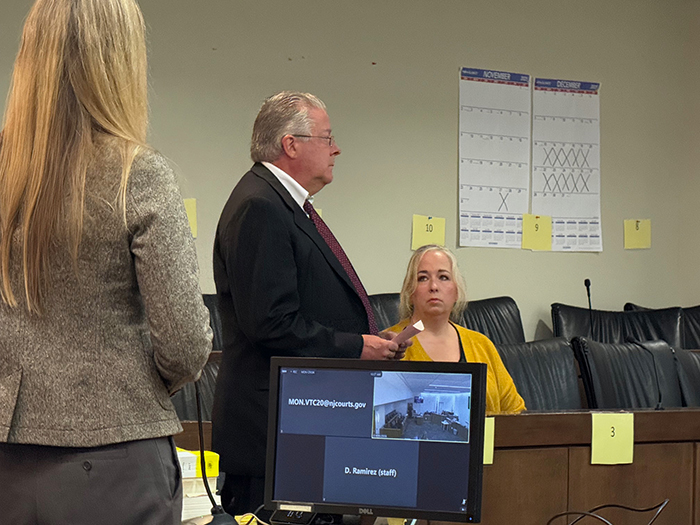
Havemann-Niedrach, 44, appeared in court with William E. Wachowski of the Law Offices of Jonathan F. Marshall. Wachowski is now the third attorney from the same firm to represent her in court proceedings, following earlier appearances by Thomas Huth and Matthew Mordas during previous hearings.
Wachowski told O’Malley that a medical evaluation intended to serve as a defense expert assessment had been completed, but the written findings were not yet available. He did not identify the evaluating doctor or the type of medical specialty involved.
The defense has previously raised the possibility of seeking to dismiss the indictment based on Havemann-Niedrach’s diminished capacity, a strategy first floated by Huth months earlier. It remains unclear whether the argument may be rooted in psychological factors, physical limitations, or a combination of both. Havemann-Niedrach arrived at one of the hearings using a cane and cited medical issues during her arrest when she informed officers about her prepared medications and ongoing health problems.
Judge O’Malley made it clear she was tracking the delay closely.
“I’d like to look at February,” she told counsel. “I want everyone to keep their hours open for February. I have plenty of trial dates to give out, and I expect everyone to be prepared.”
She instructed Wachowski to contact the evaluating physician immediately and advise them that the court was “keeping close tabs” on the overdue report.
“To the best of his ability, that evaluation should be turned over soon,” she said, emphasizing that prosecutors must have sufficient time to review the findings and determine how they intend to respond.

Judge To Defendant: Be Ready To Choose
The pivotal moment of the hearing came when Judge O’Malley addressed the defendant directly, warning her that the next hearing will require a final decision.
“Please have a conversation with your attorneys. Have a conversation with your family,” O’Malley said. “When you next appear before the court, you and I are going to be engaged in a colloquy. At that time, I’m going to ask you what your decision is — whether you’re going to accept the State’s plea offer or reject that offer and then we’ll proceed to trial.”
“That decision is entirely yours,” continued O’Malley. “But understand, we’re moving to that point so it’s entirely clear that we’ll be making the decision then. So, have those conversations you need to have because there won’t be any further delays.”
The State’s offer was first presented at a May 2025 hearing by Monmouth County Assistant Prosecutor Danielle Zanzuccki, director of the Special Victims Bureau. It would require Havemann-Niedrach to plead guilty to aggravated sexual assault, serve 12 years in state prison under the No Early Release Act (NERA), register under Megan’s Law, and have no contact with the victim.
She previously declined the offer.
Havemann-Niedrach was indicted earlier this year on seven counts:
- First-degree aggravated sexual assault
- First-degree endangering the welfare of a child through the manufacture of child sexual abuse materials
- Two counts of second-degree endangering the welfare of a child
- Second-degree official misconduct
- Second-degree sexual assault
- Third-degree endangering the welfare of a child
Prosecutors allege she engaged in a sexual relationship with her 15-year-old student, beginning in early 2024 while she was assigned to an eighth-grade classroom as a special education teacher. Investigators recovered more than 25,000 text messages, some explicit, exchanged between teacher and student. Authorities say the victim also had sexual encounters with her in her car and home.
The teen reportedly suffered a mental health crisis during the investigation, later expressing to his mother feelings of fear, embarrassment, and suicidal thoughts.
Previous Court Rulings
Judge O’Malley has already decided several critical evidentiary questions that will shape a February trial if the case proceeds.
In the same ruling, O’Malley suppressed certain statements Havemann-Niedrach made to law enforcement during her arrest, determining that they were elicited without proper Miranda warnings. While the judge noted detectives were not actively interrogating her, they nevertheless asked questions that prompted responses the State later characterized as significant.
Other evidence, including digital communications, location-based corroboration, and testimony from school personnel, has not been deemed inadmissible.

Case Nears Crossroads
The November 17 hearing made clear that the defense’s timeline is narrowing and that the case is approaching a major crossroads. If Havemann-Niedrach rejects the plea deal at the next hearing, all parties will pivot toward a February trial expected to draw significant attention.
The next court appearance is scheduled for December 8, when the judge expects to confirm whether the defendant has reached a decision.