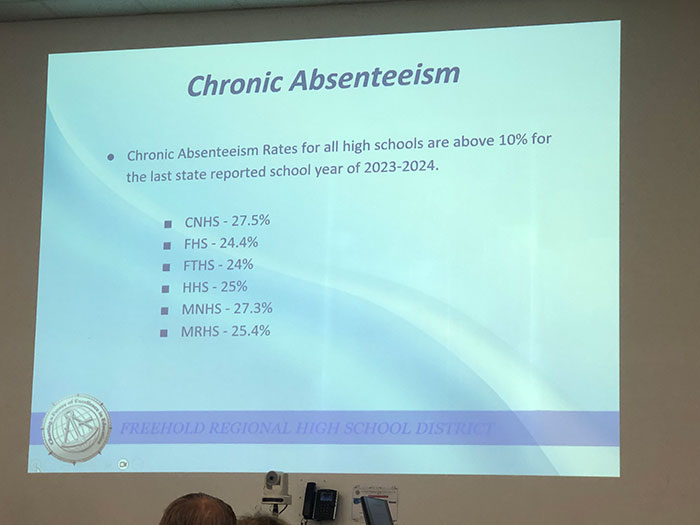
FREEHOLD – The Freehold Regional High School Board of Education discussed an attendance action plan and the strategies they are putting in place to fight “Chronic Absenteeism.”
In this instance, any student who misses more than 10% of all school days without an excuse that falls under state excused absences is labeled as chronically absent. Since the district runs on a 180-day calendar, a student would have to be absent for 18 days without an excuse under state guidelines.
The list of state excused absences include religious observances, participation in Veterans Day, participation in district board of election membership activities, take your child to work day, up to three college visits a year for students in grade 11 and 12, closure of a busing district that prevents a child from having transportation to school, and one excused absence for attendance of a civic event.
The state also gives school districts the ability to create their own reasons for excused absences. However, just because an absence is excused at the local level, that doesn’t mean it doesn’t count towards the state’s definition of chronic absenteeism.
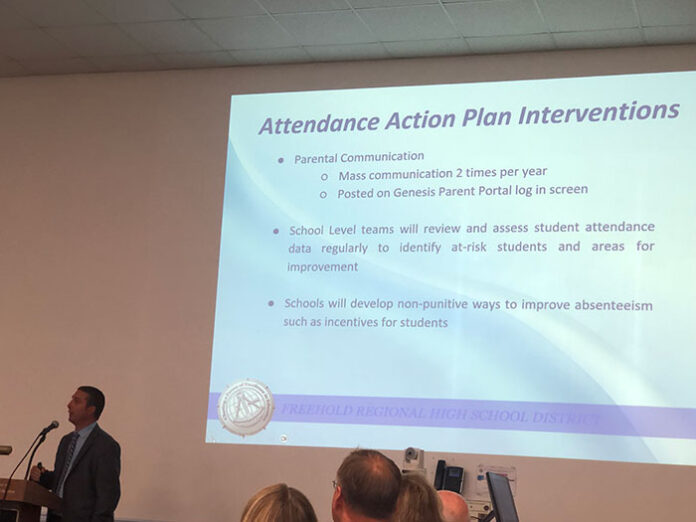
The presentation, which was given by Director of Safety, Operations, and Security Michael Mendes, showed several ways the Board is trying to combat chronic absenteeism in what he called the attendance action plan.
The first pillar of the attendance action plan involves communication with parents. The district will send two mass communications to parents per year, emphasizing the importance of attendance. Notes to parents about attendance and chronic absenteeism will also be posted on their Genesis Parent Portal homepage so that they can see them as soon as they log in.
The second phase of the attendance action plan states that each school will have a team that will review and assess student attendance data regularly to identify at risk students and areas of improvement. These teams will report on the success of the intervention programs to their district representative so they can adjust the plan accordingly.
The third phase of the attendance action plan says that schools will develop ways to improve chronic absenteeism without using punishments. These include incentives for students who have good attendance, although Mendes did not share specifics of what these incentives might be.
Other attendance action plans include connecting with families of at risk students to remove barriers that might be causing them to be absent, creating individualized action plans for students at risk, and coordinating with outside professionals like family crisis centers and health professionals.
Other ways of intervention include taking away student privileges such as parking, prom, homecoming, battle of the classes, and AP final exam exemption.
Mendes also noted how these interventions and plans will be changed throughout the year depending on the effect that they have on combating chronic absenteeism.
According to Mendes, breaking students and parents out of the COVID-19 attendance mindset has been a challenge. Absences have been up in the post-COVID era across the state. Mendes credited this to the mindset that parents believe their child should stay home if they have a sniffle or a cough.
At the end of the presentation, Superintendent Dr. Nicole Hazel talked about how they are not only fighting chronic absenteeism but also phone use during school time. Last year, a rule was set in place by the board of education stating that students were not allowed to have phones during class time. Now that rule has been extended to all instructional time as well.