
BRICK – The governing body introduced an ordinance that defines data centers and clarifies that they are a distinct land use that is not included in any existing township category.
Every piece of property in a town is zoned in a specific category. This determines what is allowed to be built there.
The proposed ordinance, recommended by the township’s Land Use Committee, defines data centers and specifies that they are precluded from the Warehouse, Distribution, Storage, Office, Light Industrial or related Land Use categories.
“Data centers are not allowed in any zone,” said Council Vice-President Derrick Ambrosino. “They haven’t been – the amendment eliminates any developer calling a data center a warehouse.”
There are no data centers in Brick, and none have been proposed, but “the Land Use Committee had concerns about rising electric bills, groundwater depletion, noise, noise pollution, wildfire risks and industrial overdevelopment,” Ambrosino said.
A data center is a dedicated building that houses computer systems, networking equipment, servers and data storage drives to store, process and share digital information. They represent a unique and evolving land use category that differs substantially from traditional land uses listed above.
Data center buildings house rows of computers and equipment for storing, processing and transmitting data for major technology companies, private enterprises, banks, hospitals, government agencies and everyday businesses.
They typically have minimal windows, high gates, security cameras and biometric screening. The computers require a lot of electricity to prevent the equipment from overheating and huge amounts of water for specialty air conditioning and ventilation requirements.
The International Energy Agency says one large data center uses the same amount of electricity as it takes to power 400,000 electric cars, and tech companies are increasingly using data centers to train and operate artificial intelligence systems, which require additional computing power.
Increasing demand for artificial intelligence has created a massive wave of new data center construction across the country, resulting in a strain on power grids.
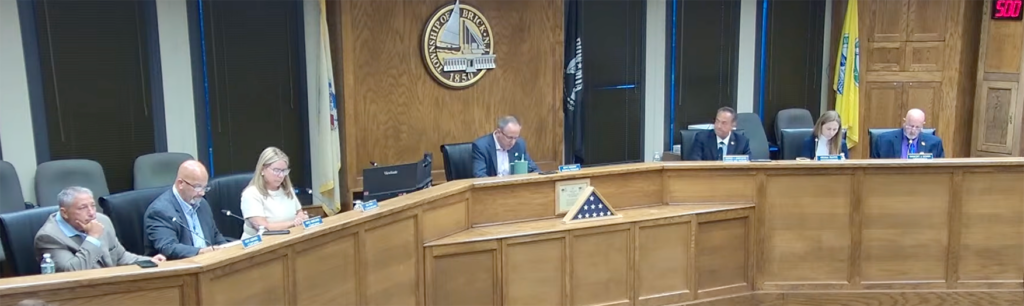
During the most recent council meeting, Councilman Gregory Cohen said he would vote in favor of the ordinance but said the problem is “unpassing it or changing it in the future” becomes more difficult.
“I totally agree that these data centers really do not belong in our township at this point in time, nor do we really have any place to put it,” he said.
Cohen said he was concerned that closing the door on data centers could also close the door on future revenues, which he said could “bring in a lot of money in taxation…we need to keep those things in mind that these things can change in the future. The footprint of a data center can change…reactors the size of a table are in the near future.”
Councilwoman Lisa Reina agreed with Cohen.
“At this time, data centers do not appear to fit the unique needs of Brick Township,” she said. “There is always an opportunity to amend an ordinance or create a new ordinance in the future as Land Use did here, if and when it is appropriate to do so.”
Data centers are a somewhat partisan issue, as Republicans nationwide are more in favor of data centers than Democrats. Reina and Cohen are two of the three Republican members of the council, the rest of whom are Democrats. However, the all-Republican governing bodies in towns such as Manchester and Jackson have unanimously banned data centers as well.
The Brick Township Council was unanimous in passing the introduced ordinance.
In May, Governor Mikie Sherrill issued a press release announcing a four-part statewide plan to address the growing impact of data centers on energy demand, resource use and local communities. The measure will help to hold data centers accountable “while still positioning New Jersey to lead in AI innovation,” she said.
The plan establishes strong guardrails to “protect communities, strengthen transparency, ensure these facilities invest in New Jersey’s energy infrastructure and deliver good-paying jobs,” she said.
The next council meeting will be held on Tuesday, September 22 at 7 p.m.