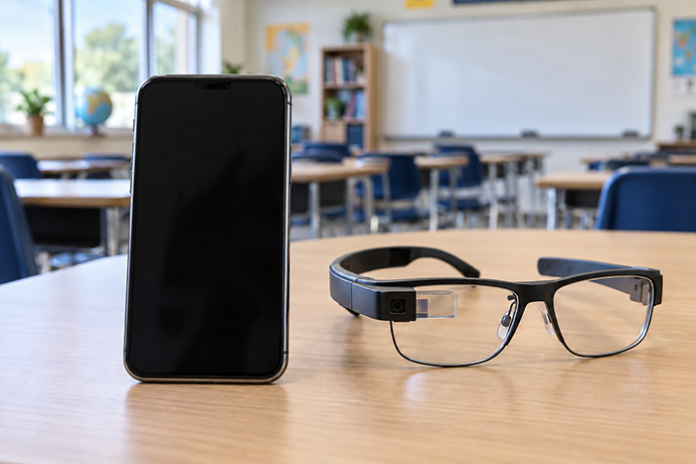
JERSEY SHORE – Smart glasses fall under the internet device ban that has started in New Jersey schools this year, but can school staff spot them?
These glasses are made by a number of companies and have been given the name “smart glasses” because they have internet capabilities like a smart watch. A portion of the lens becomes like a computer screen, and they have cameras recording video. Many civil rights groups have warned that these glasses violate privacy, recording people without their permission or even without their knowledge. This becomes an even larger problem since they could be brought to schools and record minors – in the halls, locker rooms and restrooms. Meta, the company that owns Facebook, secretly put in face recognition technology so that the wearer would learn information about anyone who they saw, according to online tech magazines such as Wired.com.
The new law requires all school districts to create a bell-to-bell ban on phones and other devices that can access the net. It’s easy to see a student taking out a phone. However, smart glasses hide in plain sight. That’s actually how they’re marketed.
JerseyShoreOnline reached out to several local superintendents about how they would control this invasive technology. Only two responded.
Toms River Superintendent Michael Citta clarified that the smart glasses are banned as per school policy as well as state legislation.
“We will be in-servicing our staff before school starts” to teach them how to recognize smart glasses and how to respond, he said.
Sources online have debated whether prescription glasses provide a loophole to use these devices.
“Prescription alone would not qualify an exemption,” Citta explained. The policy has accommodations for some devices. For example, a child might need a device to compensate for a physical challenge or learning disability. These would all be specified in another document such as a health plan or an individualized education plan.
Central Regional Superintendent Michelle CarneyRay-Yoder discussed this a bit further. If smart glasses are prescription, they can wear them. However, the district will be using an app to prevent them from being used inappropriately.
“The app will block all apps, including Meta glasses, so it will not be able to record while in school,” she said. “They can still wear their glasses if they are prescription and teachers will not have to identify whether they are wearing them.”
Therefore, the glasses are able to be worn in the same way that any pair of glasses will be worn. However, all internet usage will still be banned on all devices bell-to-bell.
The ban came from concerns that constant access to the internet hurts children’s attention span, self-esteem, and more.
Guidance set by the New Jersey Department of Education explained that all school policies must define which types of devices are covered. It gave the examples of smartphones, tablets, smartwatches, and smart glasses.
The New Jersey Education Association lobbied in favor of the ban and successfully requested changes prior to its passage so that (1) NJEA and other education stakeholders would help develop the guidelines and (2) the state didn’t impose one-size-fits-all guidelines on all boards of education.
“Growing Up Online, Findings and Recommendations from the New Jersey Commission on the Effects of Social Media Usage on Adolescents,” stated that there are many positives to social media, particularly for youth who struggle with connecting to peers in a local setting.
It went on to say that “regulating social media use is a crucial issue for the well-being of the youth of New Jersey since it directly impacts their physical, mental, and emotional health. Their quality of life, now as adolescents and in the future as adult citizens, substantially depends on our immediately and decisively confronting the challenges posed by social media today.”