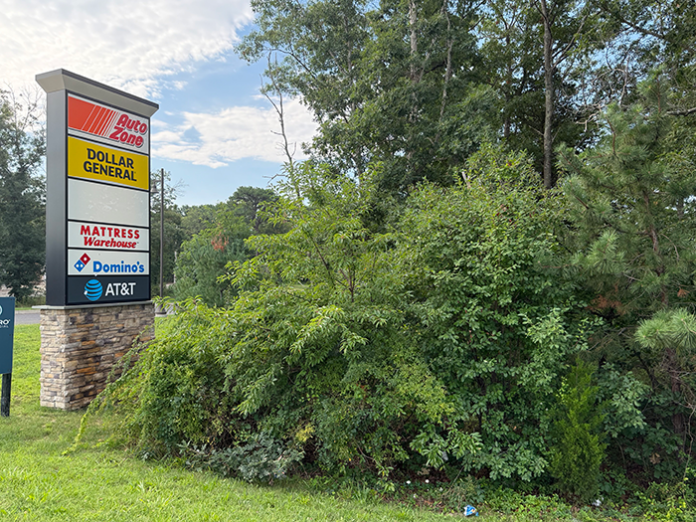
BARNEGAT – A drive-through coffee stand proposed for the last wooded section of a West Bay Avenue shopping center has cleared its first hurdle but still needs detailed site plan approval before construction can begin.
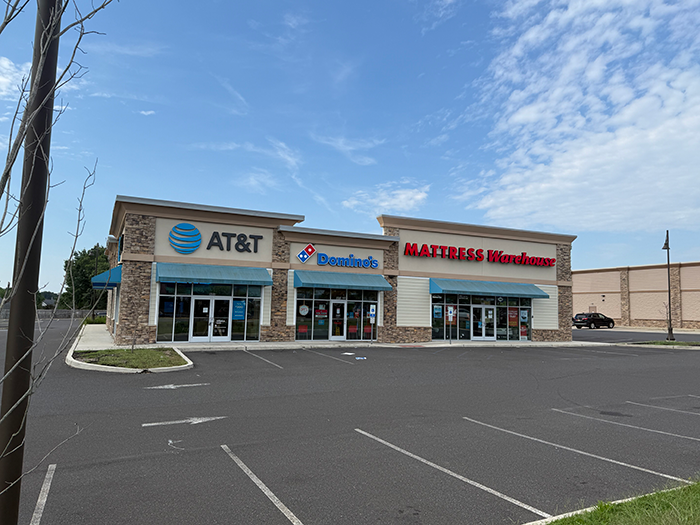
The Barnegat Township Zoning Board of Adjustment unanimously approved a use variance for a 7 Brew coffee shop at 907 West Bay Avenue. The 510-square-foot building would sit immediately east of the strip containing AT&T, Domino’s and Mattress Warehouse, near the center’s West Bay Avenue entrance and roughly across from the municipal complex. Dollar General and AutoZone are also part of the development.
The property is zoned for commercial use, but a restaurant with a drive-through is not permitted. Although representatives described 7 Brew as a coffee shop rather than a restaurant, its drive-through still required a variance. The company refers to its compact drive-through locations as “stands.” The nearest 7 Brew stand is in Toms River.
The application was bifurcated, meaning the board decided only whether the use was appropriate for the property. WP Barnegat LLC must return for preliminary and final major site plan approval, when the board will consider traffic circulation, drainage, lighting, landscaping, noise, signs, deliveries and buffering.
“This is not the last opportunity for the board to review this project,” applicant attorney Keith Davis said.
Smaller Than Rejected Starbucks Plan
Much of the hearing centered on whether the proposal was different enough from a Starbucks application rejected for the same location in 2022.
The Starbucks plan called for a 2,225-square-foot building, 22 parking spaces and approximately 1,600 square feet of outdoor seating. Its drive-through provided room for about 12 waiting vehicles.
By comparison, 7 Brew would operate from a prefabricated 510-square-foot building with no customer seating. A separate 260-square-foot structure would hold dry and cold storage. The plan shows 10 parking spaces, mostly for employees, two ordering lanes and a third lane allowing drivers to pass without ordering.
There would be no speaker boxes, advance ordering or food preparation. “Our team comes out to your car to take your order,” local franchisee Shinori Ramanathan said. Employees carrying tablets serve as what the company calls “living menus,” helping customers choose among coffee, tea, smoothies, milkshakes and energy drinks. Completed orders would also be brought directly to customers’ vehicles. One prepackaged food item is available.
Ramanathan said customers typically spend three to three-and-a-half minutes on the property. She estimated the stand would sell between 500 and 750 drinks a day and employ approximately 40 to 50 part-time workers. Staffing would range from three to five employees during slower periods to six to eight during peak hours.
The proposed hours are 5:30 a.m. to 10 p.m. Sunday through Thursday and until 11 p.m. Friday and Saturday. Deliveries would generally occur two or three times a week outside peak hours.
Traffic engineer Nathan Mosley projected 90 vehicle trips during the weekday morning peak hour and 30 during the afternoon peak. Those figures count vehicles entering and leaving during the busiest hour, not the number of daily customers.
The Starbucks proposal was expected to generate 190 morning peak-hour trips and 87 afternoon trips, making 7 Brew more than 50 percent less intensive during those periods.
Mosley said many customers would already be traveling on West Bay Avenue and stop on their way to work or while running errands. The two ordering lanes could hold 18 vehicles, which he said should prevent waiting cars from backing into the shopping center’s travel lanes.
Customers could use the shopping center’s existing right-in, right-out driveway on eastbound West Bay Avenue or its full-movement driveway on Sandpiper Road, just south of the traffic light. The applicant also plans to add a dedicated left-turn lane on southbound Sandpiper Road at the existing shopping center entrance, a proposed improvement that will receive further review during the site plan phase.
Neighbors Voice Concerns
Cynthia Knowles, a Heritage Bay resident and former member of its board of trustees, asked the zoning board to deny the variance. She stressed that she was speaking for herself and not for the homeowners association.
Knowles said residents had been told that the trustees signed an agreement under which the association would not oppose the application. In exchange, she said, the developer agreed to replace a retaining wall estimated to cost $260,000 and add the Sandpiper Road turn lane. Residents were also told they could face assessments of approximately $1,200 per household if they had to pay for the wall themselves.
Knowles said she was not opposed to reasonable commercial development or to 7 Brew. Her concern was placing a high-volume drive-through next to a 55-and-older community whose residents expected a quieter setting.
She cited the potential for additional traffic, idling vehicles, deliveries, litter, lighting and noise from early morning until late at night. Knowles also said the Heritage Bay guardhouse had been struck twice in approximately a year and a half, most recently in a hit-and-run that left it demolished.
“The fact that a business would like to operate on a property should not outweigh the legitimate concerns of the residents who live next to it every day,” Knowles told the board.
Thomas Downs, president of the Heritage Bay homeowners association, acknowledged those concerns but confirmed that the trustees had voted not to oppose the project. He did not say the association had endorsed it. Downs said the neighboring land had always been commercial property and Heritage Bay once had an opportunity to purchase it but did not. He said the developer met with association representatives and agreed to address most of their concerns.
“Who are we to say that someone cannot build on that property?” Downs asked.
Board Finds Enough Has Changed
Project planner John McDonough said the new application was substantially different from Starbucks because of its smaller building, lack of seating, reduced parking, lower traffic and limited food service.
That distinction mattered because a zoning board generally cannot reconsider essentially the same application after denying it unless meaningful changes have been made.
McDonough also noted that the property is zoned for a range of commercial uses, some of which could attract more traffic or remain open longer than 7 Brew without requiring a use variance.
Board members agreed that the smaller coffee shop represented a considerable change from Starbucks. All six members present voted in favor of the use variance, even though only five affirmative votes were required.
The vote allows the proposed use but does not authorize construction. The applicant must return for preliminary and final major site plan approval.