FREEHOLD – Superior Court Judge Jill Grace O’Malley handed down a pair of significant rulings in the criminal case of Allison Havemann-Niedrach, a former Freehold Boro teacher accused of multiple sex crimes against one of her eighth-grade students.
The judge ruled that testimony from the victim’s mother could be admitted at trial under New Jersey’s “fresh complaint” doctrine. At the same time, she suppressed certain statements Havemann-Niedrach made to law enforcement at the time of her arrest, finding they were obtained without proper Miranda warnings.
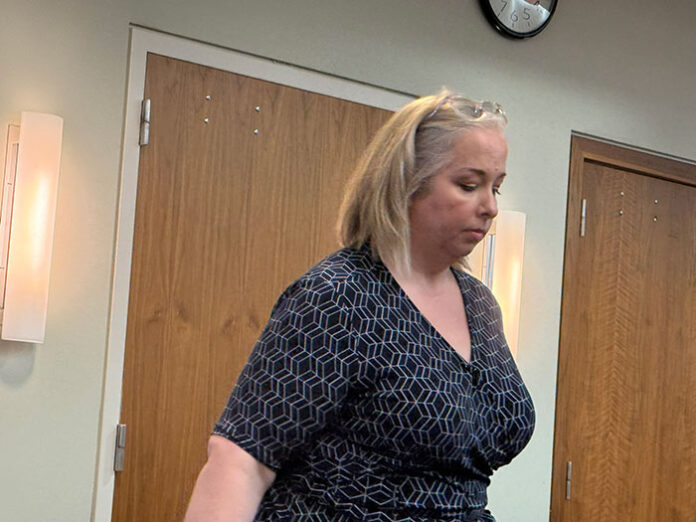
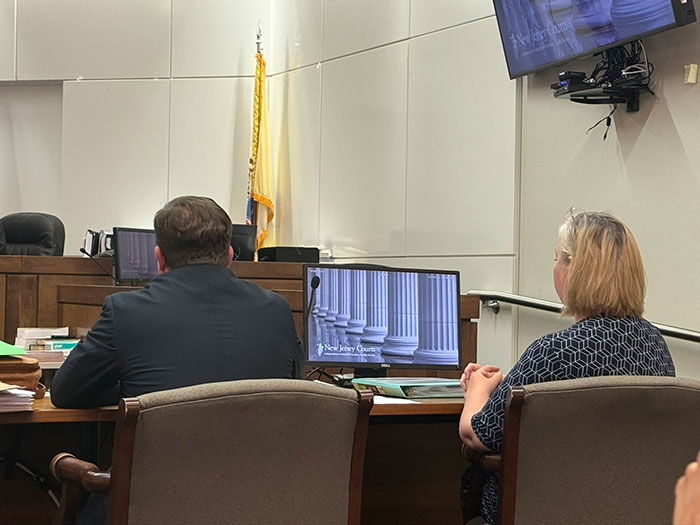
Havemann-Niedrach sat quietly alongside her defense attorney Matthew Mordas as Judge O’Malley delivered her detailed explanation of the rulings. Across the aisle, Monmouth County Assistant Prosecutor Danielle Zanzuccki also listened intently before joining Mordas and the judge in chambers for a private conference after the decision was read.
Testimony Allowed
Central to the ruling was the admissibility of testimony from the victim’s mother. In earlier hearings, she described how her son approached her on the morning after a police interview, visibly upset and apologizing. During that conversation, the boy admitted he had been in a sexual relationship with his teacher, later confirming that they had engaged in intercourse.
Judge O’Malley explained that such testimony qualifies under New Jersey’s “fresh complaint” exception to the hearsay rule, which allows certain statements to be introduced at trial to explain why a victim confided in someone close to them soon after abuse occurred.
“The court finds [the mother] to be a credible witness,” O’Malley said. “…Her testimony was consistent, and she was forthcoming in responses to both direct and cross-examination.”

“Additionally, and importantly, her emotional responses were appropriate and again, suggestive of veracity,” continued O’Malley. “During the conversation, [the mother] said the victim was emotional, sad and visibly frightened.”
During her testimony before the court, the victim’s mother emphasized that her son controlled the disclosure. She also shared that her son was apologetic and concerned that he would be incarcerated for the relationship. He also threatened to take his own life.
The judge acknowledged that children often delay reporting sexual abuse because they feel threatened or embarrassed. In this case, she found the timing reasonable, as the disclosure occurred just one day after police intervention and very close in time to the events.
“Having considered the testimony of [the mother] which the court finds to be credible,” O’Malley added. “And the facts of the case based on the totality of the circumstances, the court finds that the testimony of [the mother] is admissible under the “fresh complaint” doctrine.”
Statements Suppressed
O’Malley also considered whether statements Havemann-Niedrach made after her arrest in June 2024 could be used at trial. Body camera footage showed her conversing with Freehold Borough Detective Samuel Hernandez about various topics, including her daughter’s cell phone and the use of the Bark app, a parental monitoring tool.
O’Malley found that the defendant had already requested an attorney and had not been given Miranda warnings, even though she was in custody.
“While it is apparent from this court’s view of the body camera that the detective was not interrogating the defendant for the purpose of eliciting facts about the case, he was nonetheless asking questions that elicited certain pertinent information,” the judge said. “For instance, any conversation about the teenager and more specifically, the defendant’s teenage daughter and her cell phone.”
According to Hernandez’s testimony, Havemann-Niedrach explained how she used the Bark app on her daughter’s phone. Prosecutors later argued that this detail was important because they believe Havemann-Niedrach may have used her daughter’s phone to contact the victim.
“This information is particularly important,” said O’Malley. “Perhaps unknown to the detective at the time, but evidence discovered later suggests that the defendant may have used her daughter’s phone to gain access to the victim by perpetuating her fraud – that her daughter was dating the victim.”
“Similarly, the detective asks the defendant if she speaks Spanish and a short conversation ensues in Spanish,” O’Malley continued. “The defendant admits teaching or dealing with bilingual students. Again, this is significant proof, because it establishes that she is a teacher, and may establish that she had access to this particular victim.”
O’Malley concluded that the statements were made without required safeguards. She ruled that they may not be admitted in the prosecution’s case-in-chief, although defense counsel may use them for cross-examination.
Digital Evidence
Prosecutors have previously stated that investigators recovered more than 25,000 text messages exchanged between Havemann-Niedrach and the student. They argue that the volume and nature of the messages show a relationship that crossed professional boundaries and progressed into sexual abuse.
Some of the messages, according to prior hearings, included expressions of affection and attempts to conceal the relationship. The seven charges against Havemann-Neidrach include first-degree aggravated sexual assault, first-degree endangering the welfare of a child through the manufacture of child sexual abuse materials, two counts of second-degree endangering, second-degree official misconduct, second-degree sexual assault, and third-degree endangering.
The 44-year-old defendant who resides in Jackson was initially placed on house arrest. Court records have not been made available to explain when and why the court’s order was lifted.
The case dates back to June 2024, when police began investigating Havemann-Niedrach after concerns surfaced about her behavior with the student. A Monmouth County grand jury indicted her later that year on multiple counts of second-degree sexual assault and endangering the welfare of a child.
Havemann-Neidrach’s next court date is scheduled for October 14 at 9 a.m. The hearing will be held virtually, with all parties required to appear via a secure online link.