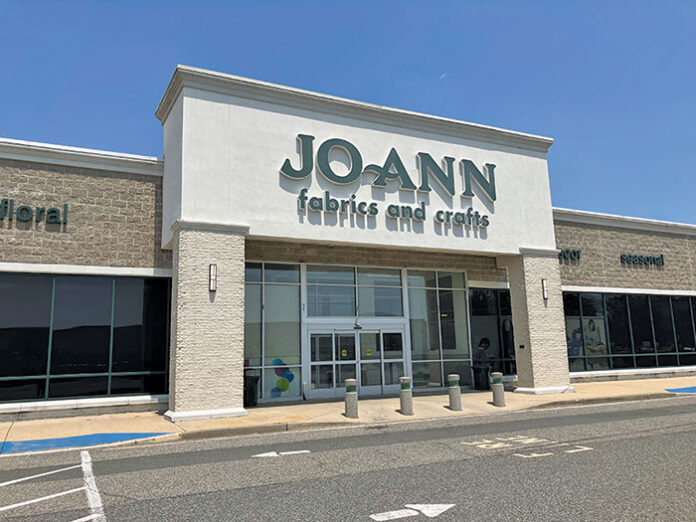
TOMS RIVER – In the months after the closure of Joann Fabric and Crafts, economic analysts are still doing an autopsy to find out just how the retail giant died.
Stores close so frequently that most people assumed it was just another casualty of Amazon. However, there are more complicated reasons. Much of it has to do with high-end financial decisions that caused the closure of more than 800 stores and the laying off 19,000 employees, of which approximately 15,000 were part time.
Starting as a family-run business in 1945, Joann’s became a leading craft retailer. It was a place where customers and staff both knew about sewing.
Flash forward 80 years, and the stores all closed by May 30, 2025. It was reported that Michael’s has purchased all of Joann’s intellectual property and private labels.
An analysis in Fortune magazine said that in 2011 Joann accepted an unsolicited bid from Leonard Green & Partners to take the company private.
According to Investopedia, an unsolicited bid is when a company attempts to buy another company that isn’t for sale. It is sometimes called a hostile takeover.
Leonard Green & Partners is a Los Angeles-based private equity investment firm with approximately $75 billion in assets under management. They did not respond to a request for comment for this story.
Joann’s had no debt in 2010, Fortune said. After it was purchased, it had $1.6 billion. That is because Leonard Green borrowed money to buy Joann’s using Joann’s itself as collateral, then saddled Joann’s with the debt.
Essentially, a private investor worth billions bought a company that wasn’t for sale with money that didn’t belong to them, then left the company with the debt.
Additionally, after the purchase, Joann’s was paying Leonard Green annual management fees.
Insiders also told Fortune that after cost-cutting measures, Joann tried to function like any generic box store and not a specialty chain. They cut staff, and had fewer employees – and fewer management – who were knowledgeable about sewing and crafts.
Jenn, a Toms River resident who has a sewing side business, misses the store.
“Joann’s was more than just a place to buy fabric, aside from all the crafting supplies they sold, it was a place of community,” she told The Toms River Times. “Joanne’s offered sewing, knitting, and other crafting classes. The women who worked at the store and cutting counter were a valuable resource to experienced and novice seamstresses alike.”
“Many local sewing shops have gone out of business and now the larger stores are too. Larger box stores have limited options and if you have a question, it’s unlikely the local clerk will have answers. I will miss Joann’s, and the service they provided. My heart goes out to all who lost their jobs,” she said.
Elizabeth Caven is a venture capital investor and founder of the UpCraft Club, a digital sewing pattern marketplace, and invented paperless sewing. After Joann’s second bankruptcy announcement in a year, she published a story to her website (ElizabethCaven.com) and CraftIndustryAlliance.org about how she met with the head of Joann’s sewing department and learned that this person had never seen a sewing pattern.
A revolving door of CEOs and Hobby Lobby gobbling up market share contributed to the decline.
During the pandemic, people focused on crafts and Joann profited. Leonard Green saw this as a time to sell high, and put the company back on the market, making $131 million and remaining majority shareholder. This allowed it to nominate up to five members to Joann’s board of directors, Marketwatch reported.
A January 15, 2025 press release announced the liquidation of the company.
“Since becoming a private company in April (of 2024), the Board and management team have continued to execute on top- and bottom-line initiatives to manage costs and drive value,” said Michael Prendergast, Interim Chief Executive Officer. “However, the last several years have presented significant and lasting challenges in the retail environment, which, coupled with our current financial position and constrained inventory levels, forced us to take this step. After carefully reviewing all available strategic paths, we have determined that initiating a court supervised sale process is the best course of action to maximize the value of the business. We hope that this process enables us to find a path that would allow Joann to continue operating as a going concern.”
Prendergast continued, “On behalf of the Board and leadership, I want to thank the thousands of Joann Team Members across the nation for their dedication to our customers and mission, especially in light of everything our company has gone through in recent years. We remain committed to continuing to support them and serving our customers – the sewists, quilters, crocheters, crafters and other creative enthusiasts we have served for more than 80 years – during the process.”