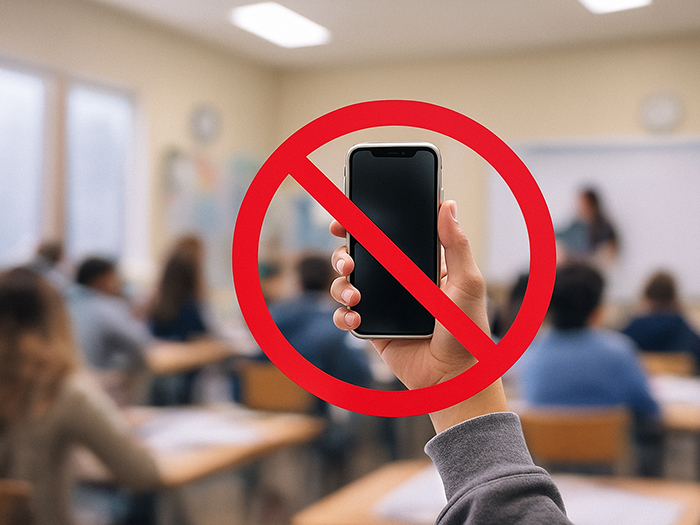
TOMS RIVER – The policy prohibiting cell phone use in class passed recently but an official said that it just puts in writing what is already in place.
The policy included all electronic devices with the ability to record audio or video, and transmit any kind of communication to others. For the purposes of this article, they will be summed up with the term “phone.”
The policy was unanimously supported by all board members at a recent meeting.
“The policy the Toms River Board of Education adopted simply memorializes the things we’ve always done here in the district,” Superintendent Michael Citta told The Toms River Times. “Students are not allowed to have their phones out during instruction. It limits distractions and maximizes teachers’ capacity to teach, and thus students’ capacity to learn.”
According to the policy, the goal is to have students fully engage with their teacher, the lessons, and their peers. Another goal is to prevent recording others without their consent. Furthermore, this would prevent kids from taking photos of tests and sharing them with students who will be taking that test later in the day.
Devices are still allowed if they monitor a health condition or if they are allowed because of something like a student’s Individualized Education Plan.
The summary of the policy is as follows:
Students will be encouraged not to bring phones to school. If they do, the student should turn it off and have a passcode protecting it from being used by others. It should stay in the student’s bookbag or locker when its use is not authorized.
The student assumes all responsibility for the phone in case it is lost, stolen or damaged.
If a student has to contact a parent, or a parent has to contact a student, they must do so through the main office.
If a student is caught using a cell phone when they are not allowed, the phone will be taken and turned in to the principal or designee’s office for the rest of the school day. The phone must be turned off and passcode protected before turning it over. They pick it up at the end of the school day, after signing an acknowledgement that this is their first offense.
For the second offense in the same school year, all of the above is the same, except it comes with one day detention. Additionally, a parent has to come to school and get the phone. If they can’t pick it up that day, the phone will stay at the office until the parent can come. The parent will have to sign off that this is the second offense.
For the third offense in the same school year, everything is the same as the second offense, except now the parent has to sign off that this is the third offense. Instead of detention, the student gets one day of an Alternate Education Program.
According to the district, an Alternate Education Program is an intervention that removes a student from the classroom, but continues to provide instruction and tailored support for behavioral and/or social-emotional needs.
“The most basic reason we have adopted the cell phone policy because it’s in line with our existing code of conduct,” Board of Education President Ashley Lamb said.
“I am aware that some members of the public have been vocal against it, citing things like ‘I pay for the phone, it’s my property etc.’ Which I couldn’t agree with more, however the bottom line is that some property is not appropriate for learning environments, and cell phones happen to be one of them,” she said.
“The simple fact is that cell phones are distracting for everyone. Children and adults alike, when we are focused on our cell phones we are not focused on the task at hand. When most people walk into a business of any kind they expect the person greeting them or helping them to be paying attention, focused, and doing their job. Not sitting on their phone or playing games. The same goes for our students. Their job at school is to focus on their education,” she said.
“To be clear, we are not suggesting staff members remove a phone from every student that walks through the door, but students should be aware that phones are not permitted,” she explained. “We do not want to see them in use during the school day. It was the same for most of us when we attended school.”
“Many staff members do make space available in their classrooms for students to secure their phones, and this is voluntary. Many students like the option because it removes the temptation and the habit of ‘doom scrolling,’” she said.
“In an emergency situation, that is not considered ‘regular class time’ and as such students are always permitted to contact their parents or guardians if the situation requires,” Lamb said.
“The take away here is that we have to address what IS HAPPENING, and what we know is that cell phones distract people of all ages. It is especially disruptive in learning environments, and we just want better opportunities for our kids. If a phone is in a purse, a backpack, a pocket, a basket, or a locker…. A student is not distracted by it, and yet they still maintain access to their phone if they should absolutely need it for an emergency,” she said.
“The policy matches the code of conduct which was created to foster healthy learning environments where students can thrive. This, like everything else Toms River chooses to do, is about what’s best for kids,” she said.
On the state level, a bill recently passed that would order the New Jersey Commissioner of Education to construct a policy for cell phone use for any time that a student is under the direct supervision of school staff. This includes official school functions outside of class time and also while they are on buses before and after school.
The Commissioner’s policy would cater to different age groups. It would ban any non-academic use of social media during instruction. Phones can still be used in emergencies, or when they are part of an IEP or documented medical reason. It would also elaborate on how to store phones that are taken away and how to communicate with parents about the policy.
The bill passed both houses and then headed to the governor’s desk. Gov. Phil Murphy pushed for a cell phone ban for the tail end of his tenure, so he might sign it before he leaves office. Governor-Elect Mikie Sherrill will be sworn in on January 20.