OCEAN COUNTY – Six-year-old Ayvin walked into the Toms River Chess Club alongside his 11-year-old brother Tommy with obvious excitement written across his face. The Barnegat kindergarten student had already attended the club’s Stafford Township gathering the week before, but this time he had heard there would be even more players waiting downstairs inside the lower level of the Toms River municipal building.
Before long, the blue-eyed boy, described as naturally shy by family, was confidently approaching strangers with a question that suddenly seemed easy to ask. “Want to play?” he asked a middle school-aged player already seated at a chess board.
Within minutes, Ayvin was doing what players of all ages routinely do inside the Toms River Chess Club, sitting across from someone he never met before, shaking hands and diving into a game that somehow manages to erase age differences once the pieces begin moving.
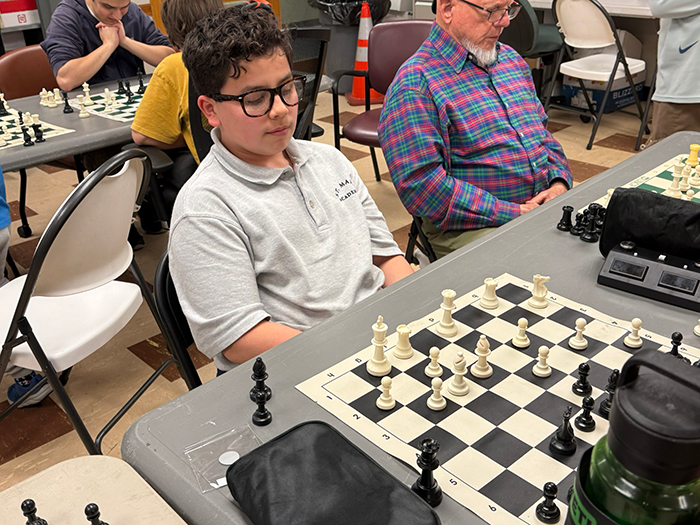
On a recent Thursday night, more than three dozen players filled one room inside the Toms River meeting room for tournament competition while others gathered in an adjoining space for more casual play, postgame analysis and conversation. Teenagers studied boards across from retirees. More experienced players coached newbies on strategy.
What stood out most was not simply the competition itself, but the interaction between generations and professions. Inside the club, backgrounds vary widely. One member is a criminal defense attorney. Another is a registered nurse. Vinnie Pizzimenti, whose 13-year-old son Preston regularly attends, works as a social worker. Organizers said the club also includes business executives, teachers, retirees, students and longtime tournament competitors, all sitting side by side over chess boards.
For many members, the club has become less about winning games and more about finding community.

A Club With History
Founded in 1964, the club has quietly become one of New Jersey’s longest-running and most respected chess organizations. The main club meets every Thursday from 5 to 9 p.m. at Toms River Town Hall, located at 33 Washington Street, hosting both casual games and United States Chess Federation-rated tournaments.
In 2024, organizers expanded south into Stafford Township, where a newer and smaller branch now meets twice monthly on Tuesdays from 5 to 9 p.m. at the Stafford Recreation Building on East Bay Avenue. Organizers said the Stafford location was created to provide opportunities for players living farther south along the Jersey Shore, where organized chess clubs are limited. Club schedules, tournament details and membership information are available through the organization’s website.
“We’ve had as many as 60 or 70 members a night,” Nick Carlson, the club’s president explained while greeting players between rounds. “Once you pass Toms River and go south, there are no chess clubs.”
Carlson described the Stafford site as a “bridge” connecting players throughout southern Ocean County and helping encourage future growth of chess clubs farther down the shore. The club now attracts players from Ocean, Monmouth, Burlington and Atlantic counties, along with occasional visitors who stop in after hearing about the organization’s reputation within chess circles. Its history stretches far beyond Ocean County.
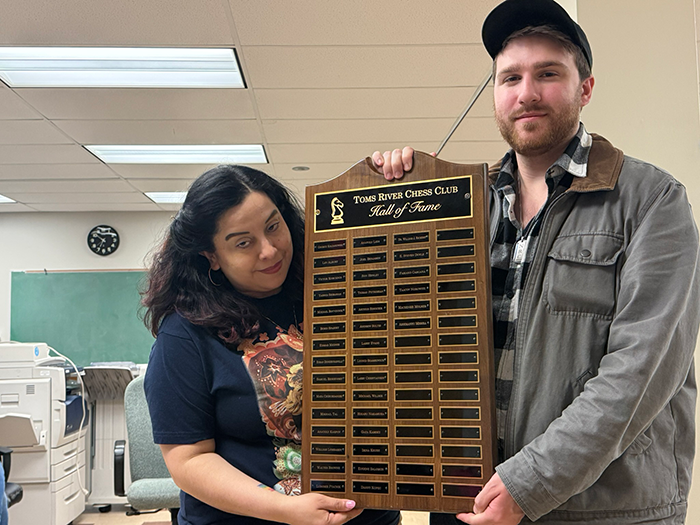
Mounted prominently on one wall is the club’s Hall of Fame plaque honoring grandmasters and major contributors tied to the organization over the decades. Organizers proudly point to the names while discussing the club’s role in American chess history. The club website notes that world-renowned players including Boris Spassky and Mikhail Botvinnik visited over the years, while former members later helped shape national and international chess organizations.
Carlson said the club has also hosted grandmasters for simultaneous exhibitions, known as “simuls,” where one elite player competes against multiple opponents at once.
Still, the atmosphere inside the room feels notably unpretentious. Children wander comfortably between tables. Adults pause serious tournament analysis to joke with younger players. Some members arrive in hooded sweatshirts while others come directly from work in professional attire. One older player quietly reviewed a game with a child young enough to be his great-grandson.
The age range itself remains striking. The club’s youngest regular member first began attending at just four years old and is now six, the same age as Ayvin. The oldest member is 97 years old.
More Than A Game
Pizzimenti, the club’s secretary, said her son Preston first became interested in chess after excelling at the game in school, prompting the family to search online for organized chess opportunities nearby.
“He was the best player in his school, and I was thinking about getting him lessons somewhere,” she said. “I just looked up Ocean County chess, and this is what came up.”
What began as a simple extracurricular activity quickly evolved into something much larger for the family. “We made lifelong friendships,” Pizzimenti said. “What I thought was going to be just a way for him to learn some chess became a second family.”
Carlson added that the welcoming atmosphere is intentional and one of the organization’s defining traits. “If a kid comes in and doesn’t really know how to play, I’ll look at one of our most empathetic members and ask them to teach the basics,” he explained.
That spirit remained visible throughout the evening as experienced adult players such as Chris Discenza, a registered nurse, agreed to challenges and encouraged younger competitors after difficult losses. Several members said the social interaction itself has become just as important as the chess.
Parents and organizers also pointed to the broader benefits of the game itself, especially for children growing up in a world increasingly dominated by screens and social media.
“There’s a large subset of parents purposely trying to provide non-digital entertainment,” Pizzimenti explained while watching players circulate between boards. “Critical thinking, attention span, focus, strategy and socialization – chess helps with all of it.”
Carlson believes the game teaches lessons that extend far beyond the board. “For kids especially, it teaches planning,” he said. “Every choice you make has a consequence.”
One thing becomes immediately noticeable while scanning the crowded room: chess remains overwhelmingly male dominated. Boys and men occupied most of the tournament tables during the evening, with only one or two women participating in a casual game. The imbalance mirrors national trends. The United States Chess Federation has reported a significant gender gap in competitive chess participation.

Joining The Club
The Toms River Chess Club welcomes players ranging from complete beginners to experienced tournament competitors. Organizers said there is no formal lesson structure, but newcomers quickly find experienced players willing to teach the basics and help them improve.
The organization also maintains an extensive chess library filled with strategy guides, tournament collections and instructional books that members can borrow. Organizers recently began digitizing the collection as part of a new app designed to track attendance, organize tournaments and catalog the growing library system. And, despite the tournaments, rankings and technology, the heart of the club remains rooted in something much simpler. It’s an opportunity for people of vastly different ages gathering together each week for several uninterrupted hours of focus, conversation & connection.
For more information, visit TomsRiverChess.org