TOMS RIVER – As movie buffs celebrate the 50th anniversary of the blockbuster movie “Jaws,” The Toms River Times looks back at two shark incidents at the Jersey Shore – one real and one bogus.
Jim Dougherty recalled being a lifeguard in the summer of 1975 at Silver Beach in Toms River. He has long roots in this town. Toms River High School South named their gymnasium after his father, a teacher and coach.
“‘Jaws’ put sharks on the map,” he said. There might be a porpoise or a dolphin spotting once in a while, but no one was thinking about sharks when they went into the water.
After the movie, every swimmer was carefully watching the ocean. Any fin in the water, a flip of a tail – even a bird drifting on a distant wave – sent imaginations into overdrive.
“Multiple times each day beachgoers would falsely report shark sightings,” Dougherty said.
So, the lifeguards were doubtful at first when another person said there was a shark fin just beyond the breakers – until the lifeguards looked out and saw it for themselves.
It was August 15, 1975. There were thousands of people on the beach.
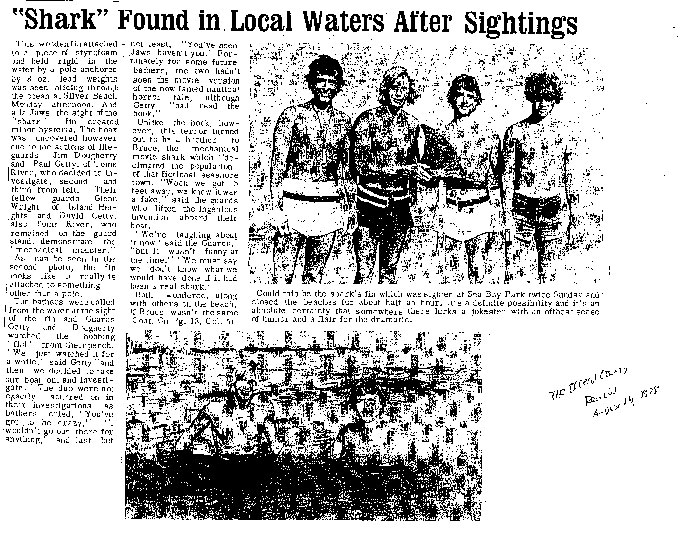
The bathers were called back to the safety of the sand. Everyone watched the fin sitting out in the water. Then, two lifeguards decided to investigate.
Lifeguards Glenn Wright and David Getty manned the stand while Dougherty and Paul Getty took to the waves. People on the shore thought they were crazy – and told them so.
“You’ve seen ‘Jaws,’ haven’t you?” one beachgoer said.
They had not. Getty had read the book, though.
They paddled a 15-foot Charles Hankins lifeguard boat out toward the fin. Upon approaching, they thought they were going to “need a bigger boat.” The dorsal fin was so large that it must have belonged to a huge maneater, possibly 12 feet long.
“During the summer, when similar scenarios occurred, once we rowed out past the waves, any sighting of a shark disappeared,” he said. “Not this time. As we went over the furthest wave, we could see that the large fin was still very present.”
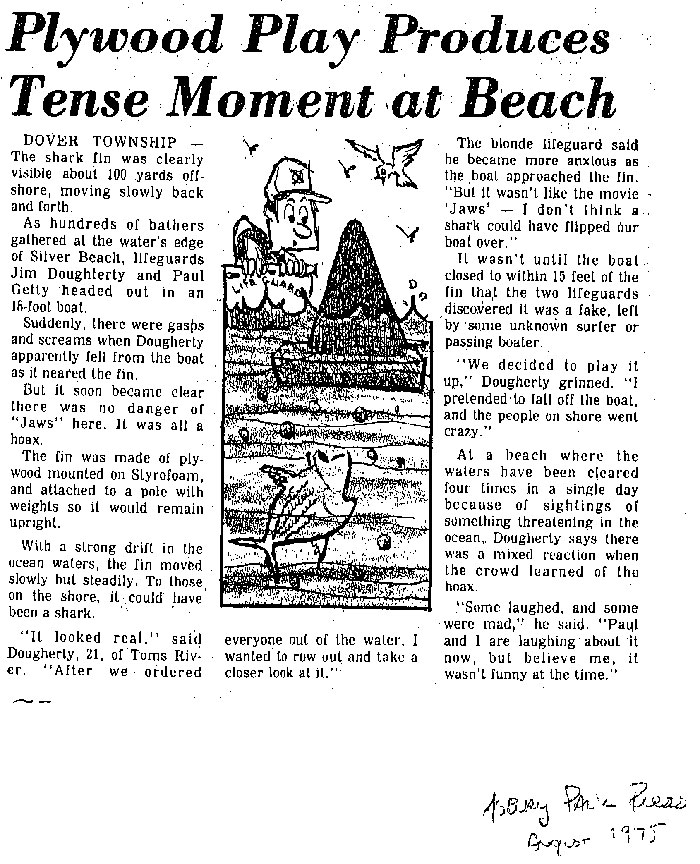
However, Dougherty noticed it wasn’t moving. When they got about 30 yards away, the fin didn’t look quite right. When they pulled close to it, they realized it was a wooden fin attached to a piece of Styrofoam painted black, anchored by an 8-ounce lead weight.
But the multitude of people watching from the shore didn’t know that.
“Let’s have some fun,” Dougherty said to Getty.
Dougherty took swipes at the fin. Each time, the people on the beach gasped and shouted. After the third swipe, he let himself fall into the ocean – to the horror of the onlookers.
Getty sprang up in panic, trying to look for him. Tension rose on the beach.
Then Dougherty calmly climbed back on board with the fake fin. Some people on the beach laughed, some booed.
It might remind some people of the scene in “Jaws” where the two boys trick people with a fake fin.
They kept the fin for a while, and everyone wanted to look at it. Dougherty doesn’t recall what happened to it.
Like a shark fin dipping back under the water after an attack, the fake fin has disappeared, only existing in memory.
Where did it come from? Possibly a boater or a surfer. The culprit was never found. However, Dougherty would love to meet the merry prankster today and share some laughs.
The Ocean County Review newspaper at the time noted that a similar hoax was reported the previous day at Sea Bay Park beach. Someone had spotted a couple in a boat that might be the suspects.
The Sharks Of NJ
Although Toms River was where parts of The Amityville Horror I and II were filmed, it has long been believed – incorrectly – that other towns in New Jersey was the inspiration for the Amity Island, the New England setting for “Jaws.”
It began in Beach Haven on July 1, 1916, according to The Smithsonian. Philadelphia resident Charles Vansant, 25, was attacked by a shark while swimming on vacation. He was pulled to shore by a lifeguard, but bled to death.
On July 6, in Spring Lake, Charles Bruder was claimed by a shark.
On July 12, Lester Stillwell, 11, was playing in Matawan Creek when a shark attacked. A young man named Watson Stanley Fisher went in the water to save him, but was killed.
Another victim, teenager Joseph Dunn, was bitten in the creek a half hour later but survived.
The dates – so close together – prompted speculation of a rogue great white shark. It struck two people in the ocean and the Matawan Creek was somehow 16 miles inland in fresh water.
The stories spun out of control at the time. Looking back, there is very little evidence of what exactly happened. The idea of it being a single, white shark is just the best theory. It’s not like there were any photos. A shark was allegedly caught, killed, and opened, revealing what news reports said were body parts of two victims. However, even this has been called into question.
It has long been believed that these attacks were what inspired Peter Benchley’s novel “Jaws.” Benchley ultimately had to publicly deny that he was inspired by these attacks when he wrote the novel “Jaws.”