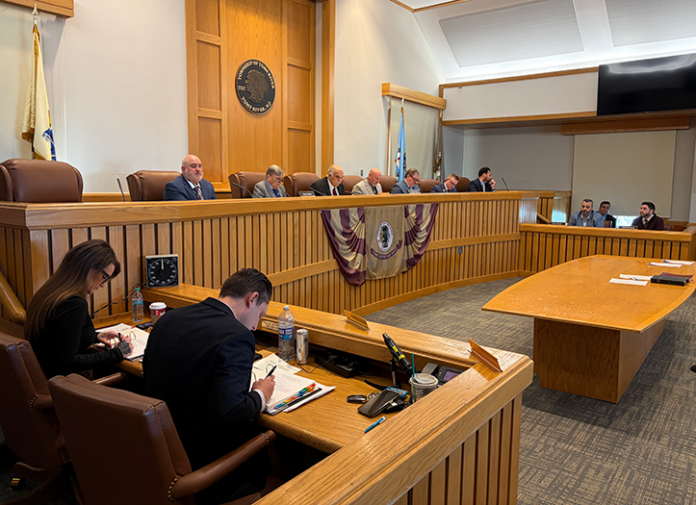
TOMS RIVER – Controversial rules put in place by the new majority leadership on the Township Council that would penalize elected officials if they left a public meeting has caused the first big political fight of the year.
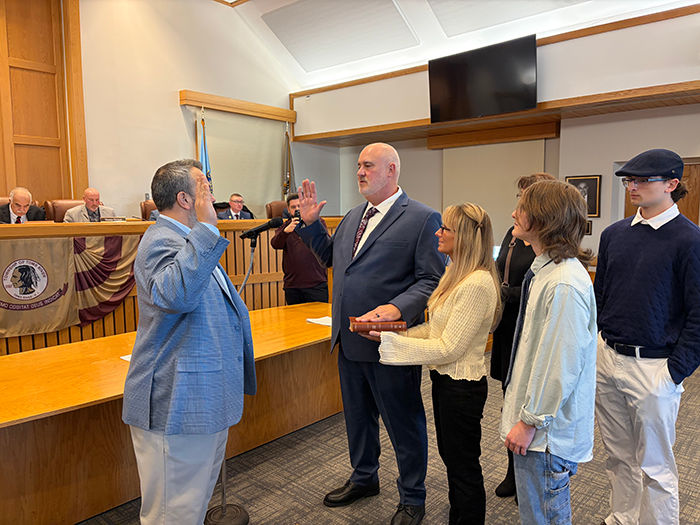
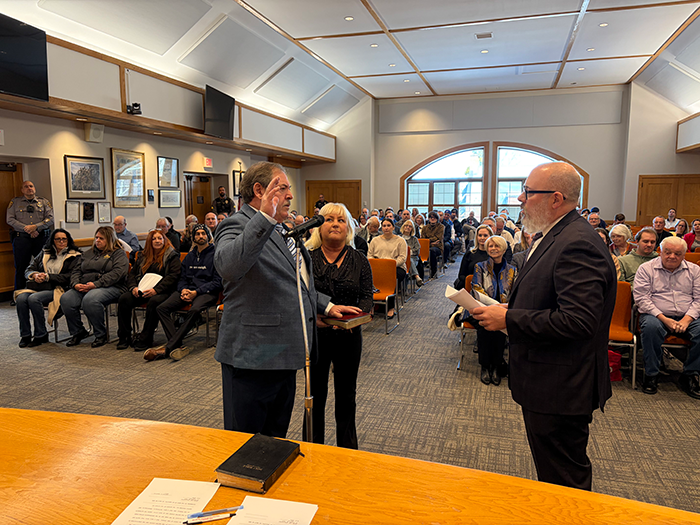
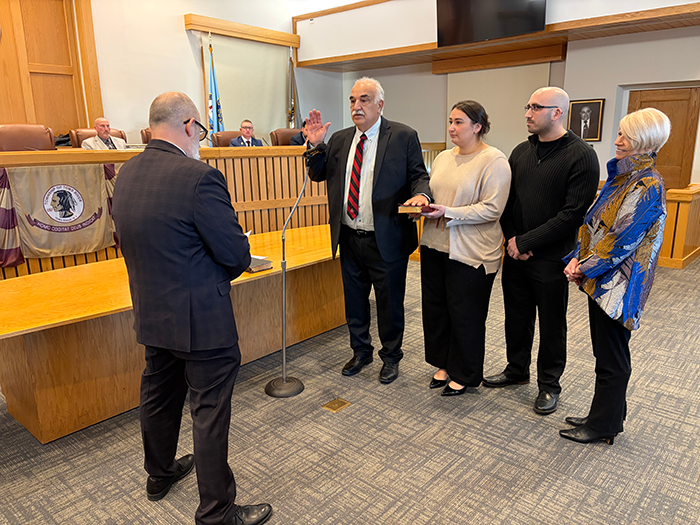
The first meeting of 2026 is a re-organization meeting, where council members who won the election are sworn into their new terms, and the council leadership positions are chosen. There is a rift between two Republican factions. Mayor Daniel Rodrick, his administration, and three council members (Craig Coleman, Lynne O’Toole, new member Harry Aber), are on one side and four council members (David Ciccozzi, Thomas Nivison, and new members Robert Bianchini and Clinton Bradley) are on the other. After the November election, the latter four council members now have a majority vote, which promises to create a power struggle between the council and the mayor.
The first significant votes of the meeting had no dispute. There were unanimous votes for David Ciccozzi to be the council president, who runs the meeting and sets the agenda. There were also unanimous votes for Thomas Nivison to be the vice president.
The most debated item was a resolution to approve a list of new rules and regulations for how to conduct meetings. The last two years have had a lot of shouting matches between elected officials.
Aber, Coleman, and O’Toole voted against it. Coleman said it violates State law and even the Constitution. But the new majority passed it.
Rodrick said that the limits that the council is putting on free speech are illegal and they should expect to defend them in court.
Decorum
In a section on “decorum,” the resolution describing the new rules notes that elected officials shouldn’t interrupt each other. They must be alert and focused on the entire meeting, including public comment. If a council member has to leave, they must notify the council president. The clerk shall take record of the early departure.
This part was the most controversial: “Any person who shall disturb the peace of the council, make impertinent or slanderous remarks or conduct himself/herself in a boisterous manner causing a disruption to the order of the meeting may be ordered to be removed at the discretion of the council president.” Anyone – including elected officials – who repeatedly disrupts the order of the meeting and fails to follow directions of the council president or the presiding officer may be in violation of township code and faces fines or penalties.
The portion of the township code that is mentioned here has this listed as penalties: “Any person violating any of the provisions of this article shall, upon conviction, be punished by a minimum fine of $250, but not exceeding $1,000, or by imprisonment not exceeding 90 days, or both, in the discretion of the court.”
Rodrick read a statement to the council, and sent it to the news media. Portions of it are below.
“What we are witnessing right now is an assault on transparency, accountability, and the basic principles that define the United States of America. The council majority has passed a set of rules that would force elected officials to sit through an entire meeting under threat of punishment – including up to 90 days in prison – simply for leaving early,” he said.
“Members of this council, and the mayor, have rights under township ordinance, under state statute, and under the United States Constitution. Participation in a meeting does not mean incarceration. Public service does not mean surrendering your freedom.”
“So why are they doing this? In my view, it has nothing to do with ‘decorum’ or ‘order.’ It has everything to do with control,” he said. “These rules are designed to force council members to sit through hours of orchestrated attacks – from the same small group of political allies and loyalists – who show up meeting after meeting to shout, insult, and intimidate. The goal is not public comment. The goal is exhaustion. The goal is submission.
“Another rule restricts the mayor’s ability to speak – making it nearly impossible for me to explain critical issues to the public. Issues involving your tax dollars. Issues involving contracts. Issues involving decisions that affect every household in this town.
“Ask yourself: why would anyone want to silence the mayor? In my opinion, it’s because there are things they do not want you to hear. They don’t want me talking about lucrative contracts handed to political insiders. They don’t want me asking questions about who benefits and who pays the price,” he said. “Instead, they want to frame the meeting, dictate what can be said and who can say it, and keep the public in the dark while business is conducted behind closed doors and contracts are handed out to the same connected names over and over again.”
“The Constitution does not exist for convenience. It exists precisely for moments like this – when those in power attempt to silence dissent, restrict speech, and coerce compliance. Freedom of speech does not mean ‘speech approved by the council majority.’ Freedom of assembly does not mean ‘you may leave only when we say so.’ And public service does not require surrendering your Constitutional rights at the door.”
“I have directed the township attorney to file with the Superior Court to ask for injunctive relief and declaratory Judgment in the coming week. These rules will not stand,” he said.
Ciccozzi responded about how during Rodrick’s majority rule, residents would be escorted out by police if they were determined to be disruptive.
In the discussion that followed, officials yelled at each other and over each other – Nivison and Ciccozzi on one side and Rodrick on the other.
“These are your people so you can hear the public comment,” Nivison said.
“You’re unfit, Tom,” Rodrick replied.
After the heated exchange, Rodrick left, as did Business Administrator Jonathan Salonis, Councilmen Aber and Coleman. Councilwoman O’Toole had called in to the meeting. She did not say anything the rest of the meeting and it could be assumed that she hung up.
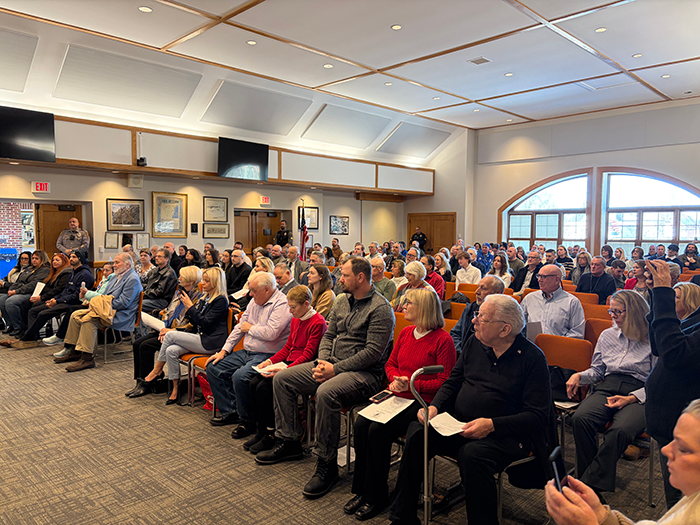
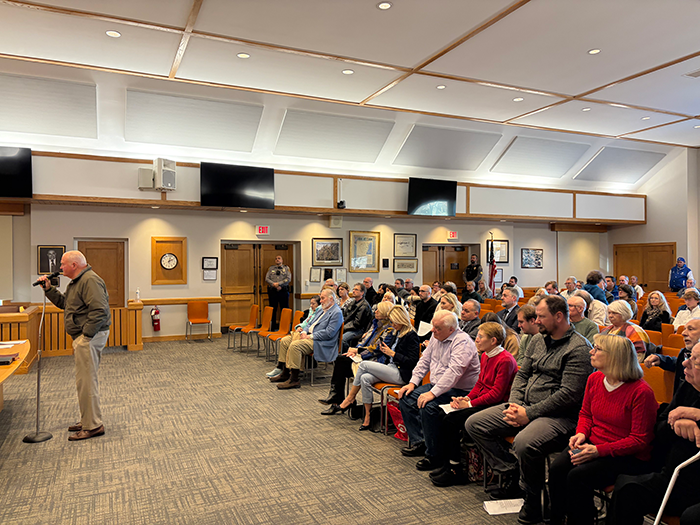
Next was the portion of the meeting where the public can comment about anything. Dennis Gallante, a stickler for procedure, said that the items the council votes on should be made available to the public, particularly the ones that were introduced from the dais and weren’t on the agenda.
“I think you way overstepped your bounds” to make it illegal for a public official to leave a meeting, he said.
There was one point where the township clerk was asked to read one of these new measures into the record, and Councilman Nivison had to give him a copy to read. There was a page missing, so Councilman Bradley had to give him the full version.
Some public points were business as usual. For example, asking for a road to be paved. There was a suggestion to put something on the town’s website where residents could report a street light that is out. Resident Julie Adamek has been adamant about keeping 18-wheelers off Cedar Grove Road. She said that it’s a county road, and the county wants the town to have a formal request, so she asked for a request for a weight limit on that road. Joseph Cocco said that by law the town is required to have a coordinator for compliance with the Americans with Disabilities Act.

Anne Hammil-Pasqua, a local attorney who is allied with the new council majority, said that there’s nothing in the new rules about people going to jail.
The assistant township attorney, John Penny, said that these fines and punishments could infringe upon Freedom of Speech as outlined in the U.S. Constitution.
“You’ve all been advised prior to the meeting,” about this, he said.
Dana Tormollan, a frequent critic of Rodrick, said even she thought criminal charges were going too far. She did criticize Aber for not being able to sit through his first ever meeting as an elected official.
“I want to set the record straight. It’s the council’s meeting and the mayor is a guest,” former Mayor Maurice “Mo” Hill said. “He’s there to answer questions.”
He asked how bills got paid in October since there was no meeting.
Tom Fredella, a frequent critic of Rodrick, said he agreed with charging people.
Gallante later came up again and asked if these new rules were run by an attorney.
Ciccozzi said that they had legal consultation on it. “It’s a matter of opinion and I believe it’ll be decided in court,” he said.
Gallante asked if it’s going to be put in the township code or will it be looked at again. Ciccozzi said all of his points will be addressed.
New Public Comment Rules
There are times that a member of the public can speak. One is during the second reading of an ordinance, and they can only talk about that ordinance. Another is an item on the consent agenda (see below). Finally, there is a portion of every meeting set aside for the public, and they can talk about any topic.
These will have a total time limit of 90 minutes. The previous council majority had limited the amount of time for the public session to 60 minutes.
Speakers will be allowed 5 minutes each, and can get another chance to speak for 3 minutes after everyone else has spoken. The previous council majority had limited this to 3 minutes per person. When Coleman was the council president in 2024, he was accused of enforcing this rule for people he disagreed with, but allowing people he agreed with to go over the limit.
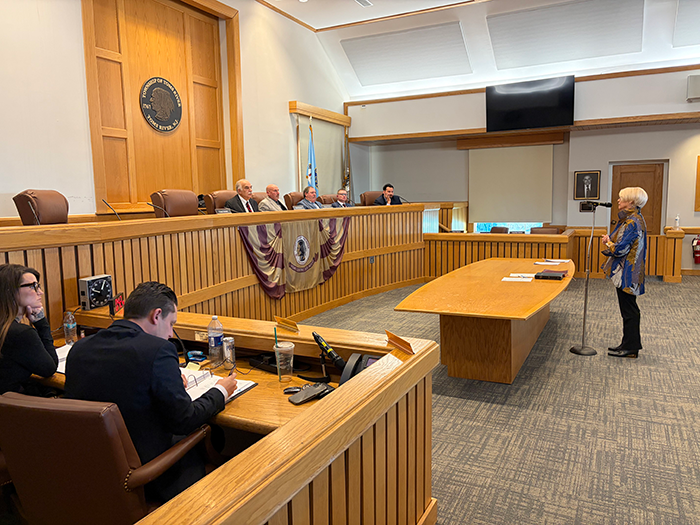
The amount of time that a township official spends responding to a resident’s question won’t be subtracted from the resident’s total. This had been an issue previously. A public official’s response to a resident can often be complicated, and can take up a lot of time. Also, sometimes this would devolve into a back and forth between elected officials with a resident standing there watching the clock tick by.
Council members will also have 5 minutes to speak. Their opportunities to speak are more frequent, basically any time they cast a vote. It is noted that the mayor is not permitted to comment during a roll call of the council vote unless granted permission by the council president (in Toms River’s form of government, the mayor does not vote on council matters).
“Should the mayor fail to refrain from interrupting, the clerk shall make note of the interruptions by the mayor in the minutes of the meeting. Should the interruptions continue to disrupt the order of the meeting, the council president may take further action to include requesting the mayor to leave the meeting, censuring the mayor by resolution, limiting the mayor to telephonic or virtual attendance for meetings, or barring the mayor from attending further meetings.”
This language was likely added because Rodrick often speaks up during meetings. He would say that as the head of the town’s administration, he knows everything that’s going on. Critics have said that his council allies didn’t know what was going on and didn’t know what they were voting for.
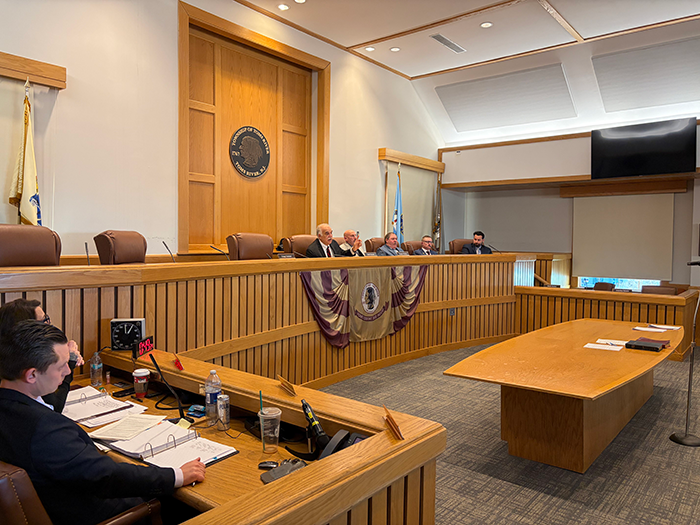
Council Seating
The resolution states “Council seating shall be established at the reorganization meeting and strictly adhered to unless otherwise changed by a majority vote of the full body of council.”
It is common practice for a council majority to seat the opposition in ways that works against them. For example, at the Brick re-organization meeting a week later, the three Republicans (the minority party) were not seated together. During Toms River’s re-organization meeting, the three Republicans in Rodrick’s camp were seated as far away from him as possible. Last year, Ciccozzi, Nivison and James Quinlisk were the minority party, and they were separated by other council members and even the township attorney.
Coleman said his reading of it was that the council would control audience seating, although the audience isn’t mentioned in this part of the resolution. He also didn’t understand what difference it made where each council member sat on the dais.
“The last time I was told what seat to sit in and ask permission to move, I was in kindergarten,” Coleman said.
Meetings And Bills
The council only had one scheduled meeting a month at the beginning of last year, although things changed. They didn’t meet at all in October. A few extra meetings were scheduled as needed.
In 2026, there will be only one meeting in June, July, August, and November. There will be two for the other months.
There will be agenda meetings for the council to discuss issues informally without voting. The mayor can only attend if invited, or if he requests it and his permission is granted.
There was an item on the agenda about what members of the administration are allowed to pay town bills. This came up before the elected officials left.
Bradley said that if they are having two meetings a month, they can pay the bills more frequently.
The Township Clerk, Stephen Hensel, told the council members that this resolution is on the agenda every year.
Peter Pascarelli, a township attorney, said that this is important for utility bills or other items when the town would have to pre-pay.
“Utility bills come whether you have a meeting or not,” Rodrick added.
Pascarella would leave the meeting partway through the public portion. Penny said Pascarella’s last day representing the council is February 29.
Agendas
Other rules will dictate how the agenda is formed and how meetings are run.
There are rules for department heads giving their opinion on township matters.
The policy covers how an item gets placed on the agenda, including emergency items.
The consent agenda has been controversial during the last few years. The consent agenda is a list of items that are often mundane, having to do with the general running of the town. They are so routine that they are lumped together for one vote to save time.
However, council members have always been able to ask that an item be pulled from the consent agenda if they want to talk about it further or if they want to vote differently for it than the rest of the group. They will still be able to do so. The public can also ask for items to be pulled out for consideration. Now, they will be allowed to comment on them.
The items won’t be read in their entirety during the meeting, but will be listed in their entirety in the minutes, if they pass.
Another sentence of note is “The council may table any item where sufficient information is not provided by the mayor/administration to vote on any item.” In past years, the anti-Rodrick council members have said they were not told details of items before voting on them.
There have been issues with meetings not being recorded or being cut off, which has led to this rule: “All council meetings will be recorded by the township and live streamed via the township YouTube channel. All council meetings are to remain on the YouTube channel for the public to view and access.”
There’s description of what constitutes a conflict of interest. An unusual part is that “to avoid the appearance of undue influence, the recused member should physically leave the dais or the room during the deliberation and vote on that specific item.” Usually, in a conflict, the council member would just say they abstain on a vote because they have a conflict. They were not required to explain what that conflict was, although they sometimes did.
The resolution specifies a council member must recuse themselves from a vote if the professional or vendor provided personal services to themselves or immediate family within the last 24 months. They can’t vote on any invoice for that professional or vendor if there’s been $1,000 or more of services within the last 24 months.
More Rules
The council president may appoint a sergeant-at-arms for meetings who will carry out all orders by the council president to maintain order.
The public and politicians are welcome to state their positions “in an atmosphere free of slander, threats of violence or the use of meeting as a forum for politics.” If anyone violates the rules of decorum, the council president can cut them off.
While slander and threats have legal definitions, it might be unclear to determine what kind of speech is determined to be “a forum for politics.”
Some rules seem generic on the surface, like officials not using cell phones. However, Rodrick has been accused of sending directions to council members and staff, which is likely the reason for this rule. These accusations have not been proven. Another sentence that seems to target this is: “Any communications will be subject to disclosure and included in the minutes of the meeting.”
There are rules about what happens if a council member has to miss a meeting, and how to accommodate their request. If present, they must be “fully focused on the meeting and maintain an on-screen presence.”