HOLGATE – It starts with a slap. Then another. Within minutes, a summer beach day along the Jersey Shore can turn into a scramble for cover. Umbrellas close, coolers are packed, and flip flops shuffle quickly toward the dunes.
The cause isn’t a shark in the surf but a change in wind direction, from east to west, carrying swarms of greenhead flies from the marshes onto the sand. With iridescent eyes and a painful bite, the insects can drive many beachgoers off the shoreline when conditions are right.
Nature’s Summer Pests
The salt marsh greenhead fly is considered one of the Jersey Shore’s most persistent seasonal nuisances. Rutgers University researchers began studying their feeding behaviors in 1972, building on earlier work from 1967 that examined the influence of weather on activity patterns.
Only the females bite, using scissor-like mouthparts to pierce skin and draw blood needed for egg production. Greenhead flies do not transmit disease, but their bites can be painful, itchy, and may trigger allergic reactions or, in some cases, infections.
Rutgers studies have documented peak summer days where a single trap collected more than 1,000 flies in one hour. Populations tend to surge in July, but activity can extend from late June through September. The most active periods often coincide with hot, humid weather and winds blowing off the marsh.
Greenhead flies are attracted to both humans and large animals such as cows and horses. Birds, bats, and dragonflies prey on them, but natural predators alone do not substantially reduce their numbers. Research from Rutgers and greenhead control programs in Massachusetts show that traps, when strategically deployed, can help manage populations and lessen their impact on recreational areas.

Holgate’s Trap Program
Holgate is the only community on Long Beach Island with an organized greenhead fly trap program. At one time, scouts built traps in Barnegat and Little Egg Harbor, but those are no longer maintained.
Randall Pearsall, president of the Holgate Taxpayers Association (HTA), said the program began nearly 30 years ago. “A couple of local residents, Cliff and Jill Denker, were talking to Bill Hudson, who owns Lorry’s Island End Motel,” Pearsall said. “They’d had some bad days, and it affected his business and everyone else’s ability to enjoy the beach.”
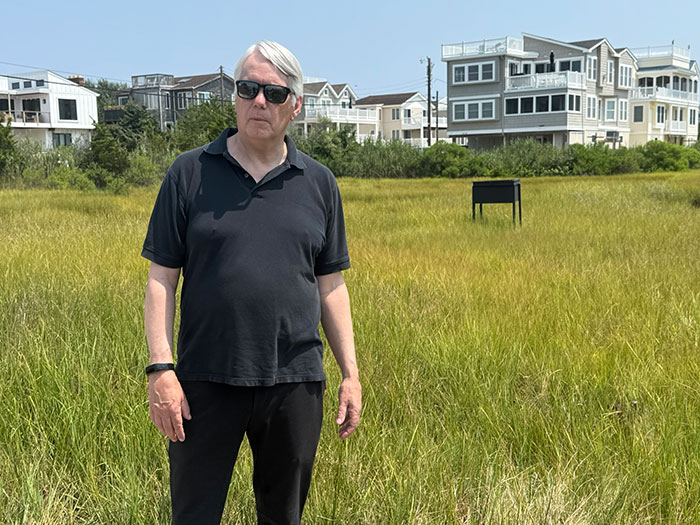
After learning about a successful greenhead program in Massachusetts, the group adapted the idea for Holgate. Following Rutgers guidelines and Massachusetts techniques, the HTA developed its own traps. Today, two styles are used: a cylindrical design and the more common large, black wooden boxes set on legs in the marsh.
Painted dark to absorb heat, the boxes mimic the size and warmth of a large animal, a primary target for biting female flies. Many are baited with octenol, a scent compound that smells like animal breath or human sweat, to increase their effectiveness. Once a fly lands, a V-shaped screen guides it into a collection chamber, where it becomes trapped and eventually dies.
Some have proposed making the traps less visually intrusive. “One of our residents suggested painting the traps to look like cows,” Pearsall said. “From a distance, it could make the marsh look like a little sculpture park instead of a field of black boxes. We’re thinking about stenciling plywood panels to give them a more animal-like appearance – something more pleasant to look at.” Pearsall said any such changes would be cosmetic and would not reduce the trap’s function.
Maintaining The Program
The trap program requires ongoing upkeep. Over time, many older traps deteriorated beyond repair, and fewer volunteers were available to maintain them. Recently, new volunteers removed damaged traps from the marsh and refurbished those that could be salvaged.
The HTA also purchased new traps built by local resident Tom Beaty, a semi-retired craftsman who constructs them as a side business. Homeowners interested in placing a trap on private property are referred to Beaty, and the association purchases from him for community locations.
Trap costs range from $100 to $250, depending on materials and order size. Marsh traps are typically made from pressure-treated wood to withstand water exposure, while traps for backyards can be made from untreated lumber.
Seeking Government Support
While Holgate’s trap program relies on local volunteers and funding, Pearsall has advocated for expanding efforts to the mainland, where large marsh areas serve as breeding grounds for greenhead flies.
At a recent Ocean County Board of Commissioners meeting, Pearsall presented the idea. Commissioner Jennifier Bacchione acknowledged the issue. “Even Bayville is bad,” she said. “I had an infection from a bite last week. It’s very bad out on the water, and it’s killing our beaches.”

Ocean County Business Administrator Michael Fiure said the county is reviewing options. State legislation could also play a role. In January 2022, then–State Senator Christopher Connors introduced a bill that would have appropriated $50,000 to empower New Jersey counties to authorize mosquito extermination commissions to run programs targeting greenhead flies. Modeled on Rutgers’ trap design, the bill called for grants through the Department of Environmental Protection to manufacture, place, and maintain traps. The measure did not advance out of committee.
In 2024, State Senator Carmen Amato reintroduced the bill, which is now under review by the Senate Community and Urban Affairs Committee.
Seasonal Reality
Even with a network of traps, there is no way to completely eliminate greenheads from the shoreline. West winds can still bring days when the flies are out in force.
In the meantime, Holgate’s greenhead defense rests on its roughly 100 traps and the volunteers who build, bait, and store them. Residents report fewer flies in areas where traps are in place, though conditions vary with weather and wind.