BARNEGAT LIGHT – To most passersby, one front yard on Bayview Avenue in Barnegat Light looks like a child’s dream playground – a giant sandbox. But those in the know understand that the sandy plot serves a far more vital purpose.
This isn’t a playground – it’s a maternity ward.
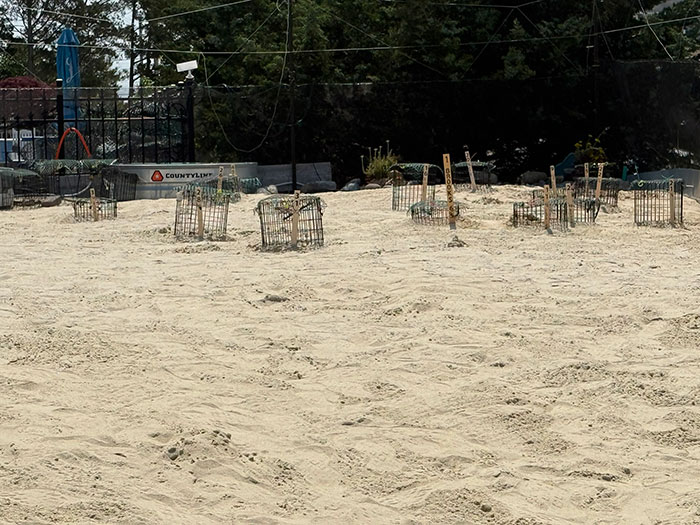
Thanks to the generosity of homeowners Lisa and Michael Dolan, the front of their bayside property has become a haven for one of Long Beach Island’s most vulnerable residents: the northern diamondback terrapin. Here, dozens of female terrapins emerge from the water each season to lay eggs in the warm sand – under the careful watch of a dedicated group of volunteers known as the Terrapin Nesting Project.
Kathy Lacey, an environmental scientist and herpetologist, launched the project in 2011 after a personal battle with cancer. Long before that, she considered Long Beach Island her “stomping grounds,” even as life took her to Pennsylvania. Lacey’s roots here run deep – her brother owns a local diner, her sister sells real estate, and she herself remains fiercely connected to the area’s ecology.
Lacey recalled the first time she became concerned for the diamondback terrapins dated back to 1984, when a building moratorium in the area was lifted. “I was very aware of the problems the turtles were having,” she said. “They took over all that property in High Bar Harbor, and in the process, replaced the natural sandy beaches with hardscaping.”
The change had an immediate and devastating effect. “The terrapins were having a terrible time,” Lacey continued. “After that, there were basically no hatchlings left in the bay.”
Years later, Lacey came down to the island with her husband. The two noticed assorted eggshells on top of the sand, which meant the eggs did not incubate and hatch. “Predators like raccoons or crows had dug them up and eaten them,” Lacey explained. “My husband said, ‘Kathy, you should do something about this.’”
“He could kick himself ever since,” smiled Lacey. “Because that meant me saying ‘bye dear’ as I went off to the shore.”
Initially backed by the Sierra Club and armed with a determination as strong as a turtle’s shell, Lacey began knocking on doors, educating residents about the disappearing terrapin population. Most hadn’t realized the turtles were even in trouble. That first year, she collected 228 eggs, and 225 hatchlings made it into the bay.

A Community Of Volunteers
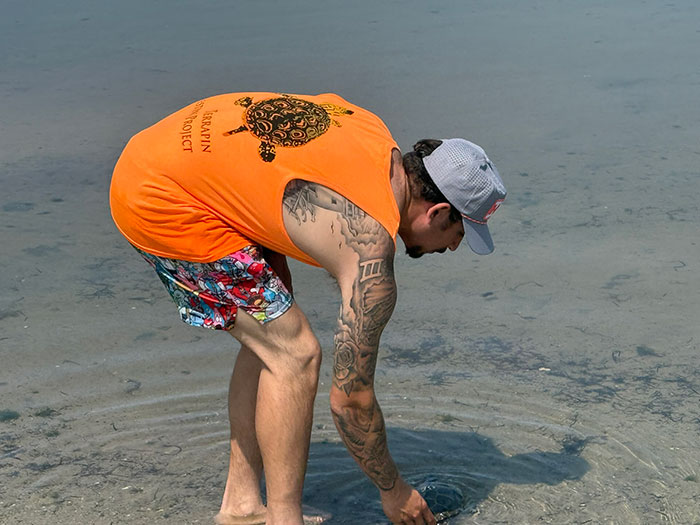
The Terrapin Nesting Project now boasts dozens of active volunteers, each playing a vital role. From May through July, they patrol neighborhoods for nesting females, rescue eggs from high-risk spots like roadsides, and tend to the protected hatcheries. The group monitors the eggs through their 60-to-90-day incubation period – timed with the hottest days of summer – and releases the hatchlings into the bay once they emerge.
“The volunteers are extremely devoted to the terrapins, the project and the ecology,” said Lacey. “Some have been there from the very beginning. Many show up four days a week and even come in from the mainland.”
Lacey is meticulous in her approach. Each turtle gets a name, location record, and – a tiny PIT (Passive Integrated Transponder) tag implanted under the skin. These chips help prevent poaching and track the turtles’ growth and migration.
One recent entry: a terrapin named Lilabeth, discovered on 25th Street and noted as “gravid” – a scientific term for carrying eggs. Her shell showed remnants of barnacles, an indicator of her time spent in the water.
Lacey said that she’s probably worked with almost every one of the 350 different species of turtles and tortoises. “If you picked up any other turtles while they were trying to nest and put them on sand, they certainly wouldn’t nest for you,” she shared. “They’d run in the opposite direction. For some reason, these girls need to know we’re trying to help them.”
Kyle Kuren serves as Lacey’s latest intern and shows up regularly to work on the project. A recent Caldwell University biology graduate and third-generation reptile enthusiast, Kuren brings some serious experience to the project. He’s had 500 hours of veterinary work, mostly with reptiles, including time at the Bronx Zoo.
The Terrapin Nesting Project operates under strict permits from NJ Fish and Wildlife – an agency Kuren hopes to work for in the future.
Diamondback Terrapins: Vital And Vulnerable
Diamondback terrapins are native to the brackish waters of the bay, where saltwater and freshwater meet. Unlike sea turtles, they don’t travel great distances and instead stay close to shore, often within a few miles of their hatching spot.
Adult terrapins are natural scavengers, eating crustaceans, fish remains, and even excess periwinkle snails. As hatchlings, they feast on mosquito larvae and algae in the marshes.
The females – larger than their male counterparts – crawl out of the bay between late May and July to dig nests and lay around a dozen eggs per clutch. Their survival depends on warm sand, protection from predators, and, increasingly, human intervention.
“Predators like raccoons, crows, and foxes can wipe out an entire nest,” said Lacey. “Then you have habitat destruction from roads and development. And on top of that, people still poach these animals for food or the exotic pet trade.”
Nature’s Own GPS
The nesting site in Barnegat Light is not just convenient – it’s scientifically significant. A second site is maintained on High Harbor Bay. Many of the females born on either site return to lay their own eggs in the same place a few years later.
“They remember the general area where their mother nested,” Lacey said. “And since we’ve had this site since 2016, some of the earliest hatchlings are now coming back to nest.”
To avoid overpopulation, Lacey discourages volunteers from relocating turtles from far-off spots. The goal is to sustain, not overwhelm, the habitat.