BARNEGAT – The Township Committee is scheduled to hold a special meeting on March 21 at 11 a.m. to give final consideration to reinstating the township’s Rent Leveling Board.
Authorities will have the second reading of the ordinance that would bring back the Rent Leveling Board, with some modifications compared to the original local law repealed in December 2023. Following a public hearing on the proposed reinstatement, Committee members will cast their final vote on the ordinance’s passage.
Established decades ago, Barnegat’s Rent Leveling Board acted as a first step for residents and the corporate owners of two manufactured home communities to work out rent increases. Brighton at Barnegat and Pinewood Estates residents are considered tenants even if they own their homes because they lease their land and pay rent to the corporate owners who are considered their landlords.
If the ordinance is approved, each of these mobile home parks will again be represented on the Board by a landlord representative and a tenant representative. Local resident John Murrin oversaw the Rent Leveling Board as its chairman before its dissolution in December 2023.
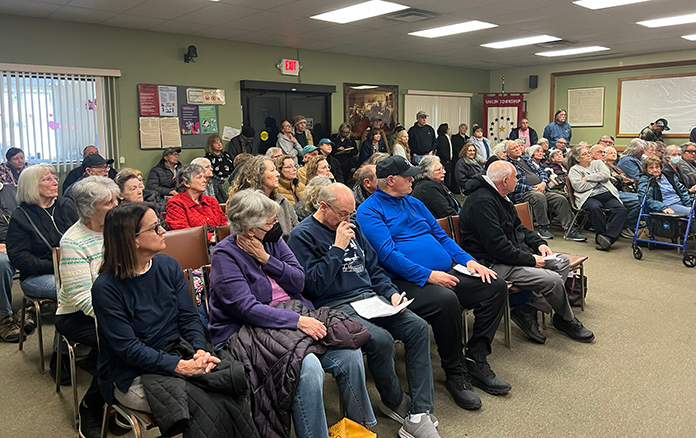
The decision to repeal the ordinance took many by surprise and sparked protests from residents of both communities who felt the board protected them from unreasonable rent hikes. However, both parties have the right to appeal board mandates in New Jersey Superior Court.
When news emerged that RHP Properties, the corporate owner of Pinewood Estates, had filed a lawsuit in opposition to one of the board’s decisions, some residents suspected a connection. However, RHP’s attorney dismissed that assumption at the first reading of the proposed reinstatement of the ordinance on March 5.
“I’ve been representing this property since 1978 when rent control was first adopted, so I’m thoroughly familiar with the history of the ordinance,” said Attorney Christopher Hanlon. “The ordinance was repealed apparently in December of 2023. It was a surprise to us.”
Hanlon said he was aware that the governing body met with local residents – their constituents. However, he emphasized the importance of considering all stakeholders’ perspectives. He highlighted the challenges faced by landlords in maintaining properties under existing regulations, advocating for dialogue between the township and property owners.
“We are involved with operating a multi-million dollar property, and this is a very significant aspect of the operation,” Hanlon stated. “The only significant income out there is from rentals, and the only way we can address that income is through an ordinance if you pass it.”
One of the challenges Hanlon said his client faces is asking for rent increases for what he termed “recapture increases” for capital improvements or utilities where the company has already spent the money.
“You have to deal with a budget to operate this town and you’re responsible for maintaining the infrastructure,” said Hanlon to the governing body. “What if you had to pave a road for safety issues and someone said ‘we’re not going to let you recover the money through tax increases?’”
Unlike Pinewood Estates, Brighton at Barnegat has worked out an agreement with their landlord that covers a number of issues. The neighboring manufactured home community only goes to the Rent Leveling Board for matters not covered as a result of prior negotiations.
Deputy Mayor Alfonso “Al” Cirulli suggested that Pinewood Estates might want to consider a similar tactic and meet with the tenants to come to some resolution.
“You need to have a meeting with the residents, listen to their concerns,” said Cirulli. “Then start addressing them or come to some kind of agreement.”
“These are our residents, and we have to be there for them,” Cirulli continued. “Not just Pinewood – but everybody. We have to stand with them. There’s a lot that can be accomplished if everyone sits down together.”
Hanlon said that Cirulli had made a valid point as far as community relations, which he felt was better served with no attorneys in the room.
Less than six weeks after dissolution of the Rent Leveling Board, Pinewood Estates residents received notification of a rent increase to bring them to market rates. Most tenants, who are on month-to-month leases currently paying $353.10, were informed that RHP, the corporate owner, intended to almost double the rent by $309.32 to $662.42. However, the announcement included a “loyalty discount” of $289.42 for existing tenants, bringing their new monthly rate to $373.00 starting April 1st.
While the $20 increase might not seem excessive, it follows another increase just months ago. Tenants were advised that the loyalty discount only applies to those who pay their rent on time. Furthermore, the discount wouldn’t apply to new residents who purchase homes within the community, who would be charged the full $662.42 rate.
An informed source who requested anonymity claims a local representative for RHP offered no written guarantee regarding the duration or potential reduction of the loyalty discount amount. RHP corporate officials were contacted for clarification of the loyalty discounts and said they had nothing to add in the way of commentary.
Township Attorney Christopher Dasti indicated that most of the proposed new ordinance mirrors language in the previous one. Landlords would be allowed to request increases based on utility costs and tax increases. Additionally, landlords would be entitled to yearly increases tied to either the Consumer Price Index or 3.5% of the previous year’s rental income, whichever is lower.
Landlords can also seek additional charges for major improvements as specified within the ordinance.
Most rent increases would require approval from the Rent Leveling Board, which would be required to hold a hearing within 30 days of receiving a complete application. Landlords facing financial hardship could also appeal to the Board for a special rent increase.
When a lease for a mobile home space ends, landlords can’t ask for more money from tenants, whether they’re new or existing, beyond increased utility costs for the landlords or any increased fees charged by the township for the mobile home space.
Tenants, whether new or existing, won’t face rent increases beyond a certain limit in any twelve-month period after their lease ends. This limit is based on the increased costs mentioned above.
If it passes, the ordinance will retroactively take effect from January 1, 2024.