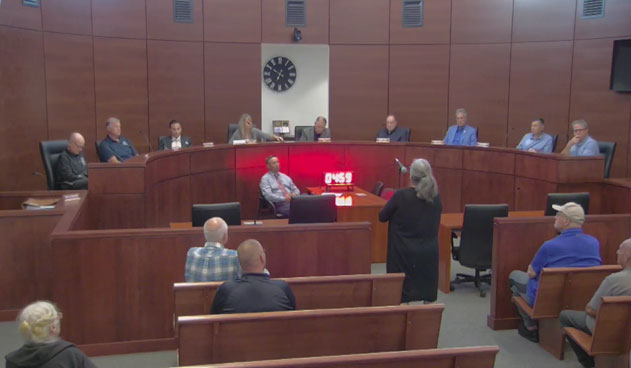
BARNEGAT – New Jersey’s new law capping rent increases for manufactured home parks was front and center at the most recent Township Committee meeting, when Pinewood Estates resident Lorraine Ferraro urged officials to bring back the township’s Rent Leveling Board.
Ferraro told the governing body she believed a board was needed to monitor landlords and protect tenants across the community. She initially called for an ordinance that would limit rent leveling at 3.5 percent from January 2026 until that portion of the new law goes into effect on March 1, 2026.
“This wouldn’t cost the township anything, and this would protect not just Pinewood or Brighton,” Ferraro submitted. “This would protect all renters in your township at no cost to you other than the simple two meeting reading to adopt an ordinance.”
The local ordinance historically only applied to manufactured home parks, not apartments or single-family rentals. Locally, that meant oversight of rent increases at Pinewood Estates and Brighton at Barnegat, the township’s two manufactured home communities.
That scope is now addressed under P.L. 2025, c.85 (A3361 3R ACS), signed by Governor Phil Murphy on July 1, which limits rent increases for manufactured home park tenants to 3.5 percent over a 12-month period.
Mayor Alfonso Cirulli said that consideration of creating a more extensive rent protection ordinance was not something the governing body was prepared to put into effect. “It would be monumental to go past the mobile home parks,” he said. “We could not handle that.”
Township Attorney Chris Dasti took the microphone to clarify the law’s reach and residents’ options. “You just can’t set a cap and say that’s the cap,” explained Dasti. “Because that’s unconstitutional (under the 14th Amendment.)”
New Jersey’s approach to rent regulation is largely determined at the municipal level. Most of the communities that have some form of rent control or rent stabilization are typically larger municipalities. Ordinances differ from town to town. Rent stabilization generally allows for formula-based increases tied to inflation.
New State Law
There are no state laws that limit rent increases in New Jersey, with one new exception. The law signed into effect by Governor Phil Murphy on July 1 caps annual rent increases for manufactured home tenants at 3.5 percent. The law applies statewide, covering every manufactured home park from Sussex to Cape May.
The road to passage wasn’t straightforward. Legislators initially approved the bill with 3.0 percent increases. However, Murphy first sent the bill back with a conditional veto, citing concerns that it went too far in preempting municipal control and not far enough in addressing landlords’ rising costs.
“The bill does not properly account for the broader economic realities that are likely to impact a landlord’s ability to maintain or reinvest in manufactured home parks, including inflation and rising operating costs,” the governor wrote, warning that without changes, landlords might lack the resources to maintain and reinvest in their communities.
He also insisted that tenants must have the right to see documentation when landlords ask for increases beyond the cap, and that towns with existing rent boards should keep authority in those cases.
Lawmakers accepted the governor’s changes, raising the cap from 3 percent to 3.5 percent, requiring proof from landlords, and preserving local jurisdiction where stronger protections already exist.
For manufactured home residents throughout the state, the law offers more uniform certainty. People or entities that own or manage manufactured parks are referred to as landlords under the new legislation. Landlords cannot impose sudden steep hikes without oversight, even if there are not rent boards in their communities. A landlord who wishes to increase rent in excess of the 3.5 percent cap must receive approval from the state’s Commissioner of Community Affairs. There are also penalties for landlords who do not abide by the rules.