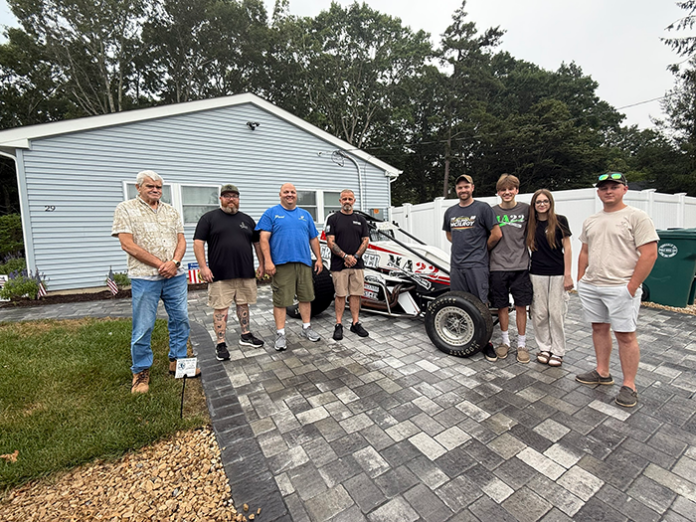
LITTLE EGG HARBOR – The sprint car sitting in the driveway outside Larry’s Home promised an evening of roaring engines and dirt-track excitement. Inside the house, however, the quieter moments revealed what the day was really about.
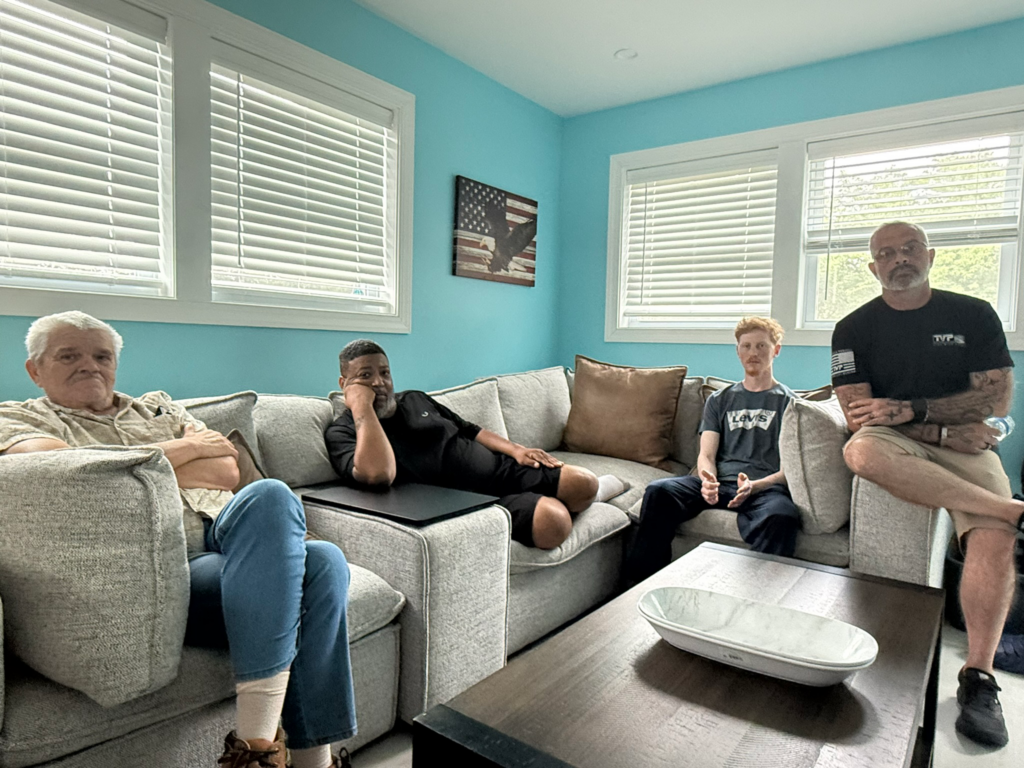
Veterans of different generations sat together in the living room. Others leaned against countertops and gathered around the island sharing lunch with members of Aleks McIlroy Racing, active-duty personnel from Joint Base McGuire-Dix-Lakehurst and a volunteer from Ma Deuce Deuce (MA-22). The conversation bounced effortlessly between military service, racing, careers and family. Laughter came easily, but so did something less obvious.
One veteran wasn’t quite ready to join the conversation. Army National Guard veteran Andrew Irwin, 24, lingered near the edge of the room, listening more than speaking. No one called him out or urged him to participate. Instead, another resident quietly explained what was happening.
“Everybody takes care of everybody in their own way,” Army veteran Tim Timberlake, 51, said. “You learn when somebody needs conversation and when somebody just needs space.”
Within a short time, Andrew eased into the discussion.
Watching the interaction, it became obvious that Larry’s Home is already fulfilling the vision Just Believe founder Paul Hulse had when he built the transitional residence in memory of his lifelong friend, Army veteran Lawrence “Larry” Robertiello. Hulse never intended the house to be simply a place where veterans could sleep. He wanted it to recreate something many veterans lose after leaving military service – the camaraderie of knowing someone always has their back.
Last week’s outing to Bridgeport Speedway offered a clear glimpse that the dream has become reality.
A House Built On Brotherhood
Larry’s Home grew out of one of the most painful experiences of Hulse’s life. Robertiello, who served two tours in Iraq, returned home carrying invisible wounds before dying in 2022 following struggles with PTSD and addiction. Hulse promised Larry’s mother that her son’s story would not end there. Instead, it would become the foundation for a place where veterans facing their own battles could rebuild their lives with dignity, support and hope.
The four-bedroom home opened less than a year ago as transitional housing, offering veterans up to a year to stabilize their lives while working with case managers to secure employment, permanent housing and veterans benefits.
Throughout the afternoon, the veterans spoke candidly, joked, and laughed about evenings around the backyard fire pit while instinctively looking out for one another. When Andrew appeared hesitant to speak, the others quietly let him settle in at his own pace. No explanation was necessary because they already understood.
Timberlake said the atmosphere reminded him of military life itself. “It’s really a microcosm of military life,” he said. “You have people from every race, creed, personality, culture, age and region of the country. Even if I don’t like you, I know you’re still going to be there when I need you. And vice versa.”
That lesson, he said, begins the day someone enters military service, regardless of why they enlisted. As the conversation unfolded, each veteran described a different path into uniform.
Tom Mauro, 48, joined the Army because he wanted to become a police officer or firefighter and knew his family couldn’t afford college. Mike Fortuna admitted the steady paycheck initially appealed to him before patriotism gradually became part of the equation. Irwin entered the Army National Guard at 17 looking for life experience.
Timberlake’s answer reflected how circumstances can change. He initially enlisted because he had a young child and wanted to build a better future for his family. After the September 11 terrorist attacks, however, his motivation became deeply personal as relatives working in New York City and at the Pentagon were directly affected.
“Everybody has a different reason,” Timberlake said. “Some people join for college. Some people need a job. Some people want to serve. But once you’re in, none of that matters anymore.”
That shared understanding often disappears after veterans return home, leaving many feeling isolated from people who have never experienced military life, he said.
Mauro knows those struggles firsthand. After serving eight years between active duty and the Army National Guard as a combat medic, he went on to careers as a sheriff’s officer and volunteer firefighter. Looking back, he said the cumulative trauma from those professions contributed to PTSD and alcoholism.
“The biggest battle wasn’t being over there,” Mauro said. “It was being home.”
Today, Mauro serves as house leader while completing certifications as a Certified Recovery Support Practitioner and Certified Recovery Specialist. He hopes to eventually return to Florida and work for the veterans treatment program that helped him rebuild his own life.
Around the house, however, his impact is already obvious. “If we have any problems, we go to Tom,” Fortuna said. “Tom helps us out. He cooks for us.”
The 79-year-old Navy veteran, who served during the Vietnam era, paused and looked around the home. “This is paradise compared to where we came from.”
Taking The Mission To The Racetrack
The Saturday trip to Bridgeport Speedway grew out of another partnership built on military service.
The outing was organized through Ma Deuce Deuce (MA-22), a veteran nonprofit that includes 13-year Air Force veteran Jay Hayden, together with Aleks McIlroy Racing. The organization’s name references the long-cited statistic that an average of 22 veterans die by suicide each day while using the military nickname for the M2 .50-caliber machine gun. Through events like this, MA-22 seeks to reduce isolation by reconnecting veterans with one another.
The MA-22 logo appeared prominently on Aleks McIlroy’s sprint car parked outside Larry’s Home, symbolizing more than sponsorship. It represented a shared commitment to ensuring veterans never feel they are fighting their battles alone.
“It’s clear that it takes a team,” Hayden said when Larry’s Home opened. “Regardless of what side of the aisle you’re on, or what organization you’re with, we have an obligation to help our veterans.”
Marine Corps veteran James McIlroy immediately understood why the partnership mattered. Racing, he said, had helped him through difficult periods in his own life.
“When I struggled, one of the things that got me through was racing,” he said. “A buddy of mine owned a sprint car, and we’d load up and drive halfway across Pennsylvania. It gave me a totally different sense of camaraderie. The only thing I could equate it to was my time in the military.”
Rather than simply watching from the grandstands, the veterans received pit passes and spent the evening alongside the team. “When you’re standing in the pits watching the car you just worked on, you’re invested,” McIlroy said. “You’re not just a fan sitting in the stands anymore.”
The race lasted only one evening, but the relationships built inside Larry’s Home continue long after the checkered flag falls. Nearly a year after welcoming its first residents, the house built in Larry Robertiello’s memory has become exactly what Paul Hulse envisioned: not simply a place for veterans to live, but a place where they belong.