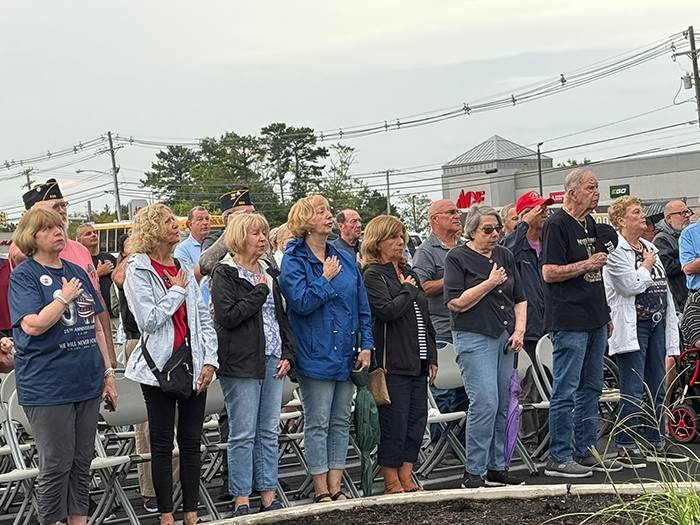
BARNEGAT – The skies cried intermittently as Barnegat marked 25 years since the September 11 terrorist attacks. Residents gathered outside Town Hall to remember the nearly 3,000 people killed and hear from those who carried memories of the day from the ground and the sky.
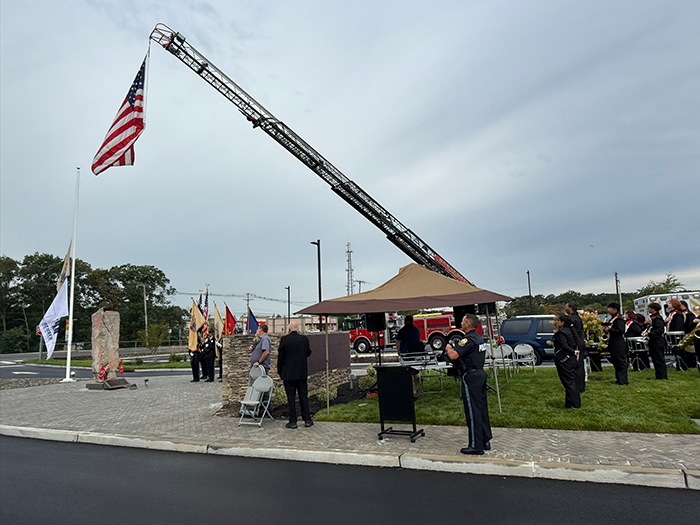
A large American flag hung from a Barnegat Fire Department truck, creating a towering backdrop for what appeared to be one of Ocean County’s most extensive commemorations. The ceremony brought together local officials, first responders, veterans and students, including members of the Barnegat High School NJROTC and marching band.
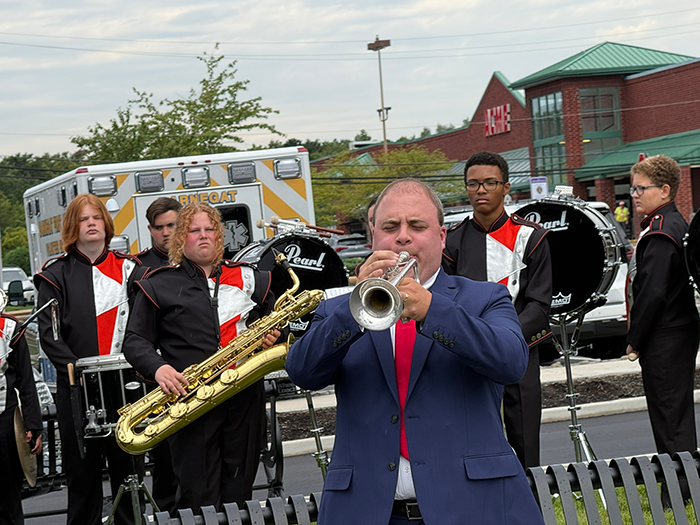
The ROTC joined the Barnegat Police Department Color Guard for the presentation of the colors. The Barnegat High School Marching Band played patriotic music, and Band Director Dan McGrath performed “Taps” as the crowd stood in silence.
For Deputy Mayor Fred Rubenstein, who organized the ceremony, the anniversary was more than a date on the calendar. Rubenstein was working in the administration of then-New York City Mayor Rudolph Giuliani when the first plane struck the World Trade Center.
An eight-minute subway delay may have saved his life. Rubenstein had been scheduled to attend a 9 a.m. meeting at 7 World Trade Center. Instead, he was near City Hall when American Airlines Flight 11 struck the North Tower at 8:46 a.m. He remained in Lower Manhattan when United Airlines Flight 175 hit the South Tower 17 minutes later.
“There was no script,” Rubenstein said. “Nobody had ever done this before. We didn’t have readiness drills. So, what did we do? We went. We tried to help people.”
Rubenstein returned to the site to search through the wreckage, digging with his hands and shovels whenever someone believed there might be signs of life. Some of his friends never came home, and the effects of the time he spent at Ground Zero followed him long after the fires stopped burning. Like thousands of first responders, recovery workers and volunteers, he later developed illnesses associated with exposure to the toxic air.
Ground Zero
Retired Barnegat Police Officer Steve Tatur accompanied Rubenstein to the World Trade Center site. Before speaking, Tatur dedicated his remarks to New York City firefighter Paul J. Pansini of Engine Company 10.
Tatur said he made a promise to a Barnegat High School student years ago that Pansini would not be forgotten. “I never will,” he said.
He said he went to New York City to help in whatever way he could while representing the Barnegat Police. One of his most enduring memories was the color of the people working at Ground Zero. “They were all gray from debris and dust at the site,” Tatur said. “In those moments, I thought, ‘This is how God sees us as the same.’”
“We are all God’s children, and that is the most important identifier of all,” he added.
Tatur spoke about the thousands who have developed cancer and other illnesses since working at the World Trade Center site. Many have died, while others continue fighting to survive.
“I have never met anyone in an oncology department speak about politics,” he said. “They speak about their families, their friends and their dreams. They do so with incredible courage and conviction every day.”
“I hope the kindness of one’s heart becomes an epidemic, like it was 25 years ago,” Tatur said. “If you pray, pray more. If you are kind, be kinder. If you laugh, laugh longer and louder while you’re at it.”
First Responders
Retired New York City Police Officer and detective Bill Cox moved to Barnegat in 2004 after spending more than 20 years with the NYPD. He arrived at the World Trade Center after both towers had fallen and told the crowd he does not consider himself a first responder.
“The true first responders, sadly, were those who were lost that day,” Cox said. “They truly deserve the moniker of first responders, and they gave up their lives doing what they knew could happen.”
Cox compared their service to writing a blank check that might be cashed at any moment. For hundreds of firefighters, police officers and other emergency personnel, that moment came on September 11.
Cox has since watched friends and former colleagues die from cancers and other illnesses linked to the attacks. Yet when those battling illnesses were asked whether they would respond again, Cox said he never heard anyone say no.
“Their place in the heavens is secure because surely they fought hell on earth,” he said.
A View From The Sky
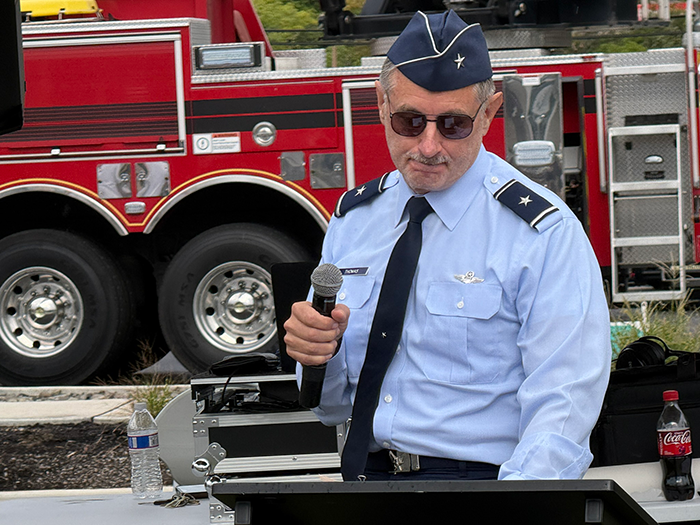
Retired Brig. Gen. Lawrence S. Thomas III offered a different perspective, one seen from the cockpit of an armed F-16 sent into the night sky to protect the northeast.
Thomas was director of operations at New Jersey Air National Guard headquarters and was a mission-qualified pilot with the 177th Fighter Wing in Atlantic City. At approximately 10 p.m., he took off with his wingman for a combat air patrol mission.
Their assignment was to defend American airspace when no one knew whether more attacks were coming. Although military pilots train for emergencies and combat, this time the threat was not overseas. It was above the cities, homes and families they had sworn to protect.
As his aircraft approached New York, Thomas looked down at Lower Manhattan. “Smoke and a fiery glow rose from the devastation,” he recalled. “From our altitude, it looked like a great wound upon the earth. I have never forgotten that sight. I never will.”
The city beneath him was largely dark, with the destruction at the World Trade Center standing out against the night. Thomas and his wingman flew patrol patterns over the region, prepared to respond if another hijacked aircraft appeared.
His appearance in Barnegat carried added significance when aircraft passed overhead during the ceremony. The flyover connected the morning observance with Thomas’ account of patrolling above the smoldering remains of Lower Manhattan.
Passing The Memory Forward
The students participating in the ceremony were born years after September 11, 2001. For younger Americans, the attacks are history rather than memory.
Rubenstein’s memories came from the streets and wreckage of Lower Manhattan. Tatur and Cox remembered those they worked beside and the physical and emotional toll that continued long after the towers fell. Thomas recalled looking down from the sky at what appeared to be a wound upon the earth.
Twenty-five years later, all four shared their stories in Barnegat with a generation that knows the attacks only through photographs, recordings and the words of those who were there.