BARNEGAT – Nearly two dozen Barnegat residents traded in their usual Wednesday night routines this fall for something far more immersive. For ten weeks, they filed into Barnegat’s gleaming new police headquarters for an inside look at how real police work is done.
The newest class of the Barnegat Citizens Police Academy included teachers, retirees, community leaders and others just curious about what really happens behind the scenes in modern policing. The program has proven to be part education, part hands-on experience, and part reality check.
Although the academy meets weekly inside headquarters, one session took participants out of town and into the Ocean County Sheriff’s Law Enforcement Training Center in Little Egg Harbor. There, they stepped into the FATS Machine, a full-scale Firearms Training Simulator that forces users to make split-second decisions using modified weapons and life-size video scenarios. It was a moment that made more than a few residents realize that police work can be as mentally exhausting as it is physical.
This year’s class includes some familiar faces from the Barnegat Township School District. One of a few elementary school teachers explained that she joined the academy because her son has participated in the department’s Junior Police Academy over the past two summers.
“I decided to take it because my son came home talking about drones, motor vehicle stops, and everything he learned,” said Marissa Bedrose, a fourth-grade teacher at Barnegat’s Joseph T. Donahue School. “He made it sound so interesting that I wanted to experience it myself.”
Sgt. Richard Boyle, who oversees the program, said the motivation works both ways between parents and children. Another participant joined as the mother of a 2004 Citizens Police Academy graduate. After hearing the stories, the mom decided she wanted to learn firsthand what goes on behind the scenes of police work.
Also making their way through the academy were Thy and Jimmy Cavagnaro, well known in the community for organizing the annual Vietnam veterans appreciation ceremony. They signed up to gain a deeper understanding of local law enforcement operations. “We support the police all year long,” Thy said. “Now we get to see the work behind everything we appreciate.”
A Full Training Schedule
The academy spans ten weeks, and the curriculum rivals the intensity of an actual recruit training calendar. Each session dove into different facets of policing, beginning with orientation and moving straight into patrol procedures, drone operations, and the fundamentals of motor vehicle stops. Participants learned from the officers who perform these duties daily, hearing firsthand how split-second decisions unfold on the road.
As the weeks progressed, the topics grew more specialized. A full K-9 demonstration gave residents a close-up view of how police dogs track, search, and respond to commands. Later sessions shifted into the technical aspects of policing, from DWI enforcement and Drug Recognition Expert techniques to CPR certification and the proper use of tourniquets in emergencies.
Detectives took over the classroom to walk participants through real investigative work. They also gained insight into the local police department’s Crime Reduction Unit and learned about SWAT teams.
Spotting Impaired Drivers
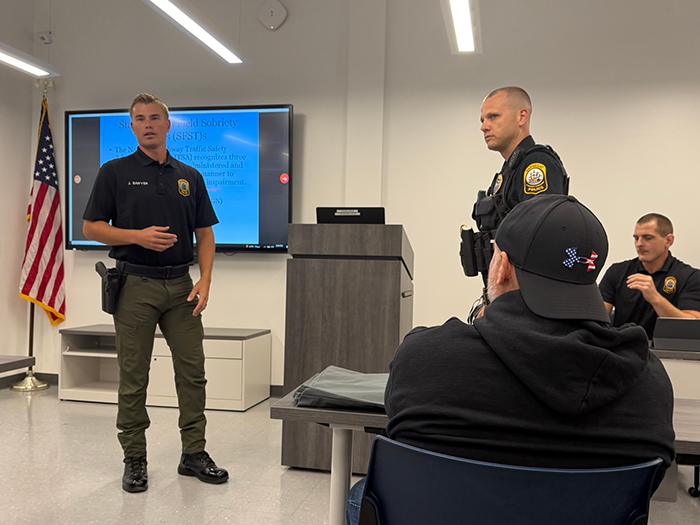
One of the many sessions that included hands-on exercises was conducted by three of the department’s finest. Patrol Officers Joel Sawyer and Robert Walder were joined by Sgt. Kris Burke in presenting DWI and Drug Recognition Expert (DRE) training.
The class began with a breakdown of the three-phase process that officers use when investigating potential impaired drivers. Participants learned that the evaluation begins long before anyone is pulled over.
“We refer to Phase I as vehicle in motion,” explained Sawyer. “That’s everything that you observe of a vehicle and the operator that’s driving the vehicle prior to contact with the driver.”
Phase II begins after the officer approaches the driver. Walder explained that this stage involves observing physical and behavioral cues: slurred or confused speech, difficulty locating documents, fumbling fingers, bloodshot eyes, or the odor of alcohol or drugs. “We’re trained to pick up on things the average person wouldn’t notice,” he told the class.
Phase III is where standardized field sobriety testing comes in, but the officers stressed that alcohol is only part of the picture. When the results of those tests don’t match the breath-test reading, or when impairment is obvious, but the breathalyzer shows zeros, the situation shifts into DRE territory.
That’s when certified Drug Recognition Experts (DREs) step in.

DREs are law enforcement officers who undergo intensive, nationally standardized training that allows them to identify impairment caused by different categories of drugs. Participants reviewed the drug matrix that DREs are required to memorize and use to make determinations. The charts outline how different substances affect pupil size, muscle tone, blood pressure, speech patterns, and reactions to light. Officers explained how depressants, stimulants, cannabis, narcotic analgesics, hallucinogens, inhalants, and dissociative anesthetics each leave behind a distinct set of clues.
“The fact is that we take all the different clues and we put them together to write a picture,” Burke said, adding that DREs have an overall rate of 91 percent in making the right calls identifying drugs a driver used. The information is then confirmed by a blood or urine test.
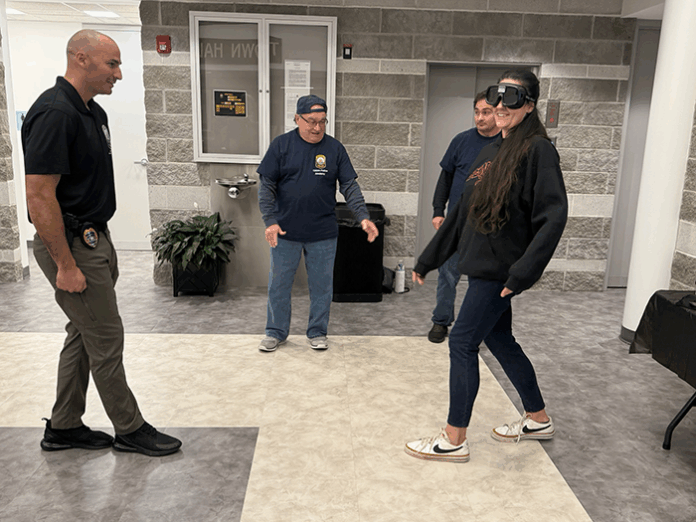
After the instructional portion of the class, the group stepped into the town hall lobby to don “drunk goggles” and attempt field sobriety tests themselves. The goggles, which simulate varying levels of intoxication, turned even simple tasks into comedic struggles. Participants attempted the walk-and-turn, one-leg stand, and Horizontal Gaze Nystagmus test, with mixed success.
Despite a great deal of laughter, the lesson landed. Residents left with a deeper understanding of the precision, training, and judgment required every time an officer approaches a vehicle or evaluates a driver. What seemed routine from the outside had revealed its true complexity.
By the time the goggles came off, many participants admitted they would see police work differently from now on, especially the split-second decisions involved in keeping impaired drivers off the road. As one resident said while shaking her head in disbelief, “I had no idea how much goes into this.”
For the Barnegat Citizens Police Academy, renewed awareness is exactly the point.