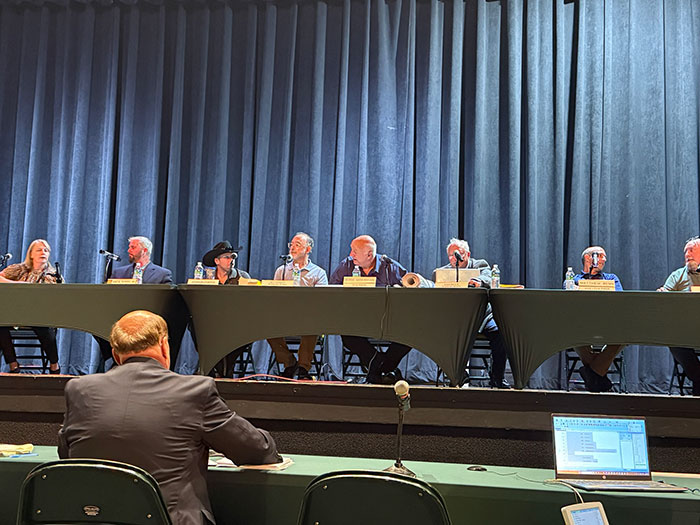
LITTLE EGG HARBOR – At a hearing that stretched until midnight and drew at least 200 residents, the local planning board unanimously voted to approve a 415-unit age-restricted housing development off Center Street.
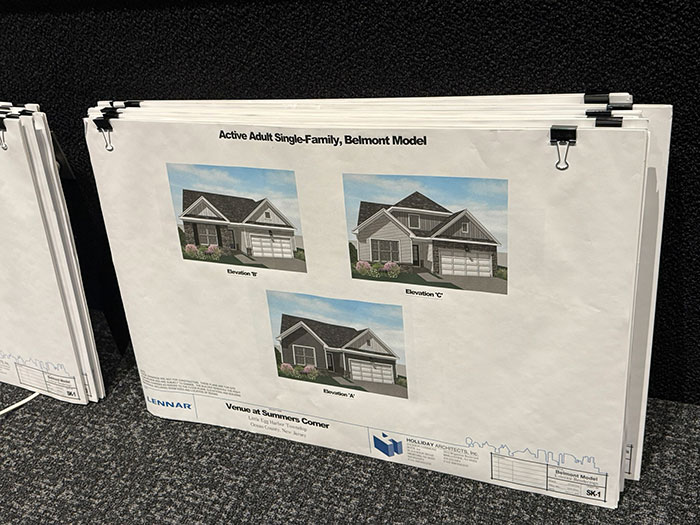
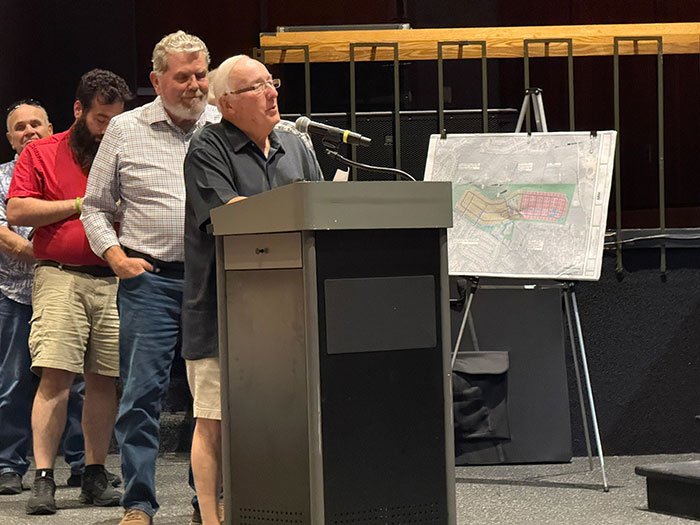
Venue at Summers Corner, as proposed by Lennar Homes, spans 146 acres of wooded land, with 199 single-family homes and 216 triplex units. Plans also call for a clubhouse, swimming pool, dog park, and other amenities designed to attract active adults over 55.
While the board emphasized that the plan complied with local zoning laws and required no variances, approval came with some contingencies. Lennar must still secure a CAFRA (Coastal Area Facility Review Act, which applies to development near bodies of water) permit from the New Jersey Department of Environmental Protection and comply with several design waivers related to buffers, tree plantings, and stormwater basins.
Residents who packed the room left upset and unconvinced. Concerns over traffic, emergency access, environmental impacts, affordable housing, and even a potential conflict of interest dominated the nearly six-hour proceeding.
Traffic And Safety
Traffic was the most pressing issue raised throughout the night. Testimony given by David Shropshire, Lennar’s traffic engineering consultant, prompted repeated objections from audience members.
Shropshire said that traffic counts relevant to the development were taken in February to determine seasonal variation and then applied a seasonal adjustment factor to the counts. “We put a very conservatively high 29 percent increase in the traffic counts,” he added. “To account for any single variation.”
He added that the numbers were further adjusted after counts were taken again in mid-August, closer to the area’s summer peak. “We factored in both sets of data,” Shropshire said. “And the analysis shows that even with full build-out of this project, the intersections will continue to operate at a level of service D or better.”
Dr. Jack Edmunds presented the board with alternative data on traffic in the area, stating that Lennar’s expert only considered development of their project. He pointed to a 2020 Ocean County traffic study.

“This was at the beginning of the COVID lockdown,” Edmunds stressed. “It tracked 19,689 cars from Route 9 to Oak Lane just in time for Labor Day weekend.” He added that with 20,000 cars on Center Street alone each week, he wondered what 415 more cars would do on all of the local roads.
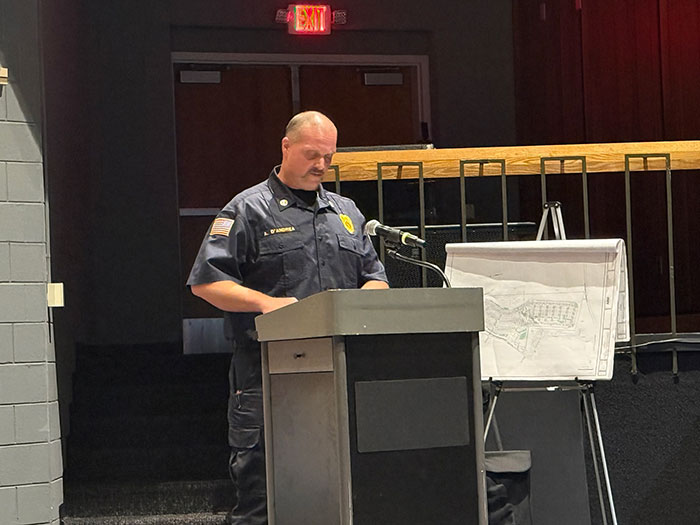
Little Egg Fire Chief of District I Anthony D’Andrea expressed several safety concerns about Lennar’s plans. He warned the two entrances on Center Street, only 600 feet apart, could bottleneck both evacuations and emergency response. “If there’s an incident, everyone will be trying to leave at the same time we’re trying to get in,” he warned.
D’Andrea also questioned whether road widths would allow fire trucks to pass if cars were parked on both sides and called for a hydraulic study to confirm that water supplies could meet firefighting demands. He urged the board to require a northern access road, even if limited to emergency vehicles.
Woods And Wetlands
Environmental concerns drew repeated objections from residents who said the project’s impact had been understated.
Karen Argenti of Whiting questioned the adequacy of the developer’s environmental impact statement. Ultimately, the planning board agreed that Lennar needed to update its statement but did not withhold approval.
Amanda Mauer of Center Street raised similar concerns, saying the wildlife studies were limited and did not capture the true character of the land. She said half the study sites were along people’s backyards and didn’t seem like a true assessment of the 146 acres.
Lennar’s environmental consultant, Marianne Risley, said that the project preserves nearly 40 acres of forest and meets DEP and Pinelands standards. She pointed to 150-foot wetland buffers and more than 650 feet of separation from Willets Creek, noting that the design “doubles the protection compared to the 2004 approval (of another project in the same space.)
Risley also acknowledged restrictions may be placed on tree-clearing schedules to protect threatened species such as the Cope’s gray tree frog and local bat populations.
Even with the board’s approval, the project cannot proceed without a CAFRA permit from the New Jersey Department of Environmental Protection, which will review wetlands, stormwater management, and impervious coverage before construction begins.
Affordable Housing
People who opposed the development said the lack of on-site affordable housing was a missed opportunity.
Resident Dave Johnson urged Lennar to use its triplex units for that purpose. “This is the last large piece that will be developed in this town,” he said. “All of the other pieces are smaller – or preserved, if they’re bigger.” Johnson added that the township would benefit instead of the developers if his suggestion was taken.
Planning Board Engineer James Oris pressed the applicant on whether dedicating a portion of the development could help meet Little Egg Harbor’s affordable housing quota.
Lennar’s project engineer, Wayne Birchler, acknowledged the idea had been considered but said it was not part of the application. Instead, the developer plans to make a financial contribution allowed under township ordinance. “That ordinance was created to effectuate affordable housing,” Birchler said, noting Lennar’s 1.5 percent contribution would equal about $3 million. “That subsidy would allow another developer to move forward with one of the affordable housing parcels in your plan, which would ultimately benefit the town.”
Conflict Of Interest Questions
Toward the end of the hearing, Britta Forsberg, an environmental advocate, raised concerns about whether the proceedings were impartial. She pointed out that the applicant’s attorney, Joseph Coronato was the planning board attorney when the property was under review for a 2006 application. She added that the current planning board attorney, Terry Brady, was also once Coronato’s law partner and that Coronato’s son worked for the firm.
“The role Mr. Coronato played at the time and the extent of his ongoing relationship with Mr. Brady and his firm together create significant uncertainty,” said Forsberg. “And cast doubt on the independence of the planning board’s review.”
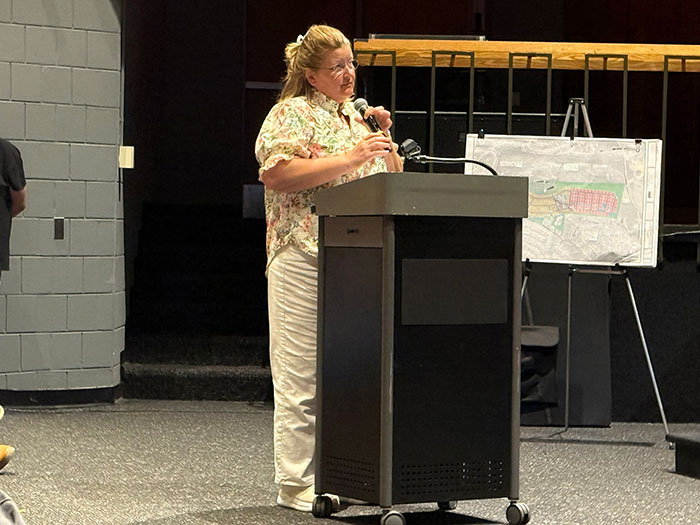
Brady responded to Forsberg’s comments, saying that he and the applicant’s attorney ended their association as law partners when Coronato became Ocean County Prosecutor in 2013. He dismissed any affiliations since then on either a professional or personal basis.
“I have no personal nor professional interest in this application,” said Brady. “I have no financial or personal involvement in this application.”
He added that he has served on his county’s Board of Ethics for 12 years and said the New Jersey Supreme Court had long ago rejected the idea that an appearance of impropriety alone constitutes a conflict of interest.