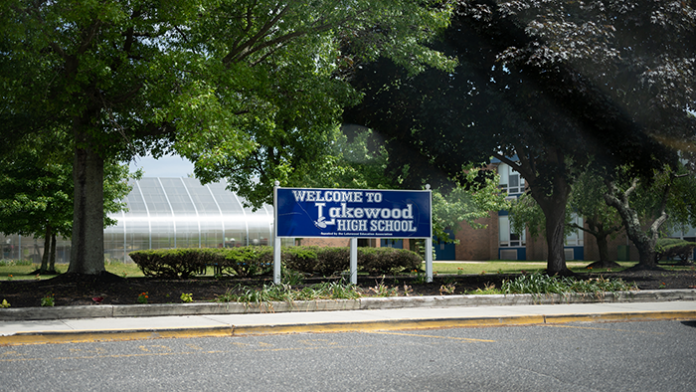
In a stunning move, the state Department of Education has taken legal steps to seize control of the Lakewood public school system, citing years of documented operational and fiscal mismanagement.
The Murphy administration, with just days to go before Gov.-elect Mikie Sherrill is inaugurated, filed on Wednesday an order to show cause, a legal document that outlines the state’s argument to take over the district.
The state argued that the district has denied students a “thorough and efficient education,” as mandated by the state’s constitution.
If the State Board of Education approves the move, it would suspend local control and the state could appoint a superintendent and school board that would have jurisdiction over spending, personnel and academics.
The takeover hearkens back to the state’s long – and mixed — history of seizing control in the state’s largest school districts, including Newark, Paterson and Jersey City. But the last such takeover was more than decade ago in Camden, with that state operation still ongoing.
Lakewood schools for the last decade have faced financial turmoil and rounds of legal battles with the state over the adequacy of its funding. A September court ruling found the Ocean County township’s struggles were due to poor fiscal management, failure to raise taxes, and transportation and special education spending issues.
“For more than a decade, the New Jersey Department of Education has been working with the Lakewood Township School District to address ongoing fiscal and operational concerns that impact students, staff, parents, and the entire Lakewood community,” said state Education Commissioner Kevin Dehmer in announcing the move in a press release.
“For all of those impacted, most especially the students of Lakewood, we are obligated to intervene in this situation and provide the district with the necessary oversight to course correct.”
Lakewood schools will have a chance to respond to the state’s legal order before it goes to the state Board of Education. Lakewood would be the first non-urban school district in New Jersey to fall under state control if approved by the state board.
Camden’s school district is the only district currently under state control, with Newark, Paterson and Jersey City all returning to local control over the last 20 years. Each takeover lasted decades before returning to local control with elected school boards, and recent studies have found that state takeovers nationally have often become politicized and left little or no evidence of to show academic benefits.
Lakewood’s elected officials and school leaders have argued that its student population makes it unique and complicated — with more than 50,000 students who attend private schools in the township, virtually all of them Orthodox Jewish, while under 5,000 students are enrolled in its public school district.
Based on previous court documents, more than half of the district’s annual budget covers costs for transportation and special education tuition for those nonpublic students, as required under state and federal laws.
While state aid to the district is calculated based on the number of students that attend the public school district, the district is also required to pay for transportation and special education tuition for the private school students who live in town, putting an annual strain on the district’s budget.
“If the State of New Jersey believes that assuming a more direct role in Lakewood’s school district will finally lead to a sustainable, long-term solution to this structural problem, we welcome that effort,” wrote state Sen. Robert W. Singer (R-Ocean), Assemblyman Alexander Schnall, Mayor Raymond G. Coles and the Lakewood Township Committee in an emailed joint statement.
“We look forward to working collaboratively with the Department of Education and with incoming Gov. Mikie Sherrill to resolve this issue once and for all,” the group of lawmakers said.
The Lakewood school district did not respond to requests for comment.
Paul Tractenberg, an attorney who has long-represented Lakewood public schools in legal filings, said it will “remain to be seen” whether the state’s move will lead to the satisfaction of the state’s constitutional mandate for students to receive a thorough and efficient education.
“Why would anyone expect that a generic statewide school funding formula would work for a unique district?” Tractenberg said in an email. “If the funding is inadequate under state control, there’s only one party to blame, and it won’t be the local school district.”
A veteran of the state’s school equity battles, Tractenberg also questioned how and why the crisis had come to this point.
“The question is why has the State gone nuclear now when it could have exercised its power and duty long ago in less extreme ways more consistent with local control,” he said.
This story was originally published by NJ Spotlight News through the NJ News Commons.