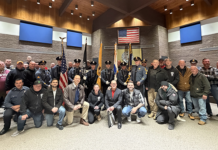
TOMS RIVER – A move to acquire Christ Episcopal Church on Washington Street has ended, leaving people to wonder what will happen next.
The mayor and administration has repeatedly said that the property was part of a broader plan to create more recreation opportunities in that area of town. Critics have said it is a response to the church wanting to open a homeless shelter there. The shelter plan had been shot down by the land use board.
During the portion of the most recent Township Council meeting when the public can speak about any issue, a few of them asked for the eminent domain ordinance to be tabled permanently.
Mayor Daniel Rodrick came to the meeting during the public portion and informed residents that there won’t be a second reading.
“We’ve completed our survey and it’s pretty clear the public does not support eminent domain. We thought the church would be a willing seller. We are not moving forward with eminent domain of the church,” he said.
The results of the survey were about 60 – 40, he said.
“It’s pretty clear the people are not with me on this one,” he said, so his actions will reflect the people’s opinion and not acquire the church.
However, this left a bit of unfinished business in some people’s minds.
Ordinances have two readings. The first one introduces it. Then, there’s a second reading where the public can speak about it. If the majority of the council approves the second reading, the ordinance becomes law a certain number of days later.
The eminent domain ordinance was introduced in spring but was never put on the agenda for a second reading.
Some members of the public said they’d be waiting for the other shoe to drop, expecting the second reading of the ordinance at any of the town’s remaining monthly meetings.
Deacon Ted Foley, who retired from serving Christ Episcopal, said letting the ordinance die without an official vote is “cruel and inhumane.” He said they have over 1,200 signatures on a petition to keep the church open.
Michael Mazur spoke as a member of the Interfaith Clergy of Toms River, a group of various religious leaders. He called the eminent domain move “an affront not only to Christ Episcopal Church but also to every congregation in our community. When you hurt one of us, you hurt all of us.”
Houses of worship help residents in need. Without them, the government can’t handle the strain on resources, he said.
Rodrick suggested putting it up for a council vote, but Council President Justin Lamb said not to. This is where the conversation strayed into the intricacies of municipal law.
Township Attorney Peter Pascarella said that ordinances have to be advertised to the public. Since this wasn’t done, they couldn’t legally vote on it. They could, however, vote on a nonbinding informal motion just to show the public how they feel.
Jerry Dasti, an attorney who was also on the dais during the meeting, said there are two options. The council can either let the ordinance die because at the end of the year, ordinances don’t carry over. Or, they can put it up for a vote at a future meeting and vote it down officially.
Rodrick said that if the council advertises that there will be a second reading, residents would assume that it will be approved.
Pascarella suggested a resolution that the council does not intend on having a second reading of the ordinance.
Although every member of the governing body is Republican, they don’t agree on the big issues.
During the first reading of the ordinance back in April, the majority of the council who usually vote with Rodrick – Council President Lamb, and council members Craig Coleman, Lynn O’Toole, and William Byrne – voted to introduce the ordinance to buy or otherwise take possession of the church and a few other waterfront properties. Councilmen David Ciccozzi, James Quinlisk, and Thomas Nivison – who usually vote against the mayor and administration – voted against it.
The resolution that Pascarella suggested instead was unanimously approved.
There were a few waterfront properties that were tied into the ordinance to acquire the church. It is unclear if these would still be part of a future acquisition.