OCEAN COUNTY – The cost of electricity is increasing quickly, as is our need for it. Far from a simple case of supply and demand, there are more complicated issues at work, which were discussed recently at a hearing of New Jersey lawmakers.
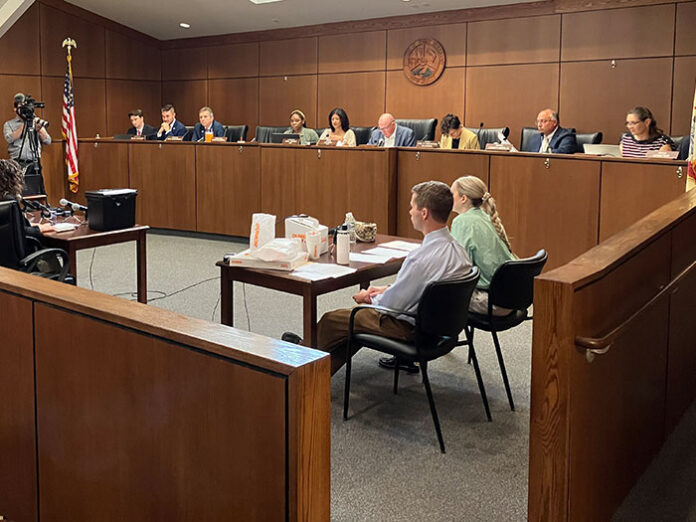
The meeting was made up of the Senate Environment and Energy Committee, and the Assembly Environment, Natural Resources, and Solid Waste Committee. Originally scheduled for Toms River Town Hall, it was changed last minute to Point Pleasant for unknown reasons. There, lawmakers listened to experts about what the future of energy is going to look like, and what we can do about it.
Senator Bob Smith chaired the meeting, which had a number of speakers. He urged each speaker to be brief since they had a lot to get through. This article is focused on the beginning of the meeting.
The first speaker was Christine Guhl-Sudovy, president of the Board of Public Utilities which oversees electricity, natural gas, and other energy sources.
The state is part of the PJM grid, she explained. It provides power to 13 states and the District of Columbia.
The energy cost has increased by 40 percent, and officials are looking at ways to control this cost.
Guhl-Sudovy said that of the 32 gigawatts of electricity needed in coming years, 30 of it is needed by data centers. Even if they are not in New Jersey, they are on the PJM grid, and therefore, New Jerseyans will be impacted by it.
According to the U.S. Department of Energy, data centers consume 10 to 50 times the amount of electricity of a commercial building of the same size. These buildings house the computers focusing on technology such as artificial intelligence.
The reason for the state’s push for renewable energy is because it’s the fastest to set up, Guhl-Sudovy said. Solar is the fastest and the cheapest, which is why it’s been a key part of the administration’s energy plan.
A gigawatt of solar power is “in the pipeline” to be constructed, she said. “Wind would’ve helped.”
Plans for windmills off the shore have been nixed, although some still want them.
A new nuclear plant would also be welcome, she said. The state gets 40% of electricity “from clean nuclear energy.”
“This administration did not shut down Oyster Creek,” she said. This was due to financial decisions of its parent company.
Fossil fuel companies were off-lined prior to the Murphy administration. A new fossil fuel plant would take about seven years from planning to opening, and cost far more than solar, she said. That’s why it’s been New Jersey’s plan to have diverse energy sources.
In order to bring down costs, the state should bring as many sources of energy online as quickly as possible, she said.
These plants could be anywhere on the grid. However, each state wants them because they create jobs and ratables.
“The increase in demand is the issue, not the plants closing for financial reasons,” she said.
Oyster Creek
As Oyster Creek Nuclear Generating Station is in the process of being shut down, or decommissioned. This was seen as a loss by local officials for the energy grid and for the economy.
“We need more nuclear,” Guhl-Sudovy said.
Oyster Creek is too far into the decommissioning process to turn it back now, she said. However, there are other options for that land.
Smith noted that Holtec, Oyster Creek’s current owner, has been talking about small modular reactor.
According to the U.S. Environmental Protection Agency, these advanced small modular reactors could produce between tens to hundreds of megawatts. They are smaller, less expensive, and able to be in places a large reactor wouldn’t be allowed. They are “likely” to be deployed at the end of the 2020s or in the 2030s.
China and Russia have been the only countries to build these. Officials have said that they are hesitant on being the test subject for the first such reactor in the west.
Last year, when Governor Phil Murphy was in Berkeley for the unveiling of a large solar field, The Berkeley Times asked him about small reactors. Although he did not mention Oyster Creek specifically, he said he has an open mind about small reactors. However, the fact that they are new and haven’t stood the test of time is giving him pause.
Senator Carmen Amato, former mayor of Berkeley, explained the solar panel project to the other members of the committees. He said that his town recently capped the town landfill and topped it with solar panels.
It had stopped being used decades ago, but was never officially capped. A private company came in, capped it, installed the panels, and is selling the electricity into the grid while providing a discount to those closest to the facility. It’s a private-public partnership that is getting more common these days.
Berkeley and Lacey officials are often in discussion since those towns have a lot of the same traits. Amato said that Lacey officials “are there with open arms” to either a small reactor, a gas plant, or anything similar at Oyster Creek.
The infrastructure is already there, so it would be an easier opportunity for a company to install there rather than start fresh, he said.
Natural Gas And Blame
Assemblyman Michael Inganamort asked about natural gas plants.
Guhl-Sudovy said “We rely on it pretty heavily right now. We are not looking to retire natural gas. My job is cost perspective. If clean energy is faster and cheaper,” then that’s the priority.
After the meeting, Republican Assemblymen Gerry Scharfenberger and Inganamort sent out a press release on their takeaways from the presentation by the president of the BPU.
“You have mentioned some of the facilities that have been closed down over the past few years. It’s ironic that we are talking about nuclear and a plant was just shut down for reasons I don’t fully understand. Would you say the diminishing generation is to blame for these increased costs?” Scharfenberger asked.
Guhl-Sadovy responded, “No. The increase in electricity demand primarily driven by data centers is the driving factor of the tightening of supply and demand.”
“In the remarks you shared, you had pointed to the prior administration for closing various energy facilities. The hearing was opened by thanking PJM pejoratively for the energy woes we are facing. I heard you identify data centers as part of the problem and I’m dispirited that it falls on a small minority in the legislature that asks the obvious question, ‘Do the people who have run the state of New Jersey for the past eight years have anything to do with this?’” Inganamort asked.
He also noted that like other residents his electric bill has nearly doubled from $212 this month last year to $393 despite his energy conservation efforts.
“The BPU does not regulate the capacity costs. That is the portion of the customer’s bill that has driven prices up. The June 1 price increase was from capacity auction results from last year,” Guhl-Sadovy replied.
Following the results of the state’s annual supply auction held in February, the BPU approved rate hikes as high as 20% for customers of the state’s major utility companies, the assemblymen said.
“Despite skyrocketing utility bills, the BPU is doubling down on the governor’s green energy agenda, which is largely responsible for driving up costs. President Guhl-Sadovy stated New Jersey should still be prioritizing clean energy generation like solar and offshore wind even though they are incredibly inefficient and could never meet the demand required to bring down prices. If New Jersey residents want to see lower electric bills, they are going to have to vote for change in November,” Scharfenberger and Inganamort said after the meeting.
Innovation
Abe Silverman, an assistant research scholar at Johns Hopkins, spoke about innovation in energy technology.
The data centers that are demanding so much electricity are outside of New Jersey, he noted. They would need twice the state’s nuclear capacity to answer it.
In the short term, “every megawatt counts,” he said. “There’s nothing in PJM for a long-term answer.”
He also noted that battery storage is an option. This would be ways to store huge amounts of power for when it is needed the most.
The PJM marketplace doesn’t look at cleanliness of the energy, he said. There’s also no lobbyist to try to get people to use less energy.
“We need to get megawatts onto the system (through creation), or off the system (by using less). Both of those do the same thing,” he said.
The issue with first of its kind technology is that it has more potential risks and costs, he said.
He urged the lawmakers to watch risks. If possible, spread it out with neighbors in other states so that it impacts people less.
“From an economic and political point of view, having a source of energy in our state is important. But since it’s a grid, it doesn’t matter,” he said. Having different options for generating electricity creates competition, he said.