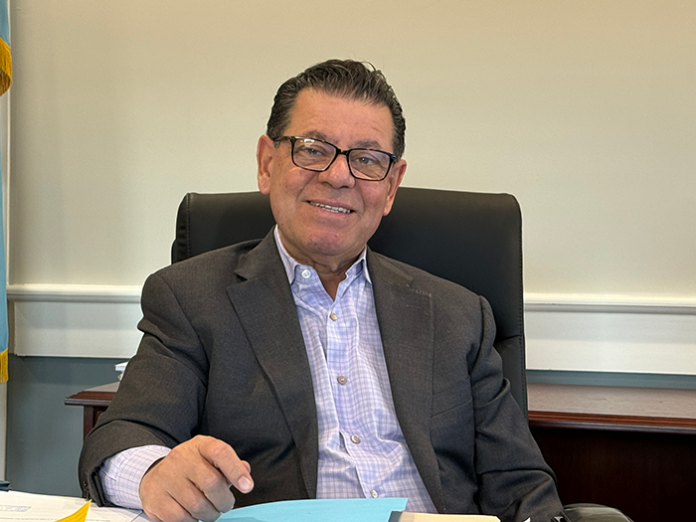
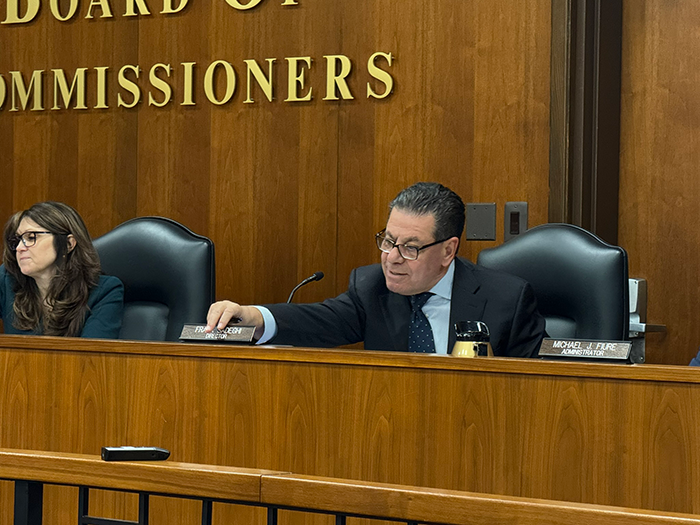
TOMS RIVER – The center seat of the Ocean County Board of Commissioners now belongs to Frank Sadeghi, who began 2026 as the board’s director. The position carries authority and visibility, but it does not fully explain how he arrived there. His path began nearly 50 years ago, when a teenage immigrant stepped off a plane at Kennedy Airport carrying little more than determination and a promise to his dying father.
Sadeghi arrived in the United States from Iran in February 1976, just before his homeland was overtaken by revolution. He was 18 years old, spoke no English, and had no family waiting for him here. His decision to leave, he said, was driven by what he called the “whole notion of freedom” and the belief that hard work could lead to a good life.
“My father said, ‘If you go to America, I know you’re going to make a life, and I know you’re going to bring the rest of your siblings,’” Sadeghi recalled. “That’s the commitment I need from you.”
Within a few years, he kept that promise. He sponsored his younger brother, then his sister, and later his youngest sibling to join him in the United States. What began as a solitary leap became a family’s permanent relocation.
Learning A Country From The Ground Up
Sadeghi’s first lessons in America were practical ones. He worked at a Kansas Fried Chicken chain shortly after arriving and later took a job parking cars in a Manhattan garage.
“I didn’t even know how to drive,” he said, laughing. “They took me down to a spiral garage and showed me the gas and brake. Within a half hour, I was parking cars.”
Those early jobs paid his rent and helped finance college. Sadeghi settled in Jersey City for easier access to Newark College of Engineering, now New Jersey Institute of Technology. Civil engineering appealed to him because it combined technical skill with visible results.
Sadeghi’s move to the Jersey Shore grew out of opportunity rather than long-term planning. A friend told him college students could make good money selling ice cream in the summer. After hearing about one student who saved thousands doing so, Sadeghi took the chance. He connected with a family that owned ice cream trucks in Belmar, rented an apartment in Asbury Park, and spent several summers working long hours to pay for college.
Building A Business -And A Name
Before starting his own firm, Sadeghi worked for established engineering companies to gain experience. After earning his professional engineering license, he founded Morgan Engineering in 1993, determined to build a company that reflected both his training and his values. The firm, which now employs more than 100 people, provides civil engineering and land development services for private and public-sector clients. Its work includes site design, infrastructure planning, and regulatory approvals that transform undeveloped land into homes, businesses, and public facilities.
“It affirms all the stories you used to hear back then,” Sadeghi said. “They used to say ‘go to America because the streets are paved with gold.’ That’s why I love this country – I love what opportunities are available.”
Sadeghi addressed the creation of Morgan Municipal, which he described as separate from Morgan Engineering. He said the idea came from Ocean County Republican Chairman George Gilmore, who suggested a separate company focused on municipal and government work.
Sadeghi said he was initially reluctant because Morgan Engineering was already successful in private development. Ultimately, the move made sense given the volume of work the firm was doing with builders and developers.
Growth has always meant more than revenue according to Sadeghi. “Our company’s paychecks feed families,” he said. “When you have a payroll, you’re not just running a business. You’re taking care of people.”
Public service began long before a county campaign. As his children grew up in Toms River, Sadeghi joined the PTA and later ran for the Board of Education, serving three terms.
His involvement eventually led him deeper into civic life. When a seat opened on the Ocean County Board of Commissioners in 2022, Sadeghi decided to run with plans to bring a business perspective to government.
Now in his third year as a commissioner and serving as director, he views the role as hands-on rather than ceremonial. “I have to see the numbers,” he said. “I have to understand what we’re approving and why.”
Ocean County Issues
One of the first issues that drew Sadeghi’s attention at the county level was the waiting list for Ocean County vocational schools. Students eager to train as electricians, plumbers, welders, and cosmetologists were being turned away.
“These are kids who want skills,” he said. “They want to work. And we’re telling them, ‘We don’t have room for you.’”
The issue, he said, came down to physical space, which led to the vocational school district and Ocean County College to begin sharing facilities. The same thinking has been applied to the Marine Academy of Technology and Environmental Science, where demand continues to exceed capacity.
“These are the brightest kids,” he said. “We can’t keep telling them ‘no.’”
Sadeghi also pointed to aviation training as a potential growth area, including programs for air traffic controllers at Ocean County Airport.
Sadeghi believes Ocean County is financially strong but warns against complacency. “I do believe Ocean County is in great financial shape,” he said. “But every dollar comes from somewhere and from someone. You can’t spend without thinking about that.”
He often speaks about growth, projecting the county could approach one million residents within 25 years. While that prospect unsettles some longtime residents, he sees it as unavoidable.
“Change is change,” he said. “Progress is progress. We don’t get to stop it. We just get to decide how we handle it.”
Sadeghi supports expanding the county’s open space program not just to preserve land but to make it usable. He has discussed introducing a referendum to modestly increase the tax levy for that purpose.
“You buy property and close the gate, but that’s not enough,” he said. “We should be creating places where people can kayak, bike, and enjoy nature.”
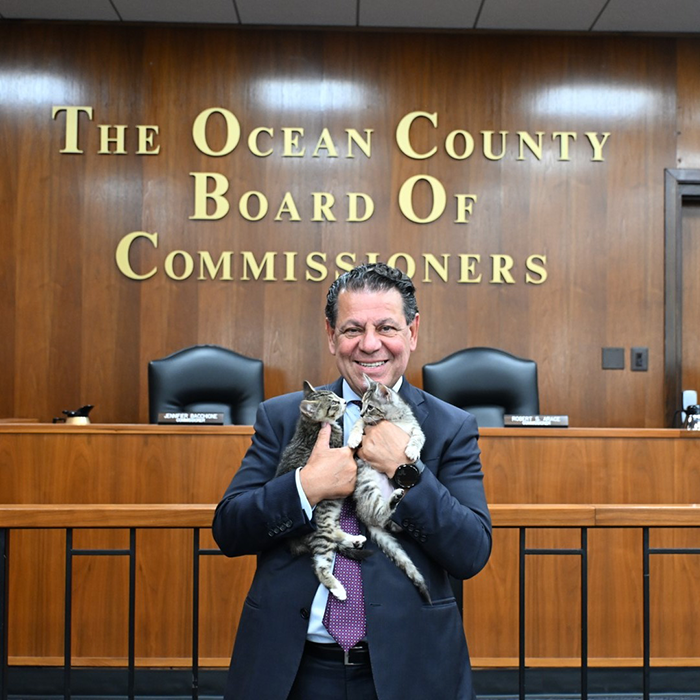
For all the discussion of budgets and infrastructure, Sadeghi has another side that surfaced when he showed off photos of two cats he adopted last year. The bonded pair had been brought into a commissioners’ meeting by the Health Department to promote shelter adoptions.
“If there’s an animal in need, it bothers me,” he said. “Let alone a human being.”
That outlook shapes Sadeghi’s approach to issues ranging from homelessness to utilities and transportation. He talks about power reliability, airport improvements, and housing pressures with the same seriousness he brings to education.
“Electricity isn’t a luxury,” he said. “Seniors depend on it. Businesses depend on it. We can’t accept failure as normal.”
Government, he admits, moves more slowly than private business. “In business, if you make a bad decision, you feel it right away,” he said. “Here, you have to work with people who come from different backgrounds and see things differently.”
Still, he says the work is worth it. “When I feel I’ve had a hand in something positive, it warms my heart,” he said. “But I ask myself every day, ‘Am I doing something that matters?’”