MANCHESTER – The subjects of renewable energy and concerns over offshore wind industrialization were discussed during a recent township Environmental Commission meeting.
Mayor Joseph Hankins, Councilwoman Sandy Drake and Councilwoman Michele Zolezi were among those who came to that session to listen to members of the Save The East Coast.org organization.
It was noted prior to their presentation by Township officials that residents should wait until the community’s energy aggregation agreement is finalized before making the choice for an energy supplier. Manchester is continuing to look at developing renewable energy sources for municipal purposes.
Save the East Coast.org is a non-profit agency and an ocean environmental advocacy group based in New Jersey whose mission is to protect the ocean and the diverse life it sustains along with coastal ecosystems and communities, from the harms and cost of offshore wind and ocean industrialization.
Mark Suer, Dennis DeForest and Kathleen DiFabio are members of the group’s education committee. They came as guest speakers and made their position clear that they were opposed to off shore wind industrialization stating it is not green, nor clean and a threat to aquatic environment.
DiFabio said the organization was founded in February of 2023 at which time once it received its non-profit status allowed it to fundraise and endorse political candidates who supported their efforts and positions. “Many people are under the impression that because they don’t live near the shore that they are not going to be affected by the wind turbines and unfortunately, that is not the case.”
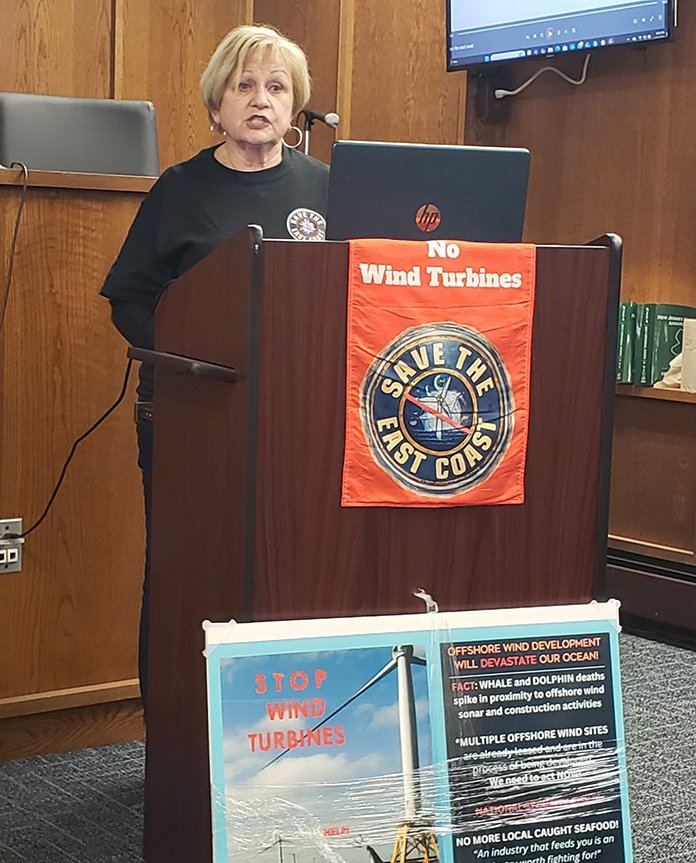
“The turbines are not clean and there is nothing good about them. They require all kinds of fossil fuels from petrol chemicals and nasty greenhouse gas to operate and 9,000 miles of cable,” she added.
DiFabio said, “there will be skyscraper sized signs out in our ocean at 900 to 1,000 feet tall and they will produce a noise like that of a jet engine. Can you imagine 54 of those where in other places like New York they want to put up 200.”
She said cooling stations will be dumping chemically treated water back into the ocean and “there is nothing clean about that. The blades of the wind turbines are not recyclable and in Wyoming they have a landfill where they are dumping all the turbine blades.”
She noted potential threats to area species such as “the white whale, bald eagle, turtles, dolphins may be harmed due to these off shore wind (projects). There has been a lot of debate as to whether off shore wind projects have been killing whales (along the Jersey and New York coast).”
DiFabio said her organization’s founder who is a professor at Rutgers University has proven at 100% that “offshore wind kills whales through his software system that he built. He founded the group because he wanted to investigate the cause of the rising number of whale deaths.”
She also said there was a connection between skyrocketing energy costs and offshore wind companies. “One thing not included in those costs is to maintain backup power for when the wind is not blowing or it is blowing too hard.”
Suer said, “I am just a regular citizen from Belmar New Jersey and having seen what was washing up in my backyard started me to be involved in all kinds of investigations as to what was happening on our beaches. These things when I was investigating them turned out to not be green or clean no matter how you looked at it.”

“They have all sorts of chemicals and they are not biodegradable they are just burying them in landfills and they have evolved over the decades into different sizes and the ones in New Jersey are supposed to be the largest one going. Right now they are on the back shelf because we and other groups spoke up and got our legislators to pass legislation.”
Suer pointed out during a PowerPoint presentation a “nacelle” which at the top of the turbine which is a “motor like any other motor so how does this make things green? You are putting in a large amount of these in the ocean and it disrupts the wind patterns, current and if you look at the examples, we have of those in Europe, Spain and Australia they are losing money on them.”
He noted that the turbine blade deteriorates and that environmental impact studies have reports of incidents where environmental pollution required cleanups of oil from the turbine mechanisms.
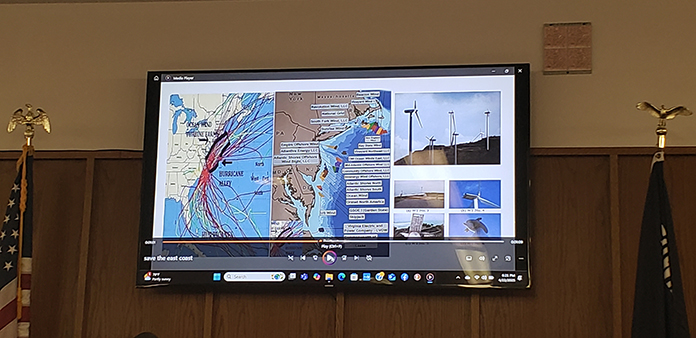
DeForest said he’s been following the issue for the last several years. He noted a blade that broke at a project in Rhode Island “they were just testing it. They didn’t even turn it on yet. If we have hurricanes how many of these are going to break?”
He noted that the wind turbine systems interfere with radar which could impact commercial fishing and shipping vessels. “They cast shadows on their radar.”
Councilwoman Michele Zolezi who serves on the Environmental Protection Agency’s Small Communities Advisory Subcommittee urged residents to become more educated about the issue and to do their own research.
A rain barrel workshop and a program about compost was held for residents of Lakehurst and Manchester at the Lakehurst Community Center. Environmental Commission meetings are open to the public.