MANCHESTER – A complicated issue determining whether townhouses can be built in an area upriver from Pine Lake has officials trying to get more information before a court issue goes further.
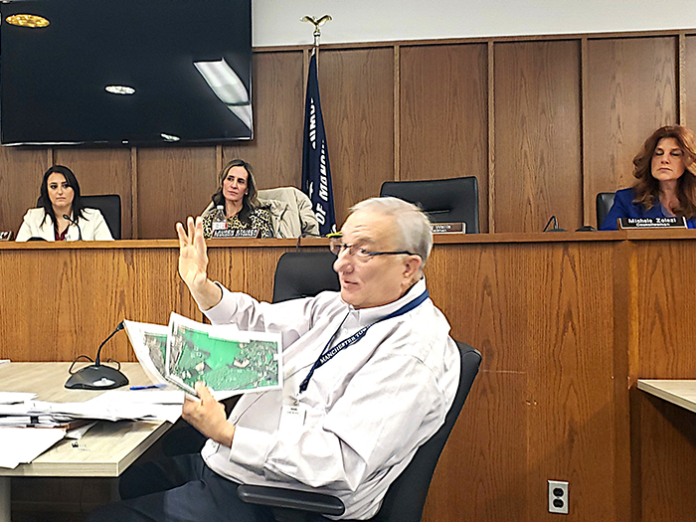
At a recent Township Council meeting, Business Administrator Carl Block explained a zoning ordinance involving an overlay zone as it pertains to development.
Every parcel of land in town has a zoning designation which says what’s allowed to be built there.
An overlay zone adds a second layer of regulations on top of an existing, underlying base zone. It’s done to address specific, localized, or sensitive issues. It supplements, rather than replaces, the primary zoning requirements, introducing extra restrictions or incentives – such as for historic preservation, flood protection, or specific design guidelines – that properties within that area must follow.
On the Council’s agenda was Ordinance 26-9.
Council President Roxy Conniff said that ordinance would “repeal the ordinance (24-40) that removed the townhouse overlay district” in an area of the township.
Block said the older ordinance that they want to repeal “was written poorly in my opinion. It gave permission to build townhouses in that zone that was currently there. The ordinance says you can build townhouses anywhere in any zone except for these zones. Typically you choose these zones, here are the permitted uses and anything not permitted is prohibitive – so permission for townhouses was there.”
He further explained, “the council said ‘we don’t want that.’ We should remove that so we are going to amend the ordinance, add that zone on that list of prohibited zones and therefore you can’t build (townhouses).”
However, the area is in the Pinelands Regional Growth Zone, which means that the environmental oversight group the Pinelands Commission had to approve it, Block said.
Block said the Commission generally reviews it, verifies it, and “you get a letter that you can enforce it. Instead I got a phone call from the (Pinelands Commission) executive director (Susan R. Grogan) saying we would like to meet with you about this first.” The Zoom meeting included members of the council.
“When we had the meeting they were very… strong about the fact that they would not certify it and that this was a part of a regional growth area and when they put this together with the town, whenever that was, I wasn’t here and I don’t think any of the council members were here when it was first designed, their expectation would be that there would be growth allowed there including these townhouses,” Block added.
Block said the Pinelands Commission “would not certify an ordinance that removed it so with that, we would not be allowed to enforce it. We are waiting for a second meeting. I did ask for a letter from them. In the meantime, we were sued by the owner of two of the lots saying ‘you can’t do this because it is already allowed to be there.’ The Pinelands won’t certify it so you can’t do that.”
“So now we are in court on one side and on the Pinelands on the other side saying we are not going to certify it and if they say that, we lose in court because the attorney is going to say, ‘your honor even though they passed it, state law is if they don’t get it certified they can’t enforce it’ if we don’t remove that impediment to our regs. It is rather complicated,” Block said.
Township Environmental Commission member Karen Argenti said, “these pieces of land, I remember this from previous years, it seems there is a history of this piece of land and how it got from light industry now to residential whatever, these lands are all wetlands and they may have built on them as there are buildings there but that doesn’t mean we should lose them. They are all connected to the union branch of the Toms River which is one of the branches that goes into Pine Lake and you do not want to have a problem with more pollution that is going to hurt the lake.”
Argenti explained that wetlands are vital ecosystems, including swamps, marshes, and bogs, where soil is periodically or permanently saturated with water. As transition zones between land and water, they filter pollutants, control floods, and provide critical, biodiverse habitats. They are characterized by specialized plants, hydric soils, and unique hydrological conditions. “There should not be any more development in that area is my point,” Argenti added.
Another resident noted that the addition of townhouses “will be a traffic nightmare.”
Resident Karen Perry asked if the ordinance could be tabled until more information was received from the Pinelands Commission.
Conniff agreed. She and Councilwomen Michele Zolezi and Sandy Drake voted to table it. Councilmen James Vaccaro and Craig Wallis were absent during that meeting. The meeting was carried to the Council’s February 23 meeting which was cancelled due to snow.
Other recent ordinances approved on second reading included 26-7 authorizing the sale of 1909 Commonwealth Boulevard to Gold Eagle Enterprises for $301,000; 26-8 entitled “Water and Sewer,” and 26-11 adopting portions of the general reexamination of the Master Plan.