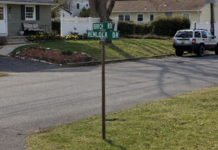
BARNEGAT – What now appears to be just another apartment complex on North Main Street once echoed with the clatter of glassmaking and the hiss of steam whistles.
Long before residents of the Laurel Oaks Apartments called it home, the land hosted the Barnegat Glass Company – Ocean County’s only glass factory and once a symbol of industrial promise for the growing bay town. And even earlier still, it was home to the Lenni Lenape people.
Local historian Giovanni Rawley transported guests back in time with a vibrant presentation titled “The Significance of the Barnegat Glass Company” at Cloverdale Farm County Park. The talk, part of the Barnegat Historical Society’s 2025 Speaker Series, drew about two dozen history buffs eager to learn about a nearly forgotten cornerstone of Barnegat’s past.
Rawley, a 2021 graduate of Barnegat High School, has quickly become one of the town’s go-to sources for local history through his Facebook page Ol’ Tales of Barnegat NJ. What started as a hobby sparked by a job at a local antique store has evolved into an impressive personal collection – and an online community of more than 4,500 followers.

“I actually thought maybe 50 to 100 people would be interested,” said Rawley, reflecting on the page’s growth. “But people started sharing their own stories, their artifacts, and memories. It’s turned into something way bigger.”
Rawley’s talk on Saturday was packed with rarely seen photographs, old newspaper clips, glass samples, and stock certificates – all tied to the glass company that once employed dozens of local men and also young boys.
The Barnegat Druggist Hollow-ware Glass Company was incorporated in 1892 with $20,000 in capital. A year later, Benjamin P. Chadwick built the facility – approximately 90 by 180 feet – on nearly three acres of land. The factory’s earliest leadership included President Wilkinson Grove Conrad and Secretary Jeremiah Spader Storms.
“South Jersey sand was considered perfect for glassmaking,” said Rawley. “The original furnace was a pot furnace with fieldstone tunnels, about 15-16 feet long.”
Among its early products were half-pint pocket bottles, often stamped with the names of towns like Ocean Grove. According to Rawley, medicine bottles labeled for towns like Lakewood, Tuckerton, or Toms River likely came from the Barnegat factory.
In 1897, Thomas Edward Ludlow purchased the property, hoping to develop a company town. He built a handful of homes for workers, but the plan never gained traction.
“Only three or four homes were ever built,” Rawley noted. “It just didn’t take off.”
Despite its promise, the factory’s story unfolded like a novel right out of Charles Dickens – filled with strikes, fires, and even drunken umbrella menders attempting a hostile takeover.
“That one’s wild,” Rawley read from a news clip. “Three drunk men burst in and tried to take over the glass house during a night shift. The workers were so scared they blew the steam whistle to alert the town.”
The makeshift militia – namely township committeemen Charlie Reeves and Joe Gluck – rounded up the intruders and carted them to the county jail.
And that wasn’t the only altercation. In 1909, a dispute over water at the factory pump between an Italian and an American worker led to a gash on the back of one man’s head and a trip to lock-up for the other.
The stories may seem almost comical in hindsight, but Rawley pointed to their significance.
“They help paint a picture of what life was like – how hard people worked, how tensions brewed,” he said. “And how essential this place was to the town.”

Industry Fades, But History Remains
Barnegat’s glassmaking boom dimmed by 1914. Strikes and the introduction of machine-made bottles in 1909 made it hard for small glasshouses to compete. The final nail came in the form of a fire that destroyed the building. What was once an economic engine became little more than a hollow shell.
A 1918 article mournfully described Barnegat as resembling “war-stricken Belgium,” with its mills, saw factory, and glass house all shuttered. Eventually, the remains of the factory were rented out to the Butler Brothers of New York for hay storage.
Still, the factory left a legacy. Workers crafted decorative “end of day” glass pieces from leftover materials – canes, chain links, and vases that are now rare collector’s items. Some are displayed at the Barnegat Heritage Village Museum.
“Here’s one of my favorite photos,” said Rawley, gesturing to a black-and-white image of glassworkers outside the factory. “You can see all the men – and the kids too – with the dirt floor beneath their feet. It says so much about the time.”
Among the names listed: Fred Barr, Kenneth and Ralph Cranmer, Charles Hakinson, Edward Reeves, and Jane Horsebreak Jr. – many of them with roots still in the area.
“I’d say the glass factory was one of the most important industries in Barnegat, second only to the Baymen,” Rawley said. “It brought people here and helped shape what the town would become.”

Keeping The Story Alive
Rawley’s own connection to the town’s past began in 2019 when he worked at Unshredded Nostalgia, an antique shop owned by the late Jim Episale.
“He’s the one who sparked my interest in collecting,” Rawley shared. “At first, I looked for things from the glass factory and the original Barnegat High School.”
As Rawley continues to uncover and preserve Barnegat’s rich past, his passion has turned into a profession. He now buys and sells antiques full-time, conducting online auctions and offering local insight into the town’s historical treasures.
He concluded his presentation with a special moment for one audience member who shared how the talk helped her piece together family history.
“I had a great-great-uncle who died in Barnegat in 1909,” she said. “He worked in the glass factories down in Bridgeton, and I never knew how he ended up here. Now I do.”
From hand-blown bottles to tales of whistles calling workers to shifts, the spirit of the Barnegat Glass Company still lingers – buried just beneath the surface of Route 9, waiting for someone like Rawley to dig it back up.