JERSEY SHORE – Having to live with a life-altering injury or disability can impact a person on so many levels. With the help of a Canine Companion, the days can hopefully be a little easier to manage.
That’s what an organization called Canine Companions showed everyone who attended a recent event held at the Brick Branch of the Ocean County Library. Billed as a “volunteer puppy-raiser” event, All About Service Dogs with Canine Companions was fully booked, with a full house eager to learn about service dogs.
What are Canine Companions? For those who don’t know, this organization helps raise service dogs from about 8 weeks old to help with basic everyday needs. These highly trained, well-behaved dogs not only help those with disabilities, but also help veterans who have PTSD. In all, the dogs trained by Canine Companions help their human counterparts in so many ways.
For someone who has a disability or a condition, everyday tasks like getting dressed and walking down a flight of stairs are almost impossible.
That is where organizations like Canine Companions step in.
“Essentially, it’s an introduction to our organization and the wonderful things our service dogs can do,” said Rudy Breedy, executive director for the Northeast Region of Canine Companions. “We have wonderful volunteers who are not only puppy raisers but happen to be three-time recipients of our dogs. They are going to talk about how these dogs have impacted their lives and how the general community can get involved.”
Breedy said that the public doesn’t always know that the service dogs Canine Companions offer are free to those who apply and are approved. “We provide our service dogs to individuals who are in need completely free of charge; there’s no cost associated with that,” he said. “We’ve done that for over 50 years.”
When asked about the program itself, Breedy spoke from the heart. “Our dogs have the power to transform lives,” said Breedy. “The people who support us, whether as a volunteer or as a donor, also have that same power. It has a profound impact in ways you can never imagine. It helps improve the overall mindset and mentality of a family.”
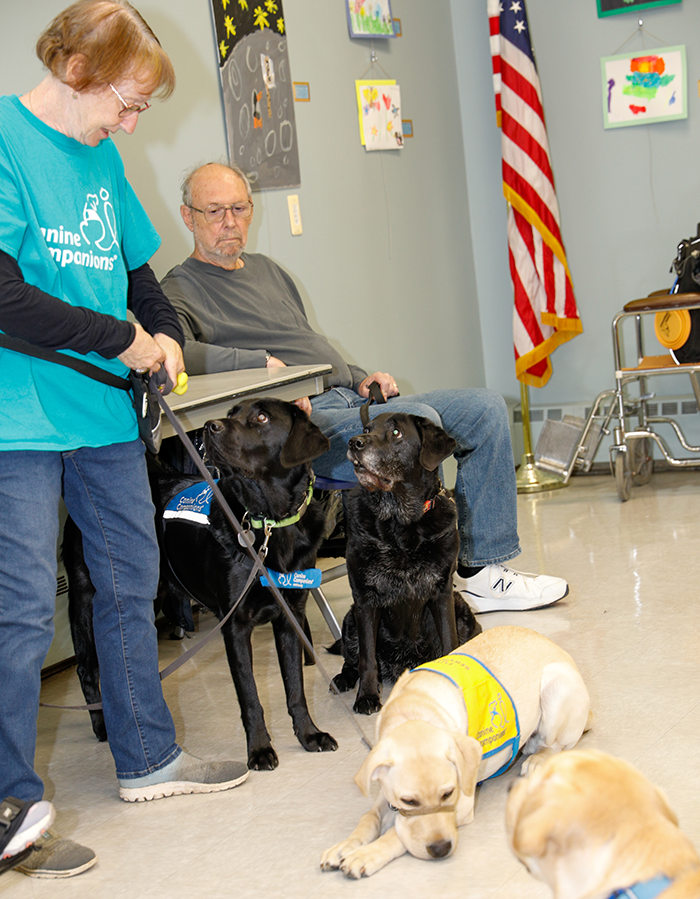
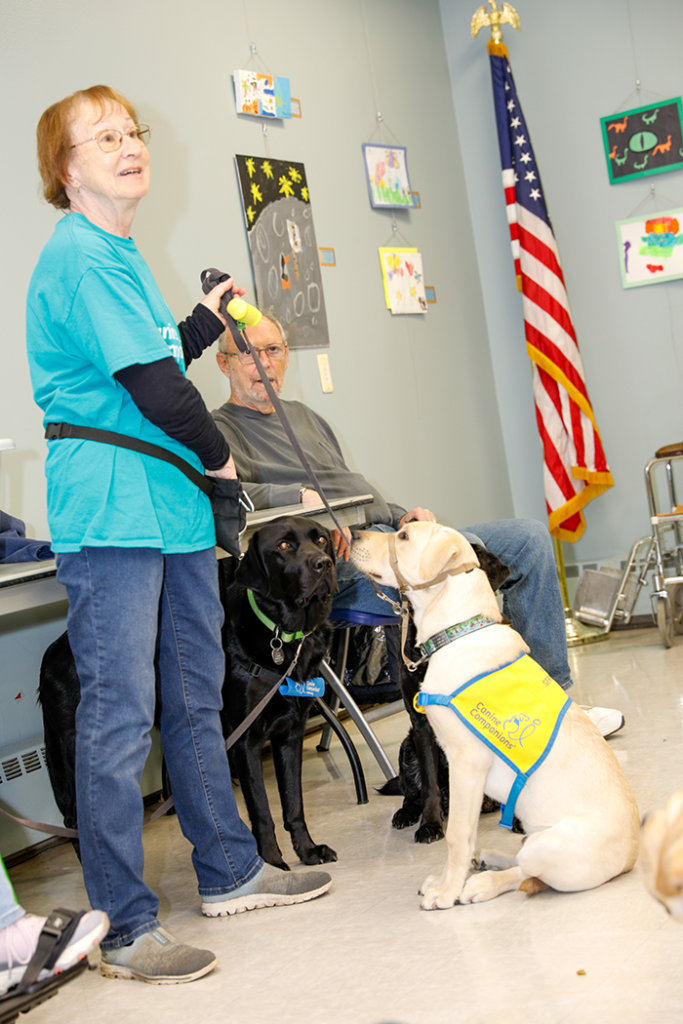
The event presenters were Dennis, Louise, and Kim Bratnik, who brought three dogs to display their talents to the public. They have dedicated a portion of their lives to raising puppies for those who need them. Since 2008, when their daughter Kim graduated with her first service dog, the Bratniks have been an example of a volunteer family who helps others in need. In fact, the Bratniks had a 5-month-old yellow lab named Fiddler who was training. Fiddler is the ninth dog currently being trained and will hopefully pass the rigorous training all Canine Companion dogs undergo, according to Breedy.
Dennis Bratnik said Canine Companion dogs are fully trained at 16-18 months old. With training starting around 8 weeks old, the dogs can be ready for their new owner in about a year, provided the dog graduates from the extensive program.
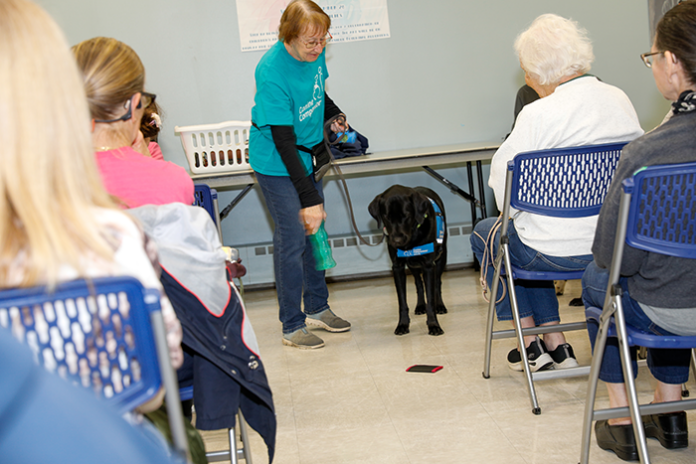
The two other dogs with the Bratniks were Gretal, a semi-retired black lab, and Apollo, Kim’s current service dog, who showed off his skills to the audience. Things like opening cabinet doors and picking up items that have fallen to the floor are standard training for Canine Companion dogs. Apollo can pick up items as thin as a credit card, which was shown to the audience as well.
Then came the “pill trick.” Canine Companions are trained to only accept treats that are given or handed to the dog. Louise dropped a few treats on the ground, and all three service dogs ignored them. The idea is that if a person accidentally drops a pill, the dog will not pick it up.
Dennis Bratnik shared a key piece of information with the audience during the presentation. “We are in desperate need of puppy-raisers right now,” said Bratnik. With the current wait time for a service dog assignment at almost 2 years, Canine Companions needs more volunteer puppy raisers to train much-needed dogs. The demand in the northeast region is ever-growing.
Several audience members also brought their Canine Companions service dogs to the event, showing the need in every community for these expertly trained pups.
During the question-and-answer portion of the event, Louise Bratnik said these dogs “can go anyplace a person can go with your shoes on.” One of the only places a Canine Companion service dog is not allowed would be a sterile hospital environment, such as an ICU ward. But all other places, like schools, work sites, restaurants, etc., are technically service dog safe.
After the program, many audience members wanted to see the dogs up close. Even though dogs like Fiddler, Gretal, and Apollo are working service dogs, they are still dogs at heart and do doggie things. Whether it’s treats for good behavior or scratches behind the ears, these dogs can be dogs while providing a much-needed, much-appreciated service to the community they serve.
For those interested in arranging a service dog, the event was an eye-opener. New Jersey has many laws governing service dogs and what is and isn’t acceptable. The Bratniks said new laws are coming out all the time, so it’s important to review all state and federal laws before having a Canine Companion dog. In general, dogs with a blue Canine Companion vest are fully trained service dogs, while yellow-vested Canine Companions are in training. The difference between a service dog and other companion dogs are vastly different. Leash requirements and service dog vests or patches depend on the level of training each dog has completed. It is advised to review any and all designated training programs before obtaining or having a service dog for use.
For more information on Canine Companions and how to either get involved as a volunteer puppy-raiser or if you or someone you know needs a service dog, please visit: canine.org.