BRICK – Recycling rules vary in New Jersey, with acceptable materials and collection procedures differing by county and even by municipality.
Brick follows guidelines set by Ocean County, which operates the Materials Recovery Facility (MRF) in Ocean County, located at the Northern Recycling Center on New Hampshire Avenue in Lakewood.
This is where recyclable materials collected from county residents are processed before being sent to end markets. The county also has a Southern Recycling Center in Stafford Township, which mostly functions as a transfer station.
Steven Krakovsky now wears two hats at the Department of Public Works (DPW): not only is he the Department Supervisor, but since completing a series of courses at Rutgers recently, he is also the New Jersey Certified Recycling Professional (CRP), replacing longtime Recycling Coordinator Trish Totaro, who retired earlier this year.

“You have to be certified to fill out the tonnage report at the end of the year, and the report is all of our recycling – not just what the town picks up, but all of our commercial, all of the haulers that come into town and take recycling out – they report their tonnage back to us, and that gets broken down into a report,” he said from his DPW office recently. “We send that to the state and they reimburse us our recycling tax that we pay at the landfill every day.”
Every ton of garbage taken to the landfill by truck is charged a $3 recycling tax. In 2024, the township paid out and got back $115,258.
Brick collected 7,821 tons of recycling material in the same year.
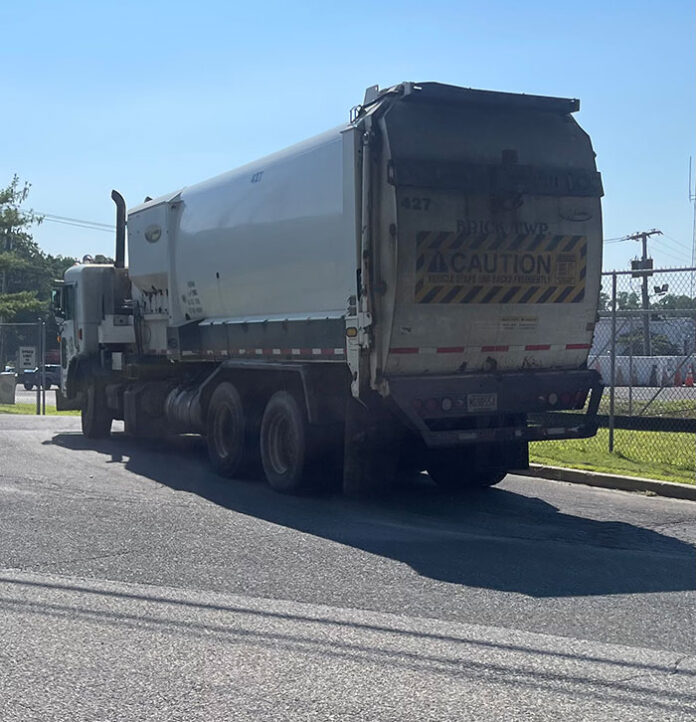
The motivation to recycle is to keep from paying “tipping” fees at the landfill. The less garbage that is dumped results in a lower cost for disposing of trash. It costs $86 a ton to dispose of trash at the landfill, and each truck holds 13 tons of garbage.
There are no tipping fees for recycling trucks when they are emptied at the county recycling center, said Brick DPW assistant sanitation supervisor Charlie Clark.
Acceptable recyclables to be placed in residential blue robo-cans include cardboard (do not tie into bundles), mixed paper, glass bottles and jars and metal cans.
New materials added and now accepted include chipboard from food/tissue boxes, aluminum foil wrap and trays, and plastic bottles, jars and food containers with the numbers 1, 2 or 5.

Recyclables must not be placed in plastic bags since they jam up the sorting machines at the recycling center, Clark said.
“It’s the worst thing you can do,” he said. “The machine has fingers in it that sort the material, and they just get bales and wads of plastic jammed up, and every morning they have to take the machines apart by hand and clean all that out – and it takes hours.”
The county recycling center takes all electronics, household hazards, fluorescent lightbulbs, engine oil and has a new expanded electronics recycling program.
The 10 courses Krakovsky took at Rutgers focused on various aspects of recycling program management and included Recycling Health and Safety, where he learned about the dangers of microplastics.

“That was very interesting, although it has nothing to do with actual recycling,” he said. “You should never heat any of your food in plastic, especially black plastic, or use black plastic spatulas or cook in those frying pans that have the black non-stick coating because black plastic, when heated, gives off the most micro plastics that we then ingest.”
In the class, they learned about a study done that shows micro plastics, or tiny plastic particles, can end up in human bodies, which are contaminated with microplastics and are present in brains, blood, breast milk and other organs. The full extent of the health risks are unknown.
For more information on what can and cannot be recycled, visit co.ocean.nj.us/recycle.