BERKELEY – Results were presented from a study about what would happen if the towns that send their kids to Central Regional Middle School and High School formed one district.
Currently, Central has kids from Berkeley, Ocean Gate, Island Heights, Seaside Park and Seaside Heights. A regionalization study was made to determine what would happen if Central also took on the elementary schools.
Much has been made in the past about changing the school structure, since the Seasides have to drive past Toms River schools to get to Central. Toms River even tried to take Seaside Heights under their wing last year but that fell through. There was also a political football being passed around during some board of education elections ages ago with candidates promising to unite Central and the Berkeley Township School District, but nothing ever came of this.
Regionalization has become a buzzword again under former Governor Phil Murphy, especially in light of how many local districts lost state aid because of Trenton lawmakers. The theory is that regionalization would save money.
The study was done to test that theory. This was possibly the first serious look into what would happen if Central took on all of the students of all five towns.
The presentation was given by the Rowan School Regionalization Institute, a group of educational experts who were retained to determine if it would, in fact, save money. They were also tasked to look at some other important topics that can’t be measured the same way money can, such as educational opportunities for children.
The Regionalization Institute members said this is the fifth such study they’ve done. They presented their findings to the public during a special meeting of the Central Regional Board of Education.
This article isn’t meant to be a conclusive description of everything in the study, just the high points of the presentation as chosen by the reporter. The presentation was, in turn, the summary of the entire study chosen by the institute members.
Education Changes
Scott Oswald, the project manager for the Regionalization Institute, was a former superintendent of the Collingswood and Oaklyn School Districts. He explained that the study was based on how the districts are right now – as a snapshot in time. Things might change in the future that could alter figures one way or the other.
He noted that New Jersey does not recognize a limited purpose regional school district as opposed to an all purpose regional. He explained that a limited purpose regional is like Central Regional, which has students from 7th through 12th grade. An all-purpose is pre-kindergarten through 12th.
He said that regionalization would increase the amount of time students get with subject areas. For example, the difference is 80 minutes a day studying English language arts now, versus 120 minutes a day if they regionalize. It means that students would essentially gain 18 days of education a year. (40 minutes a day times 180 days in a school year equals 7,200 minutes, or 120 hours. Divided further by the length of a school day equals 18 days.)
Math instruction would increase from 45 minutes a day to 90 minutes a day. This works out to more than 20 days a year.
Regionalization would solve the disconnect of sending districts having different curriculum than Central, he said.
While the facts of math don’t change, for example, the ways that they are taught can be different from school to school.
Teachers start their school year evaluating what their students know, he said. If kids are coming from different districts with different curriculums, it would take more time to evaluate them and get them all on the same page.
For those in special education, it could be even more difficult to onboard them into a new school, he said.
They also looked at staffing, and noted that those numbers come from state requirements – not what would be ideal.
The Vote
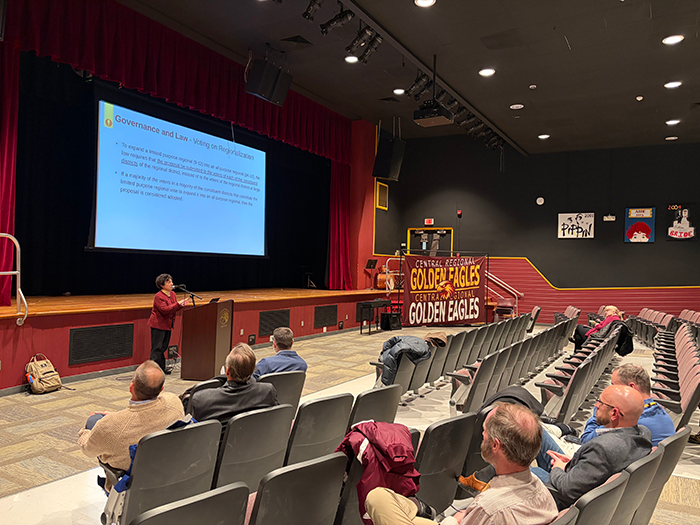
Former State Department of Education Commissioner Lucille Davy handled governance and law for the Regionalization Institute. She explained that a majority of the voters would have to vote for regionalization in a majority of the five towns.
The Board of Education make-up would not change. It would still be five from Berkeley, and one each from the four smaller towns.
Each of the boards of education would have to agree to put a question to voters, Oswald said. The State Commissioner of Education would have to approve the wording of the question. Then, when it goes on the ballot, the state would pay for the election.
Voters would know what their new tax rates would be before election day, he said.
The fact that there is a regionalization study doesn’t mean this is a done deal.
“This is the beginning of the conversation, not the end,” Oswald said.
Finances
Brian Diamonte, president and chief executive officer of the Diamonte Group, which analyzes education data, handled finance and operation for the Regionalization Institute. He looked at the collective bargaining agreements, comparing staff salaries and other factors. The law states that if the regionalization goes through, staff can never get pay cuts. Therefore, the elementary teachers would be brought to the slightly higher Central Regional steps. He estimated that this would cost a total of $62,300 for the entire district.
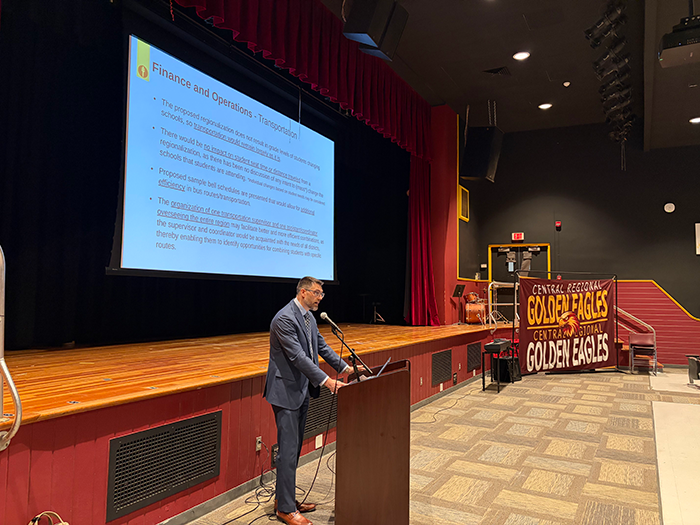
Transportation would be different, he said. With all the schools being organized under one roof, the start and end times of the schools might stagger differently.
The transportation expert that looked at the situation said that this is a model for shared services – which is rare praise, Diamonte said.
A larger savings would be in administration, where they expect $498,200 a year in savings.
While one superintendent is more efficient than what they currently have (2.7 superintendents across all five towns. This is because Central and Berkeley each have a full time superintendent but the smaller districts share.), they propose increasing assistant superintendents from .8 to 2.
Business administrators would go from 2.2 to 1, he said.
They proposed cutting child study team staff from 22.6 to 20.
One of the cons is that sometimes a supervisor can get stretched too thin, Diamonte and Oswald both said.
Diamonte also addressed the state aid the districts receive. There’s a hold harmless agreement that if regionalization happens before 2029, the combined state aid wouldn’t be lower than the total of what all districts would get.
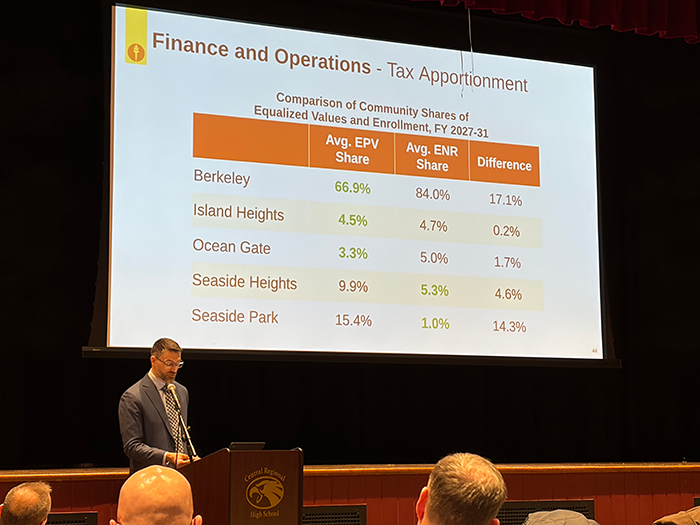
When it comes to determining how each town pays school taxes, there were figures based on enrollment and also equalized property value.
Seaside Park has increases in taxes in all scenarios because it pays tuition right now. So if it goes to equalized property value, Seaside Park would pay more, Diamonte said. He noted that the increase doesn’t need to happen right away; it can be phased in.
Central Regional officials likely predicted this, so they asked the Regionalization Institute to factor in what would happen if Seaside Park voted against it.
Diamonte said that Seaside Park would continue to pay tuition per child, just as it is now, and would not join the combined district.
Criticism
There wasn’t a huge crowd in the auditorium. Many of the people in the audience were officials from the various districts and towns impacted.
Lisa Gleason, superintendent of Seaside Park and Lavallette, asked questions from the audience during the portion of the meeting turned over to the public. She said that she wasn’t sure that sharing the same curriculum is appropriate if the district has varied populations. Curriculum isn’t a one-size-fits-all situation.
She also suggested that extra administration might be needed because of additional special education students in the elementaries.
Oswald said that these higher numbers of special education and English language learner students are part of the study.