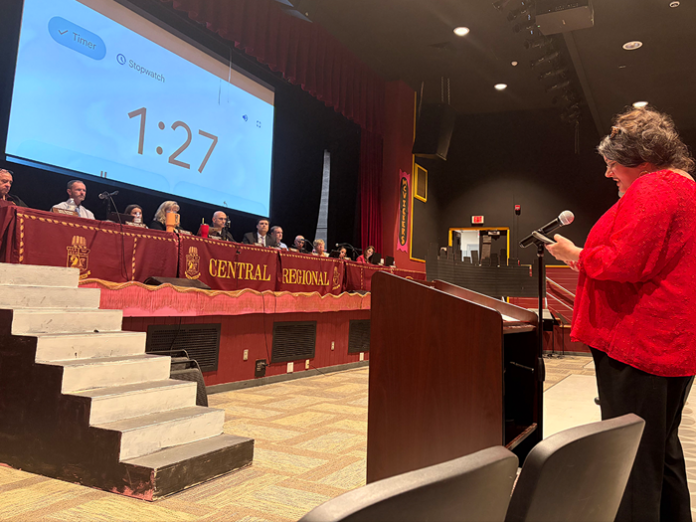
BERKELEY – The Central Regional Board of Education voted to keep the policy protecting the identities of trans students, after hearing from teachers, county residents, politicians and a religious policy leader.
Policy 5756 essentially protects the privacy of students who identify with a name or gender that is not what their parents know them as. Trans rights activists celebrate the policy because it protects a vulnerable population. Opposition groups state that it’s the parents’ rights to know what is going on in their children’s lives. A more in-depth examination of the policy is at the end of this article.
The policy was up for debate because two members of the board, Merissa Borawski and Heather Koenig, brought it up for vote. They campaigned on removing the policy.
Central’s meetings have a public comment period before most board action. Several people got up to speak because they knew that this was going to be up for a vote. They received word from one side or the other.
The first speaker was Sean Hyland, a Berkeley resident who is Director of Advocacy for the New Jersey Family Policy Center.
“It’s unethical, dangerous, and a gross violation of parents’ rights,” he said of the policy.
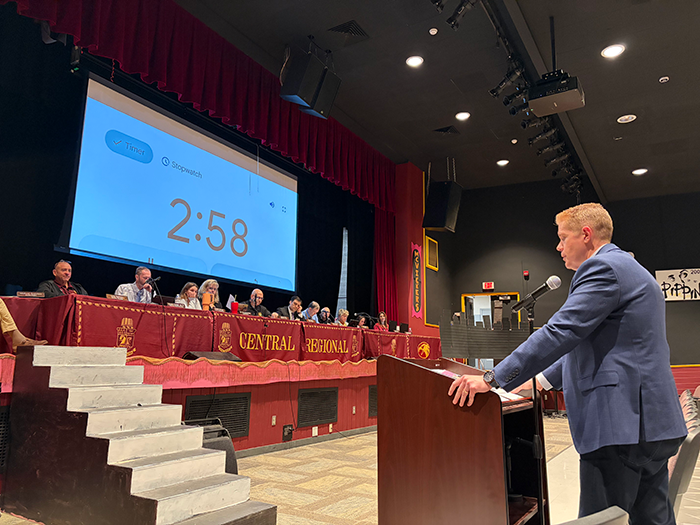
He referenced former State Attorney General Matthew Platkin, who “conceded in court” that the policy is not required.
He noted that other districts have repealed this policy.
The next two speakers were Central teachers, co-advisors of the Prism Club, formerly known as the Gender Sexuality Alliance Club, speaking as citizens before the board and not as members of the staff.
Maria Foukarakis drew attention to the district’s mission statement and goals, such as “positive school climate,” “learn how to be a good citizen,” and “learn how to respect and get along with people who think, dress and act differently.”
“Some of you may not personally agree with the policy but as a society we have an obligation to think about the students and I mean ALL students,” she said.
Matthew Solomon said “Transgender students are already one of the most vulnerable populations in any school. This policy tells them: you belong here, you are protected here, and adults will step in when harm happens. Removing it sends the opposite message.
“I say this not just as a teacher, but as someone who grew up as a queer kid in this community. I know what it feels like to walk school hallways wondering if today is the day you’re targeted, ignored, or erased. I also know how life-changing it is when even one adult says, ‘I see you and you’re safe here.’
“Before revoking this policy, I ask: Have you spoken to a single transgender student about what this protection means to them? Have you spoken to a guidance counselor or school psychologist about what safety and affirmation do for a student’s mental health? Have you spoken to a teacher who sees, every day, how these protections help students stay in school, stay engaged, and sometimes simply stay alive? If the answer is no, then this decision is rushed, and it is dangerous,” he said.
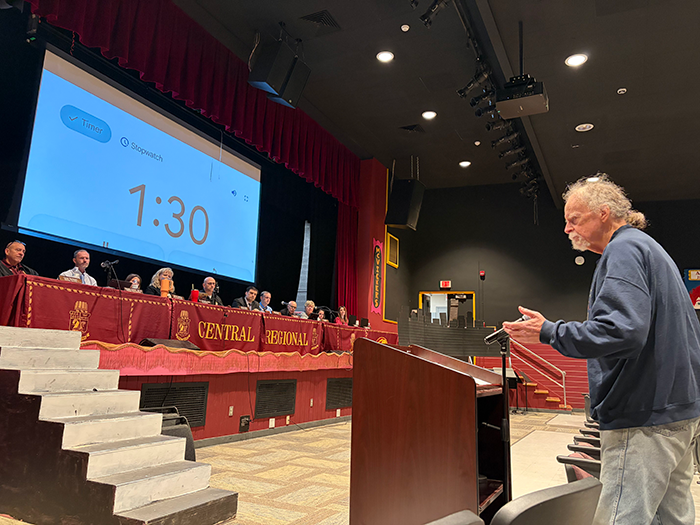
Larry Erickson of Berkeley spoke in support of the policy, stating how transgender people are constantly treated as “other” and discriminated against.
“It takes courage to be trans in today’s society,” he said, urging the board to take on a degree of the courage that a trans person has and vote to keep the policy.
Frank Ogrodowski of Jackson said that the policy doesn’t prevent kids from speaking to their parents about anything that’s going on in their lives. It’s wrong to assume that the policy is what is standing in the way. If the parents and children have a relationship where they can be honest about these things, then the policy won’t get stop that.
“We are not assuming abuse,” he said about the families. “Parents have the same rights they always have.”
When addressing the board, he said “Your primary responsibility is the safety of students, not the feelings of parents.”
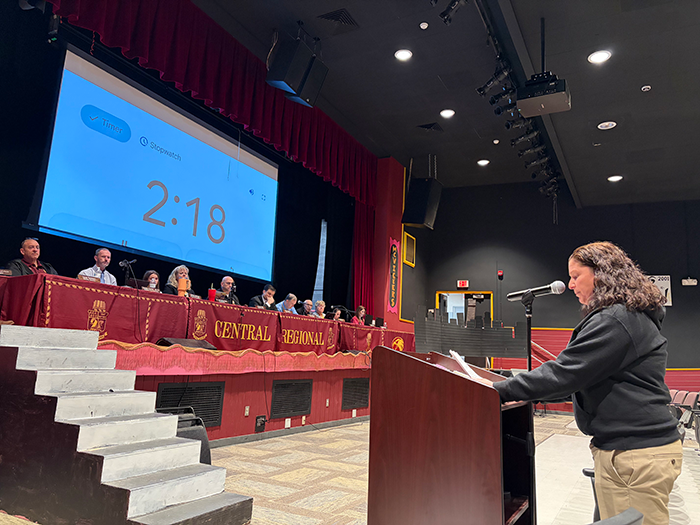
Kimberly Bruner of Berkeley said that as the parent of a Central student, and as a graduate, “it’s very much an issue for me.”
“It sets a dangerous precedent for parental rights and religious liberty,” she said, of parents and staff. She also said it curtails freedom of speech in relation to teachers speaking to parents.
She said that the policy is guidance, not a law.
“Parents love their children, and they’re on their side,” she said.
The Board Vote
All of these comments – and more that would not fit in the article – took place before the issue even came up for a vote. Koenig and Borawski introduced a motion to repeal the policy.
Koenig said there’s already a Law Against Discrimination. “The law applies to everything, including schools. This law protects everyone equally.”
Borawski said “The students will always be safe because of that law.”
Allowing parents to have information like this is a way for parents to be able to help their kids, she said.
Before the vote, the attorney for the Board of Education, Mark Toscano, explained the legal issues that members of the public brought up.
For example, some people brought up a case in California that made it to the U.S. Supreme Court. He warned that it’s a different policy and can’t be applied to New Jersey. In California, parents can’t find out from the teacher their child’s gender identity or preferred pronouns, even if they ask.
In NJ, “if a parent asks if their student is receiving accommodations based on gender identity, the school must answer honestly,” he said.
He noted that there were two New Jersey cases where the courts upheld the policy when a school board voted to remove it.
“The board is obligated to follow both the state and federal laws,” he said.
When it came down to a vote, it was split 4-4, which means nothing changed and the policy remained.
Borawski and Koenig (both Berkeley residents), John Serpica (Ocean Gate), and JoAnne Penn
(Seaside Park) voted to remove it. George Dohn, Lou Tuminaro and Denise Pavone-Wilson (all Berkeley), and Michael Graichen (Seaside Heights) voted to keep it. Susan Cowdrick (Island Heights) recently resigned so there were only eight members on the board.
Policy 5756
The policy itself can be found at: nj.gov/education/safety/sandp/climate/docs/Guidance.pdf
The policy, 5756, is 2,800 words long. It opens with mentioning that the “New Jersey Law Against Discrimination (LAD) generally makes it unlawful for schools to subject individuals to differential treatment based on gender identity or expression.”
It goes on to talk about Title IX which prohibits discrimination on the basis of sex in federally-funded education programs and activities.
Essentially, the school shall accept a student’s gender identity, and “school districts should be mindful of disputes between minor students and parents concerning the student’s gender identity or expression.” In some cases, the district might have to seek legal assistance regarding the students’ civil rights and protections under LAD.
One point that a lot of political pundits make is that the policy prevents schools from outing children. “School staff members may not disclose information that may reveal a student’s transgender status except as allowed by law. The principal or designee is advised to work with the student to create an appropriate confidentiality plan regarding the student’s transgender or transitioning status.”
The student’s status might be disclosed if the child’s health and safety are at risk, because of something like a bias-related crime. The policy explains the right way to disclose the child’s transgender status in order to minimize harassment and to help the family accept it.
“With respect to gender-segregated classes or athletic activities, including intramural and interscholastic athletics, all students must be allowed to participate in a manner consistent with their gender identity.” This includes restrooms and locker rooms. The policy also recommends the nurse’s restroom for changing and bathroom use.
A couple speakers at the meeting noted that the NJ Attorney General said the policy was not necessary.
In researching this article, JerseyShoreOnline.com found an article in The Patch covering Holmdel’s Board of Education, quoting an unnamed Attorney General spokesperson that the policy was not necessary. The Patch writer contacted the Department of Education but did not get a response.
JerseyShoreOnline.com reached out to both the State Department of Education and the NJ Attorney General’s Office but didn’t hear back by press time. One issue is whether the policy is actually required, or if it gives guidance on how to follow the law, which is also required. Other questions that remain to be answered is why the Attorney General’s Office would speak on a Department of Education issue, what exactly they meant by that statement, and if it is being taken out of context.