MANCHESTER – While a redeveloper is thinking about installing a data center, hundreds of residents gave their thoughts on the matter.
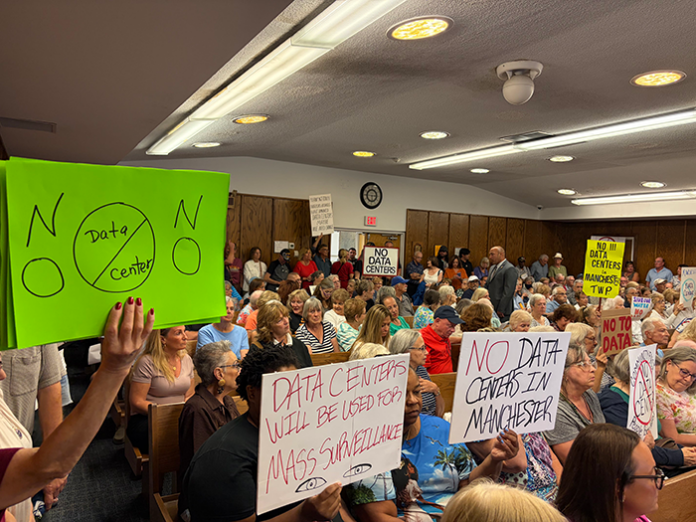
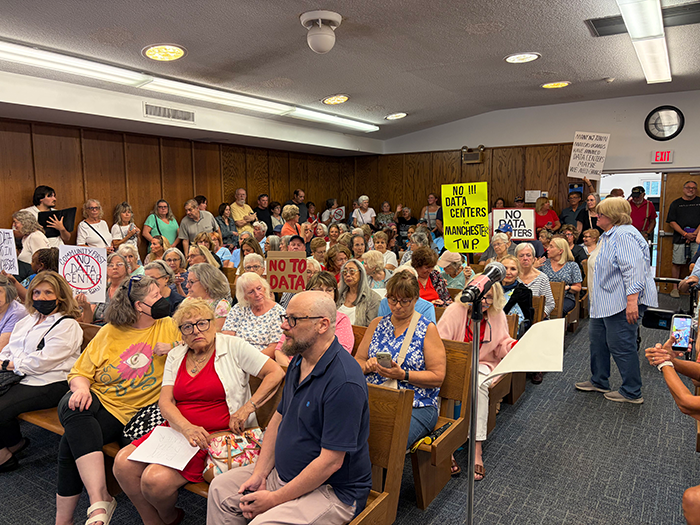
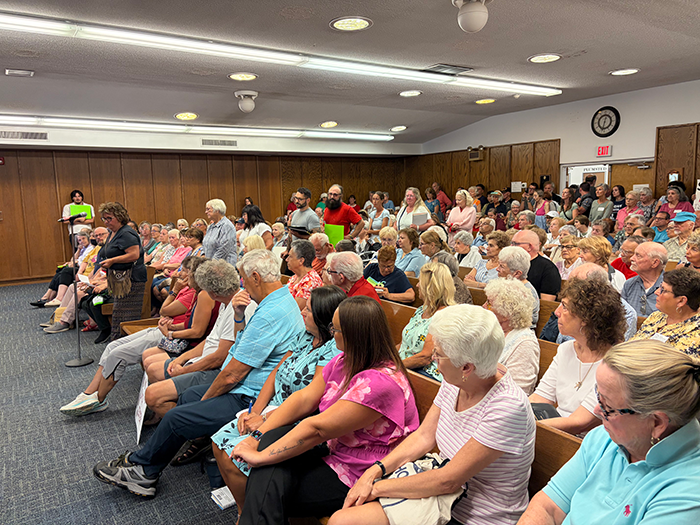
Usually there are few members of the public at Township Council meetings, but this one was standing room only, exceeding fire code.
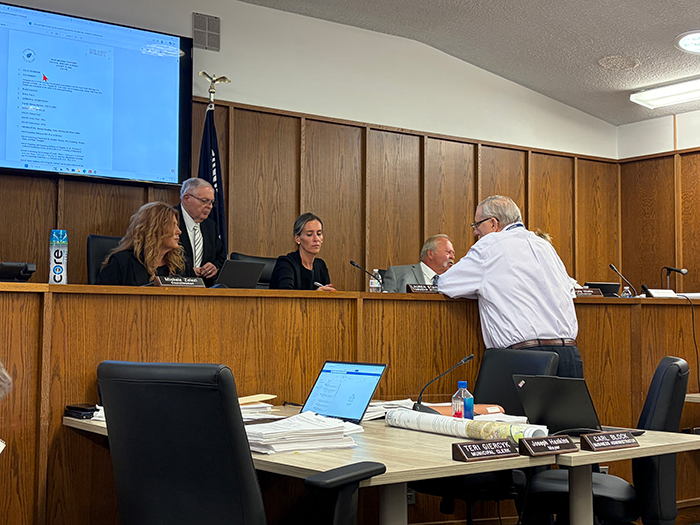
Council President Michele Zolezi opened with a statement that while data centers are a permitted use in the redevelopment area, there is no project proposed. A warehouse in that area has been approved.
She said since it hasn’t been proposed, it would be premature to discuss what could be. At this point, loud shouting drowned her out. Once it calmed down, she restarted, going back a bit in case anyone missed anything.
While it might be premature to discuss it, it doesn’t mean that the public is being ignored, she said.
She also noted that there is a difference between the Pinelands Alliance, a volunteer advocacy group, and the NJ Pinelands Commission, a state board that oversees development in the Pinelands. She also cautioned against believing rumors spreading online.
Council meetings have time for the public to speak on ordinances. However, since there wasn’t anything about data centers on the agenda, the public would have to speak during the general public comment section. Normally, this is held at the end of the meeting, but Zolezi moved it to the front. She asked people to contain their comments to one minute, in order for everyone to be heard, but no one was cut off if they went over.
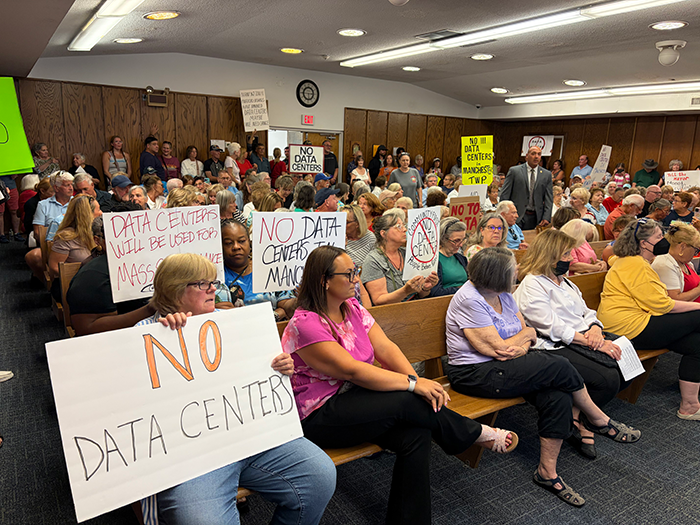
The public held signs against data centers, applauded speakers criticizing them, and shouted down anything perceived to be in support of them.
The first speaker was Britta Forsberg, executive director of Save Barnegat Bay. She said that the environmental impact of a data center could reach other towns and waterways.
Natalie Gregorio of Leisure Village West said people worked hard their entire lives to retire to a quiet community, which would go away once a data center becomes a neighbor.
“Most residents don’t know what AI is,” so a data center should be built near cities where people who use it are, she said.
Residents spoke about the environmental impact of data centers, especially as how they use a great deal of water. Manchester already has water usage issues, they said, and there have been contamination of radon and chemicals used in firefighting training at the joint base.
AI has been linked to a “dumbing down” as people rely on it for basic questions, as well as mental health issues, as people talk to chat bots thinking they are real, residents said.
One resident said the Ocean County Animal Facility in Jackson will be close enough to be affected, because data centers are known for generating loud noise.
What Is A Data Center?
A data center is a building that contains a great deal of computer power. These have mostly been needed with the rise of artificial intelligence. Companies like Google have attached AI to their use, so simply doing a Google search provides AI results whether you wanted to use AI or not.
There are warnings on AI products that state the results are not 100% accurate. In fact, critics have noted that AI tends to “hallucinate,” making up false information.
Owners of AI companies have said on record that they have not yet made a return on the investment for their creations. It is unclear what will happen to data centers once the money runs out.
Possible Location
At a previous meeting, Business Administrator Carl Block confirmed that a developer who has approval for a warehouse complex was considering if a portion of that can be used for data center use. He noted that a review of power usage, backup power usage, water usage and the answers to those questions are being sought.
It is unknown how much of the complex could be used, or what parts of the complex could be used, if any at all.
According to a 2024 redevelopment plan found on the state’s website, the closest neighbors are the Renaissance community.
The area is 224 acres at the boundary of Manchester and Jackson. Stavola Industries acquired it in the 1970s and mined it for sand and gravel until the mid-1990s. It has been underutilized and vacant since. (Stavola is currently applying to modernize its asphalt-producing business in Brick.)
Freemont Avenue is in the northern portion. It’s described as a privately owned road, but Renaissance residents can use it from dawn to dusk, and the township has to do snow removal and light maintenance.
According to the redevelopment plan: “The Redevelopment Area is bordered by the New Jersey Southern Branch Consolidated Rail tracks to the southeast, and to the southwest by an unnamed tributary to the Ridgeway Branch of the Toms River. The parcel to the northeast across Freemont Avenue is preserved open space owned by Ocean County. A recycling center to the northeast across Freemont Avenue is preserved open space owned by Ocean County. A recycling center and asphalt plant is located to the northwest across Freemont Avenue and an asphalt plant is located to the west. The Renaissance Village age-restricted residential community is located to the southeast of the rail tracks west. The Renaissance Village age-restricted residential community is located to the southeast of the rail tracks.”
The land in question is described as Block 62, Lots 30 and 31.01 on Township of Manchester Tax Maps including rights of way, and as an area in need of redevelopment.
Redevelopment means that a local governing body has more control over what goes there. With most development, a builder proposes a plan, and the land use boards approve some or all of it. With redevelopment, there’s a redevelopment board appointed by the governing body who meets with the property owner and hashes out what can be put there.
The redevelopment plan by produced by Morgan Municipal, whose principal is County Commissioner Director Frank Sadeghi,
Residents: Ban Or Repeal
“Over 40 towns have banned data centers. You have the power to ban it outright,” said Manchester resident Mary Ellen McKay.
Another resident, Judy McCormick, said that Howell and Jackson did bans before any developer was considering it. The council shouldn’t wait until a data center is proposed.
Howell resident Joe Bizonos brought a copy of Howell’s ban ordinance for Manchester to copy.
“The fact that a bunch of rich people invested their money in data centers is not the problem of the people of New Jersey,” he said.
Several residents asked the council to craft an ordinance to ban data centers, or to repeal the ordinance allowing them. Officials said they would take that under advisement.
Special Meeting For Data Center Discussion
Several speakers brought up that they were in violation of fire codes and that people were waiting outside, upset that they couldn’t hear what was going on inside and that they wouldn’t be heard by the governing body.
Officials said they had no way of knowing that there was going to be this big of a turnout for this meeting. Members of the public criticized that, since Zolezi had a prepared statement. Zolezi responded that she wrote her statement that morning when it seemed like there was going to be a large crowd. “Our emails were blowing up,” she said of the council members.
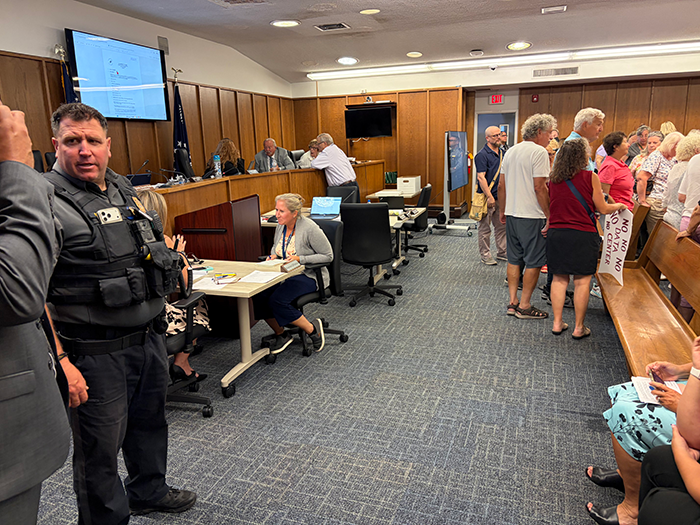
There were also more police officers for security in the room than at a normal meeting. The additional officers left when the crowd did.
At one point, after most of the crowd had left, Zolezi thanked the clerk for fielding a large number of phone calls and emails from residents.
Members of the public criticized Mayor Joseph Hankins for not being in attendance. Business Administrator Carl Block said that the mayor had business to attend to in another county that was planned prior to when data center talk started to spread online.
Although the council approved the land for data centers last year, it only spread through public consciousness relatively recently.
Officials asked the crowd if they’d like to have a meeting at a larger venue where the only purpose was to hear from the public about their opinion of data centers. The public was overwhelmingly in favor of this idea.
The meeting was not announced yet since the location would need to be secured on a date when the officials are available. Also, state law requires towns to put out an advertisement for any public meeting.
One resident said that the council members who voted to allow data centers last year should speak publicly about why they think it’s a good idea.
“Everyone knows the detriments of data centers; what are the benefits? If you voted for it you must know,” said resident Phyllis Scharago.
One speaker also called for meetings to be broadcast in case people can’t make it to the time or location.
Data Center Ordinance
The ordinance that was the focus of the night’s discussion was 25-27. This means it was the 27th ordinance written in 2025.
One section of the ordinance reads “Whereas, it is the desire of the Governing Body to revise the plan again to authorize the inclusion of the use of data centers within the Redevelopment Area…”
An ordinance takes two votes – one to introduce and one to adopt. When the ordinance was introduced on July 14 of last year, Council members Sandy Drake, James A. Vaccaro Sr., Craig Wallis, and Roxy Conniff voted to introduce it. Zolezi was absent. When it was adopted on August 11, Drake, Vaccaro and Conniff voted yes, while Wallis and Zolezi were absent.
Conniff was the council president at this time, the person who sets the agenda. Earlier this year, she resigned and moved to another town. Councilwoman Judith Noonan was her replacement. Noonan was the council member who brought up data centers at a recent meeting which heightened the awareness among the public.
When the matter was opened up to the council or the public for discussion before either votes, no one had any comments, the minutes said.
After The Crowd Left
Once everyone who wanted to speak about data centers had an opportunity to do so, the public comment portion of the meeting was closed. Zolezi gave the public a few minutes to leave if they wanted to.
While they were filing out, a discussion took place between business administrator Block, Township Attorney Lauren Staiger, and council members Zolezi, Wallis and Noonan. Vaccaro joined a few minutes later. Their microphones were off. The council never voted to close the meeting or re-open it. However, there was a discussion between elected and appointed officials that was not recorded for the minutes.
When Zolezi re-opened the meeting, the council quickly went through minutiae that was on the agenda. None of it was related to data centers.
When it came time for the council members to speak about any topic they choose, Wallis said “I didn’t appreciate the catcalls but a lot of people made a lot of sense.” The “catcalls” were about how he had voted to allow data centers last year.
He said that if there is a council meeting for the public to talk about data centers, he’d like an executive session at a meeting before that so the council can talk freely among themselves.
Noonan noted how a lot of zoning and master plan changes were done before some of the current members were on the council.
She warned that people shouldn’t believe everything they see on the internet, because there was very incorrect information out there. For example, she was quoted as not knowing about the data center idea even though she was the one who brought it up (as reported by The Manchester Times).
In regards to the crowd, she said they knew there would be more people than normal, but not so many that they would fill the meeting room. If they had, they would have planned for it, she said.