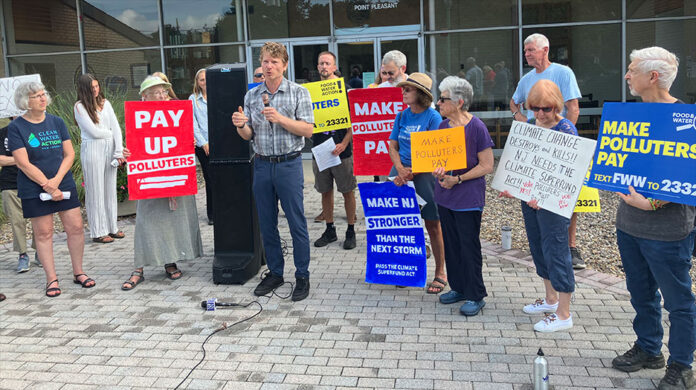
OCEAN COUNTY – A press conference was held to build support for a bill that would charge certain fossil fuel companies money that would then be used on grants for climate resiliency.
Curtis Fisher said he lives off Drum Point Road in Brick. Sometimes the flooding is so bad that he can’t leave his neighborhood. Furthermore, the infrastructure is being devoured by saltwater intrusion.
“Ocean County is one of the most threatened areas in the state,” he said. The cost to respond to these climate issues is in the hundreds of billions of dollars, he said, quoting figures from the State Department of Environmental Protection as well as the Army Corps of Engineers. So, who is going to pay for it?
“We’re only asking for our fair share,” he said. New York and Vermont have already passed similar legislation.
According to the summary, the bill would establish a program within the DEP to collect compensatory payments from the fossil fuel companies and distribute them, in the form of grants, to climate change adaptation and resilience projects.

The bill would target fossil fuel companies that are responsible for more than 1 billion metric tons of greenhouse gas emissions between January 1, 1995 (the year of the first United Nations Conference of Parties climate change conference) and the end of the calendar year in which the bill takes effect.
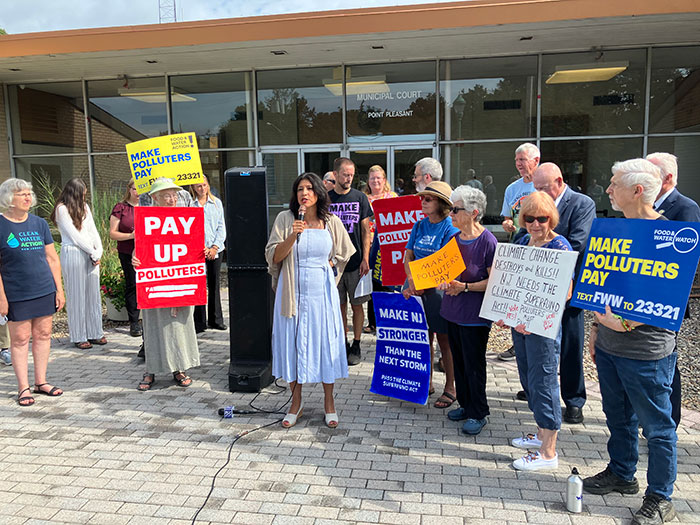
The press conference was held outside Point Pleasant Borough Hall, where inside there was a meeting of the Senate Environment and Energy Committee and the Assembly Environment, Natural Resources, and Solid Waste Committee. The purpose of the conference was to get the bill on an agenda before the legislative session closed.
More than 50 municipalities have already endorsed this bill, said Senator Bob Smith (D-17th). He urged people to contact their mayors and governing bodies to get on board.
“The planet is under attack,” he said.
He mentioned how forest fires have claimed 15,000 acres in southern Jersey. This appears to be a reference to the Jones Road Wildfire in Barnegat and Waretown. This was caused by arson but made worse by drought conditions and high winds.
He mentioned two people who died in Plainfield due to flash flooding.
Reports said the two people were Lubia Estevez and Forest Whitlock who were driving together when they made a turn and their car ended up in a ditch. Fast-moving water swept their car under a bridge.
“We’re not seeing leadership on the global line,” Smith said. “Polluters should pay is a concept we can all get behind.

He noted how there were studies that the fossil fuel companies knew about for decades detailing how their pollution was causing harm to the planet. They hid this research, and lied to the public about it.
This is in reference to a report by Inside Climate News which learned that Exxon had a study done in 1977 showing how global temperatures would increase if CO2 continued to be emitted.
John Weber, a councilman in Bradley Beach, spoke about torrential rain that flooded basements in 2023. A lot of these people didn’t get helped by their homeowners insurance.
Bradley Beach didn’t suffer as badly as other towns during Superstorm Sandy because of municipal bulkheads and dunes built by the Army Corps, he said.
The damage from extreme weather doesn’t have to be from a hurricane hitting a shore town; it could be sudden flooding at a town that’s inland and upland, he said.
Amy Goldsmith, state director of Clean Water Action, said that after floods you can see people putting their ruined possessions out to the curb for the town to collect and take to the dump. This puts a strain on a town because their public works employees are the ones picking it up, and the town pays tipping fees at the dump.
After a disaster, people make donations to help those impacted. However, she warned “donations are not policy. Donations are good will. We need big corporations not to give a donation but to pay up.”
Assemblyman Robert Carabinchak (D-18th) said that everywhere he goes, people are talking about the weather. How hot it is. How sudden and intense rainstorms are. And no one can remember weather like this ten years ago.
This shows that everyone is noticing climate change even if they don’t call it that.

Doug O’Malley, state director of Environment New Jersey, and also a member of Empower New Jersey, said the state was a leader in passing environmental legislation. He spoke about Ciba-Geigy, a chemical company that dumped uncountable tons of toxic waste in the land and water around Toms River.
“Ciba knew what it was doing,” he said. “Climate polluters know what they are doing. We know the feds aren’t coming to bail New Jersey out.”